

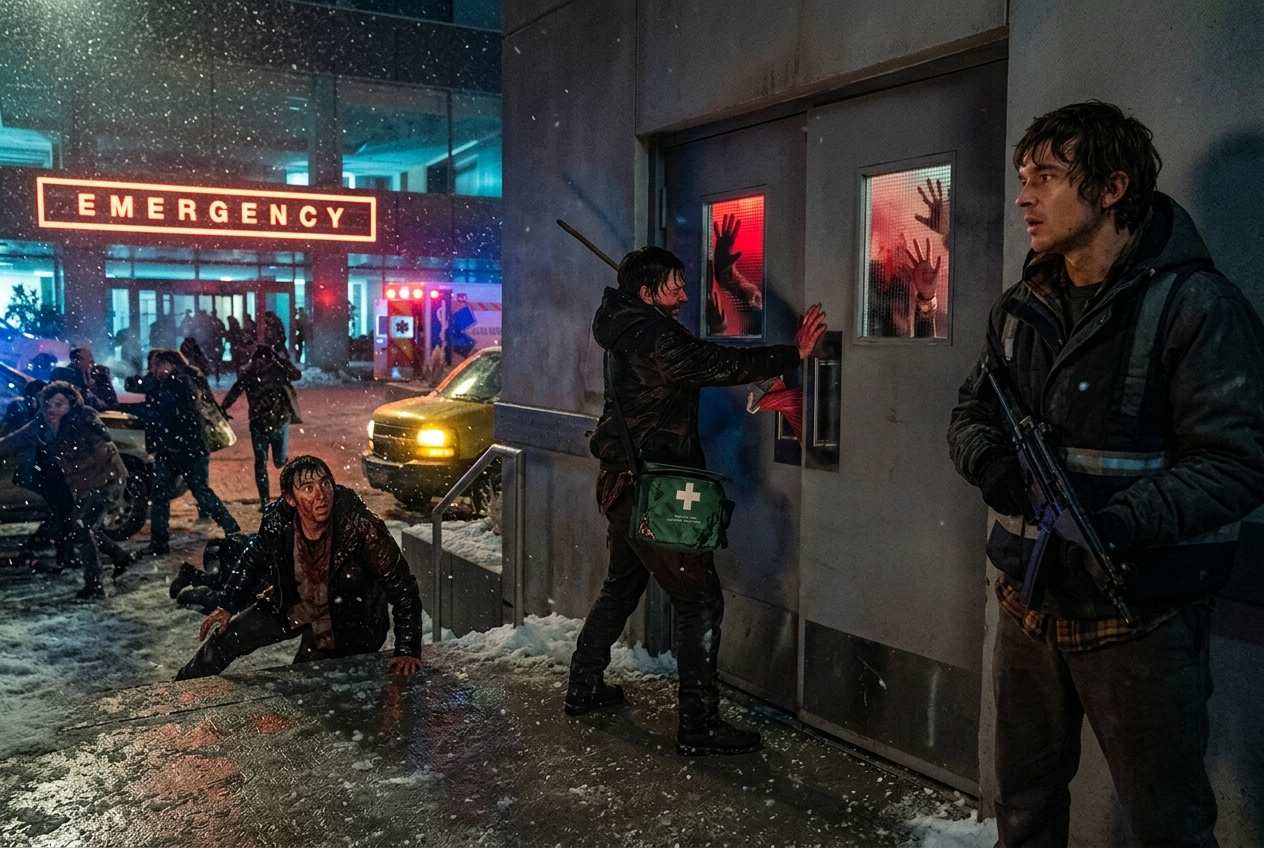
Zach Cregger’s Resident Evil reboot has arrived, and it’s not the movie the horror-video-game genre has trained anyone to expect. Rather than another retread of zombies-in-a-mansion or Umbrella Corporation conspiracy plotting, the film that opened in theaters on September 18, 2026 is an original, standalone story set inside the world of the games — and early reactions suggest it might be the first Resident Evil movie critics actually love.
Here’s everything worth knowing about the new Resident Evil movie: the plot, the cast, why Zach Cregger got the job, what critics are saying, how it’s performing at the box office, whether you need to sit through the credits, and how this reboot stacks up against seven earlier attempts to bring the franchise to the screen.
Resident Evil (2026): The Basics
- Release date: September 18, 2026 (wide theatrical release), following a September 17 Fantastic Fest premiere
- Director: Zach Cregger (Barbarian, Weapons)
- Writers: Zach Cregger and Shay Hatten
- Studio: Columbia Pictures / Sony Pictures Releasing, with Constantin Film, Davis Films, Vertigo Entertainment, and PlayStation Productions producing
- Starring: Austin Abrams, Zach Cherry, Kali Reis, Paul Walter Hauser
- Rating: R
- Runtime: Roughly 94–95 minutes
- Budget: Reported around $75–80 million
What Is the New Resident Evil Movie About?
Unlike the six Milla Jovovich-led films or 2021’s Welcome to Raccoon City, this Resident Evil isn’t a direct adaptation of any specific game — it borrows the franchise’s atmosphere and mythology while inventing a self-contained story built for a two-hour runtime rather than compressing an entire game’s plot into a feature film. It’s an original screenplay set inside the franchise’s universe, following Bryan (Austin Abrams), an ordinary medical courier who agrees to transport a package to a remote hospital near Raccoon City — and ends up trapped in the worst night of his life once a T-Virus outbreak begins to spread. What follows is less a conspiracy thriller and more a survival ordeal: limited ammunition, scarce resources, and an increasingly hostile world closing in around one very unlucky, very relatable protagonist.
Cregger has been explicit that this isn’t a retelling of any single game’s story. In comments to press, he’s described it as a “weird story” that he wrote himself and has “nothing to do with any of the other Resident Evil movies” — a deliberate break from the franchise’s history of mixed live-action adaptations. He’s also said he intentionally never watched the earlier Resident Evil films before making his own, wanting to approach the material without inheriting their tone or mistakes.
Why Zach Cregger Directing This Movie Is Such a Big Deal
The casting of a director is rarely franchise news on its own, but Zach Cregger’s involvement is the single biggest reason this Resident Evil reboot has generated so much buzz. Cregger spent years as a comedy performer and writer before pivoting to horror, and in a short span he’s become one of the genre’s most trusted names:
- Barbarian (2022) — his breakout horror feature, a critical and word-of-mouth hit about a woman who arrives at a rental property to find it’s already occupied.
- Weapons (2025) — an original R-rated thriller about a group of missing schoolchildren that opened to roughly $43 million domestically in August 2025 and went on to earn around $270 million worldwide against a $38 million budget, with co-star Amy Madigan winning an Oscar for the role.
After a bidding war among studios for the rights to his take on the property, Sony landed Cregger’s Resident Evil, with Constantin Film (which produced the earlier Jovovich-led series) co-financing. That pedigree is exactly why expectations shifted so dramatically for a franchise that, as one franchise retrospective put it, had become something of a punchline after two earlier reboot attempts struggled to land with critics.
Meet the Cast
Austin Abrams as Bryan
Abrams, who previously worked with Cregger on Weapons, leads the film as Bryan, the courier-turned-survivor at the center of the story. Critics reviewing the film have specifically singled out his performance — largely on-screen in POV-adjacent shots throughout — as unusually committed, blending physical comedy, genuine terror, and emotional desperation in a way that’s been described as both goofy and wry.
Zach Cherry, Kali Reis, and Paul Walter Hauser
Rounding out the principal cast, Zach Cherry, Kali Reis, and Paul Walter Hauser join Abrams, each stepping into original roles created for this story rather than characters pulled directly from the games. Full character details are being kept close to the vest by the studio ahead of wide release, in keeping with Cregger’s general preference for protecting story surprises.
What Critics Are Saying
The reception has been the biggest surprise of the film’s rollout. After decades of Resident Evil movies landing anywhere from mixed to outright panned, this reboot arrived at an unusually high approval rating from critics on Rotten Tomatoes — in the high-90s percent range, among the best-reviewed entries the franchise has ever produced, and by several accounts the best-reviewed video-game movie yet made, live-action or animated.
In his review for The Hollywood Reporter, critic Frank Scheck described Cregger’s work as a propulsive, simultaneously terrifying and funny thrill ride that shows off both his filmmaking skill and his dark sense of humor. Other critics have echoed that mix of horror and comedy as the film’s defining trait — several reviewers have noted it plays as scary and genuinely funny in near-equal measure, a tonal balance Cregger also struck in both Barbarian and Weapons.
Speaking to press at the Los Angeles premiere, Cregger himself said he’d felt confident about the film even before reviews landed, adding that he liked what he’d made and hoped audiences would agree. Given the response so far, that confidence appears to have been well placed.
Resident Evil Box Office: Record-Setting Debut Expected
Sony opened Resident Evil in roughly 3,500 North American theaters, with the studio initially projecting a three-day opening in the $40 million range. As reviews and word-of-mouth built ahead of release, independent tracking services raised their estimates considerably, with industry midpoint projections climbing toward $45 million domestically and some outlets suggesting ticket sales could approach $50–60 million. Globally, early forecasts placed the film’s opening weekend total near $80 million, with some later estimates pushing that range even higher amid the film’s strong critical momentum.
Any of those outcomes would shatter the Resident Evil franchise’s prior domestic opening-weekend record, long held by 2010’s Resident Evil: Afterlife at roughly $26.6 million. That the reboot appears positioned to more than double the franchise’s previous best debut — on a fraction of the marketing history and audience goodwill the earlier Jovovich films built over a decade — underscores just how much critical buzz has driven ticket sales this time around.
The film opened alongside holdovers like Practical Magic 2 and Spider-Man: Brand New Day, with box office analysts framing Resident Evil as exactly the jolt the early fall theatrical calendar needed after a comparatively subdued previous weekend.
Does Resident Evil (2026) Have a Post-Credits Scene?
No. Multiple outlets that attended early screenings have confirmed the film does not include a mid-credits or post-credits scene. Once the story ends and the credits begin, that’s the entirety of what Cregger has to offer this time — there’s no extra stinger, sequel tease, or hidden cameo waiting for anyone willing to sit through the cast list.
That’s a notable departure from franchise tradition; earlier Resident Evil films frequently used end-credit moments to set up new characters or hint at where the story would go next. Cregger’s choice to skip that convention fits the film’s identity as a self-contained story rather than the opening chapter of a pre-planned cinematic universe. Asked about future installments, Cregger has said he can’t help thinking about where else the story would go and that he has ideas — but has been careful to note the film hadn’t even been released yet when he made those comments, and that any sequel talk depends on how this one performs.
Practically speaking: you’re free to head to the parking lot the moment the credits start rolling without missing any additional footage.
How This Reboot Differs From Every Previous Resident Evil Movie
To understand why this version is resonating differently, it helps to see where it breaks from the franchise’s history:
- Not a game adaptation. Every previous live-action Resident Evil movie, including 2021’s Welcome to Raccoon City, tried to adapt or reference specific games and characters. This one tells an entirely original story set in the same universe.
- A single, ordinary protagonist. Rather than a squad of trained operatives or established game heroes, the story follows one unlucky courier reacting to chaos in real time — a survival-horror structure closer to the tension of the early games than the action-heavy tone of the Jovovich films.
- Horror-comedy tone. Cregger’s blend of dread and dark humor, already a signature in Barbarian and Weapons, replaces the more straightforwardly action-oriented style of earlier entries.
- No franchise baggage. Cregger has said he deliberately avoided watching the prior films while developing this one, aiming for a clean creative slate rather than continuity with six previous movies and one earlier reboot attempt.
The Franchise’s Rocky History, Briefly
Resident Evil has been one of gaming’s most enduring horror properties since Capcom’s original 1996 release, but its journey to the screen has been anything but smooth. The Milla Jovovich-led film series, which ran from 2002 through 2016 across six movies, became a commercial force — ultimately a billion-dollar franchise — despite rarely earning strong reviews and taking significant creative liberties with the games’ plots and characters. A 2021 attempt at a more faithful, back-to-basics reboot, Welcome to Raccoon City, aimed to correct course but landed poorly both critically and commercially. A short-lived Netflix live-action series followed in 2022 and was cancelled after one season.
That history is exactly why Cregger’s involvement mattered so much to fans and industry watchers alike: after two failed attempts to crack the “video game movie curse,” the franchise needed a filmmaker capable of treating the material seriously without being shackled to slavish game accuracy — and, based on the response so far, that’s precisely what this version delivers.
Where the Movie Was Filmed and Produced
Resident Evil was shot with Dariusz Wolski behind the camera as cinematographer, edited by Joe Murphy, and scored by Hays Holladay and Ryan Holladay. Production involved a partnership between Constantin Film (the German studio behind the earlier Resident Evil series), Davis Films, Vertigo Entertainment, Columbia Pictures, and PlayStation Productions — the latter’s involvement reflecting Sony’s broader push to fold its gaming IP more directly into its film division following the success of other PlayStation-adjacent film and TV projects.
Is Resident Evil (2026) Worth Seeing?
Based on the critical consensus so far, the honest answer for most horror fans is yes. A film in a franchise historically associated with critical disappointment landing among the best-reviewed entries in its genre this year is a genuinely unusual outcome, and reviewers have been consistent in praising both its scares and its sense of humor. If you’re a longtime Resident Evil fan hoping for direct game references, go in with tempered expectations — this is a new story, not a greatest-hits adaptation. But if you’re after a tightly paced, R-rated survival-horror thrill ride with a strong central performance and Cregger’s now-signature mix of dread and dark comedy, the reviews suggest it delivers.
Every Live-Action Resident Evil Movie, Compared
To see how big a departure the 2026 reboot really is, it helps to look at where it sits against the rest of the franchise’s live-action history:
| Film | Year | Director | Lead | Critical Reception |
|---|---|---|---|---|
| Resident Evil | 2002 | Paul W.S. Anderson | Milla Jovovich | Mixed; a modest commercial hit that launched the series |
| Resident Evil: Apocalypse | 2004 | Alexander Witt | Milla Jovovich | Poor reviews, strong box office |
| Resident Evil: Extinction | 2007 | Russell Mulcahy | Milla Jovovich | Poor reviews, continued franchise growth |
| Resident Evil: Afterlife | 2010 | Paul W.S. Anderson | Milla Jovovich | Poor reviews; held the franchise’s prior opening-weekend record |
| Resident Evil: Retribution | 2012 | Paul W.S. Anderson | Milla Jovovich | Poor reviews |
| Resident Evil: The Final Chapter | 2016 | Paul W.S. Anderson | Milla Jovovich | Series’ highest Rotten Tomatoes score (still poor) and highest gross |
| Resident Evil: Welcome to Raccoon City | 2021 | Johannes Roberts | Kaya Scodelario | Mixed-to-negative; more faithful to the games but underperformed |
| Resident Evil | 2026 | Zach Cregger | Austin Abrams | Overwhelmingly positive; among the best-reviewed video-game films ever made |
Across seven prior films, the franchise grossed north of $1.2 billion worldwide on a combined production budget of a few hundred million dollars — proof that Resident Evil has always been commercially reliable, even when critics weren’t on board. What’s different in 2026 isn’t box office ambition; it’s that, for the first time, the reviews and the box office momentum are moving in the same direction at once.
What Makes Zach Cregger’s Directing Style Work
Cregger’s rapid rise from comedy background to horror auteur has been built on a specific, recognizable set of instincts that show up again in Resident Evil:
- Tonal whiplash. Both Barbarian and Weapons are structured around sudden, jarring shifts between genuine dread and unexpected comedy, often within the same scene. Early reactions to Resident Evil describe the same push-pull at work, with critics specifically praising how funny the film is without undercutting its scares.
- Grounded, reactive protagonists. Rather than hardened action heroes, Cregger tends to center ordinary people reacting to escalating chaos in real time — a structure that lines up naturally with Bryan’s arc as an unprepared courier thrown into a survival situation.
- Structural surprise. Both of his prior films are known for mid-movie perspective or structural shifts that recontextualize everything that came before. Reviewers going in expecting a straightforward monster movie have noted the script “flips” more than once, a hallmark of his writing.
- Practical, tactile scares. Cregger has leaned on practical effects and tightly controlled suspense sequences rather than pure jump-scare frequency, a choice that maps well onto Resident Evil’s survival-horror roots as a franchise built on scarce resources and creeping dread rather than nonstop action.
It’s this specific combination — horror pedigree plus comedic instinct plus willingness to write an original story rather than chase fan-service references — that industry watchers point to as the reason this reboot succeeded where two previous attempts didn’t.
The Ending, Lightly Teased (No Major Spoilers)
Without spoiling specific plot turns, early reporting on the film’s conclusion indicates the story doesn’t wrap up neatly. Some accounts describe Bryan’s ordeal leaving him permanently changed by the end of the night, with the infection he’s exposed to continuing to affect him after the credits begin to roll conceptually, even though there’s no literal scene shown. If you want to go in completely blind, it’s worth avoiding “ending explained” pieces until after you’ve seen it — but if you’re the type who likes knowing the shape of a story going in, most spoiler coverage agrees the film closes on an unsettled, ambiguous note rather than a clean victory, consistent with the survival-horror tone it’s going for throughout.
Where To Watch Resident Evil (2026)
As of its September 18, 2026 release, Resident Evil is a theatrical exclusive, playing in roughly 3,500 North American theaters and in IMAX. Sony has not announced a streaming or digital release date. Historically, major Sony theatrical releases have arrived on premium digital rental platforms 30–45 days after their opening weekend, with a wider streaming debut following months later — so audiences hoping to watch from home should expect a theatrical-only window of at least a month, with an exact date to be announced closer to that point.
PlayStation Productions’ involvement is also worth noting for anyone tracking Sony’s broader gaming-to-film strategy. The division, which previously backed projects adapting other PlayStation and gaming-adjacent properties, has increasingly positioned itself as a bridge between Sony’s game studios and its film arm, aiming to avoid the pitfalls that sank earlier attempts at video-game adaptations across the industry. A strong critical and commercial showing for Resident Evil would likely accelerate that strategy, making this reboot something of a bellwether for how seriously major studios treat game-based IP going forward.
How AI Search and Voice Assistants Are Answering “Resident Evil Movie” Questions
Searches like “resident evil movie,” “resident evil 2026,” and “resident evil post credit scene” have spiked sharply since the film’s premiere reviews broke, and a growing share of that traffic is now being answered directly by AI-generated overviews and voice assistants rather than traditional search result lists. A few things are worth knowing about how those systems are handling a fast-moving news topic like this one:
- Freshness is everything on breaking entertainment news. Because box office projections, review aggregator scores, and release-week details change by the hour around a film’s opening weekend, AI systems and search engines alike tend to prioritize the most recently published, clearly dated sources over older, more general franchise overviews.
- Direct questions get direct answers. A specific query like “does resident evil 2026 have a post credit scene” is more likely to surface a precise, confidently sourced answer than a broad query like “resident evil movie,” which pulls in a mix of franchise history, trailers, and news simultaneously.
- Named entities matter. AI systems parsing entertainment coverage rely heavily on correctly identified names — the director (Zach Cregger), the lead actor (Austin Abrams), the studio (Sony/Columbia), and the release date (September 18, 2026) — to disambiguate this specific film from the franchise’s seven earlier entries and its animated spin-offs.
- Aggregated critical consensus carries weight. Because so much of the current conversation around this film centers on its unusually strong reviews, expect AI summaries to lean heavily on Rotten Tomatoes-style consensus figures and named critic outlets (The Hollywood Reporter, Variety, Deadline) when answering “is the new resident evil movie good” style questions.
Frequently Asked Questions
When does the Resident Evil movie come out?
Resident Evil opened in theaters and IMAX on September 18, 2026, following a Fantastic Fest premiere on September 17.
Who directed the new Resident Evil movie?
Zach Cregger, the filmmaker behind Barbarian (2022) and Weapons (2025), wrote and directed the film, co-writing the screenplay with Shay Hatten.
Who stars in Resident Evil (2026)?
The film stars Austin Abrams as Bryan, alongside Zach Cherry, Kali Reis, and Paul Walter Hauser.
Is the new Resident Evil movie based on a specific game?
No. It’s an original screenplay set within the Resident Evil universe rather than a direct adaptation of any single game in the series.
Does Resident Evil (2026) have a post-credits scene?
No. Multiple outlets that attended early screenings have confirmed there is no mid-credits or post-credits scene in the film.
Is Resident Evil (2026) connected to the Milla Jovovich movies?
No. This is a standalone reboot with no narrative connection to the six Milla Jovovich-led films (2002–2016) or to 2021’s Resident Evil: Welcome to Raccoon City.
What is the Resident Evil movie rated?
It carries an R rating.
How long is the new Resident Evil movie?
The runtime is approximately 94–95 minutes.
How is Resident Evil doing at the box office?
The film opened to strong industry projections, with a domestic opening weekend tracking in the $40–50 million range and a global debut estimated near $80 million or higher — figures that would set a new franchise opening-weekend record if they hold.
Will there be a Resident Evil sequel?
Nothing has been confirmed. Cregger has said he has ideas for where the story could continue, but has stressed that any sequel would depend on how this film performs, and he currently has other projects in development.
Is the 2026 Resident Evil connected to the Netflix series?
No. The 2022 Netflix live-action Resident Evil series, which followed Albert Wesker’s daughters and was cancelled after one season, is a separate continuity with no connection to this theatrical reboot.
Does the movie feature characters from the games, like Leon or Jill?
The film is built around original characters rather than established game protagonists. Sony and Cregger have kept full character details under wraps, but early coverage confirms the story does not center on franchise mainstays like Leon Kennedy, Jill Valentine, or Chris Redfield.
Why did Sony choose Zach Cregger for a Resident Evil movie?
After a bidding war among studios for his take on the property, Sony secured Cregger on the strength of Barbarian and Weapons — two horror films that combined critical acclaim with strong box office, making him one of the industry’s most in-demand genre filmmakers at the time.
Resident Evil’s Place in the 2026 Horror Movie Landscape
Resident Evil arrives during an unusually strong stretch for horror at the box office. The genre has spent the past several years proving it can compete with (and occasionally beat) tentpole blockbusters on opening weekends, and 2026 has continued that trend. Cregger’s own Weapons was part of that wave in 2025, and his Resident Evil reboot now extends it further by doing something relatively rare: taking an established, IP-driven franchise with a rocky critical history and turning it into an auteur-driven horror film rather than a straightforward studio cash-in.
That distinction matters for how the film is being discussed. Coverage of Resident Evil (2026) has consistently framed it less as “the eighth Resident Evil movie” and more as “the new Zach Cregger movie,” a shift in framing that reflects how much directorial reputation now drives horror marketing and audience turnout. Fantastic Fest, where the film held its premiere the night before wide release, has increasingly become a launching pad for genre films looking to generate exactly this kind of pre-release critical buzz.
Fan and Early Audience Reactions
Beyond professional critics, early audience response — from premiere-night reactions to opening-day social chatter — has skewed heavily positive, with much of the commentary specifically calling out the film as a rare video-game adaptation that works as a movie in its own right rather than as a nostalgia exercise for franchise fans. Comparisons to Cregger’s own Barbarian and Weapons have been common, with some early reactions suggesting this new film may be even more purely entertaining than either of his previous two horror features, while others note it leans harder into humor than Weapons did. Letterboxd and other audience-review platforms have shown a wave of enthusiastic, meme-heavy reactions in the days surrounding release, typical of a horror film that’s crossing over from genre-audience anticipation into mainstream cultural conversation.
What’s Next for Zach Cregger
Even with Resident Evil dominating his current press cycle, Cregger already has more projects lined up. He’s attached to a prequel exploring the world of Weapons, continuing to build out that original story rather than moving straight into a traditional sequel, and he’s also been linked to a project called The Flood. Whether Resident Evil becomes an ongoing franchise entry for him specifically will likely depend on how this film performs commercially over its opening weeks, but Sony’s evident enthusiasm for the project — reflected in the marketing push and theater count behind this release — suggests the studio would welcome him back if he’s interested.
A Quick Refresher: Who’s Who Behind the Camera
- Zach Cregger — director, co-writer, and the film’s biggest selling point, coming off Barbarian and Weapons.
- Shay Hatten — co-writer, with prior action and genre screenwriting credits.
- Dariusz Wolski — cinematographer, an industry veteran known for his work across large-scale studio productions.
- Joe Murphy — editor.
- Hays Holladay and Ryan Holladay — composers, credited with the film’s score.
- Robert Kulzer, Roy Lee, Miri Yoon, Carter Swan, and Asad Qizilbash — among the film’s producers, representing Constantin Film, Vertigo Entertainment, and PlayStation Productions respectively.
Related Reading
For more on how Resident Evil’s opening weekend stacks up against the rest of the current theatrical slate, see our roundup of this week’s box office, including how Spider-Man: Brand New Day and other new releases are performing. You can also track the film’s verified performance and critic scores directly via Resident Evil’s Rotten Tomatoes page, read the full cast and production details on Wikipedia’s entry for the film, and follow ongoing box office tracking at Box Office Pro’s weekend preview.
The Bottom Line
Zach Cregger’s Resident Evil arrives with a rare combination for this franchise: genuine critical acclaim, strong box office momentum, and a story built to stand on its own rather than lean on 24 years of prior movies for goodwill. Whether or not it ends up spawning a new run of sequels, this reboot has already accomplished something the previous seven live-action entries never quite managed — convincing critics and longtime skeptics alike that a Resident Evil movie can be genuinely great. For horror fans deciding whether to catch it this weekend, the combination of a tight runtime, a fresh story, and reviews this strong makes it one of the easier recommendations of the fall season.