

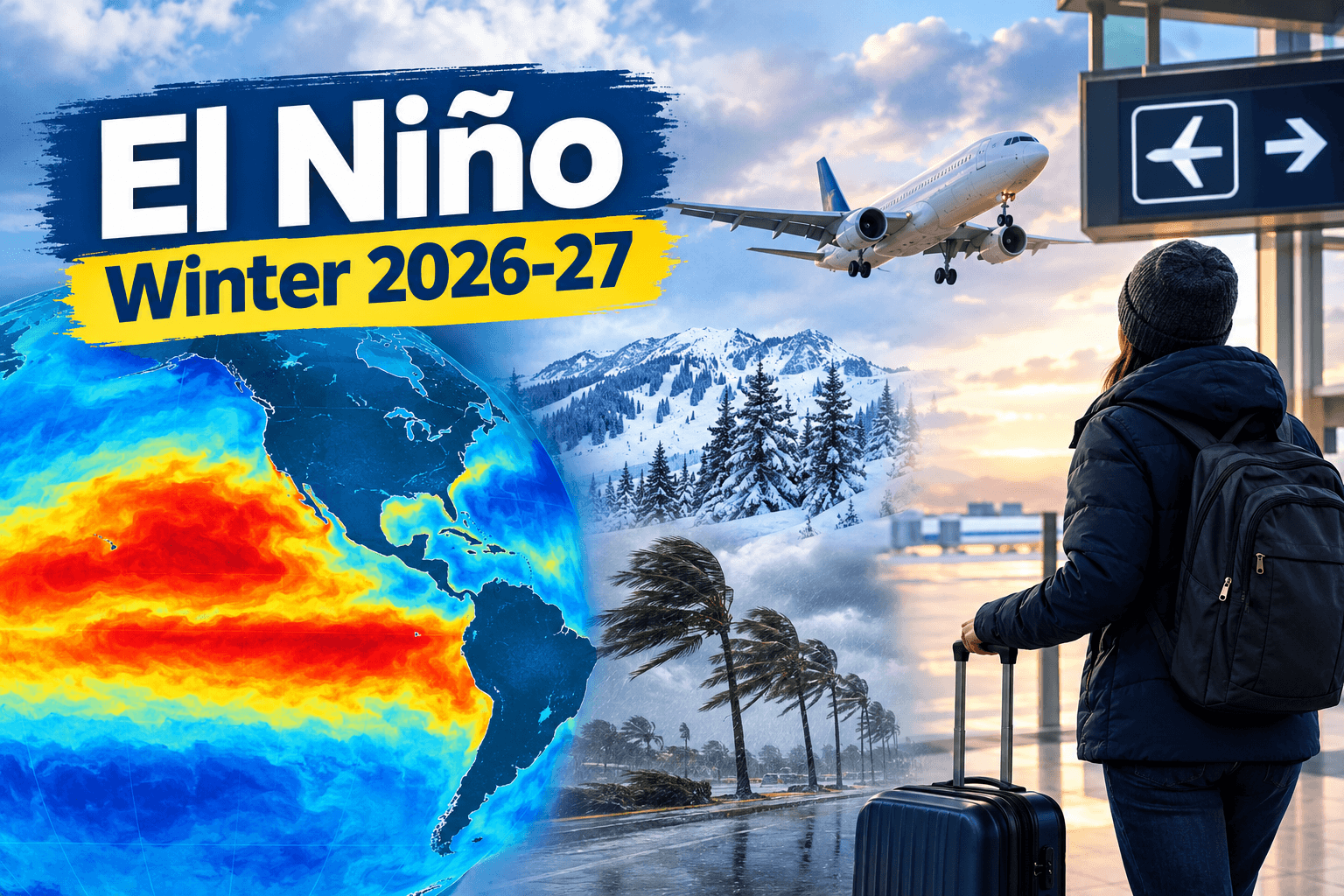
NOAA declared an official El Nino Advisory on June 11, 2026, and forecasters now put the odds at 63 to 90 percent that this winter’s El Nino will become a ‘very strong’ event, potentially one of the most powerful since reliable records began in 1950. For travelers, a strong El Nino winter typically means a wetter, stormier US South and Southeast, a milder and drier Pacific Northwest and northern US, and a generally more active storm track that can disrupt holiday travel plans in specific regions.
Quick Answer
- What is happening: A very strong El Nino is developing and expected to peak through winter 2026-27.
- Confirmed by: NOAA’s Climate Prediction Center, which issued a formal El Nino Advisory on June 11, 2026.
- Strength: A 63 to 90 percent chance of reaching “very strong” status, depending on the forecast source.
- Travel impact: Wetter conditions likely across the southern US, milder and drier conditions likely in the north.
- Ski travel: El Nino winters typically favor the northern Rockies and Pacific Northwest less, and the Southwest more, than La Nina years.
What Is El Nino?
El Nino and La Nina are opposite phases of the El Nino Southern Oscillation, or ENSO, a recurring climate pattern driven by ocean temperature changes in the equatorial Pacific. Under El Nino conditions, trade winds weaken, allowing warm water to flow back toward the Americas, which shifts the Pacific jet stream south and reshapes storm tracks across North America and beyond. The cycle typically lasts 9 to 12 months and recurs irregularly every two to seven years.
How Strong Is This El Nino?
NOAA confirmed El Nino conditions had arrived based on ocean temperatures in the central and eastern equatorial Pacific rising above the 0.5 degree Celsius threshold required for a formal declaration, combined with consistent wind pattern and atmospheric data. Forecasters have placed the odds of the event reaching “very strong” status, meaning ocean temperatures more than 2.0 degrees Celsius above average, at around 63 percent as of the initial advisory, with some later model runs from NOAA-linked services putting the odds as high as 90 percent for a very strong event. If confirmed, this would rank among the most powerful El Nino winters since 1950.
What This Means for US Winter Travel
NOAA’s winter outlook, which follows the typical El Nino storm pattern, points to warmer-than-average temperatures across most of the northern half of the US, including the Pacific Northwest, Upper Midwest, and the entire eastern half of the country. Meanwhile, California, Arizona, New Mexico, most of Colorado, and the Southeast fall into the “probability of above” zone for winter precipitation, meaning these regions face higher odds of wetter-than-normal conditions. This pattern generally matches classic El Nino winters, where the southern storm track becomes more active while the northern US and Canada tend to stay milder and drier.
What This Means for Ski and Snow Travel
For winter sports travelers, a strong El Nino typically shifts the odds against the Pacific Northwest, northern Rockies, and northern Plains, which tend to see below-average snowfall in El Nino years, and toward the Southern Rockies, California, and parts of the Southwest, which often see enhanced storm activity and heavier snow. Colorado sits in an unusual middle zone in NOAA’s current outlook, falling into the “equal chances” category for temperature, meaning forecasters see roughly equal odds of above- or below-normal conditions for that specific region this winter.
What This Means for Hurricane Season and Air Travel
El Nino winters tend to increase wind shear over the Atlantic Ocean, which generally suppresses hurricane activity, a pattern that can mean a comparatively calmer late-season Atlantic hurricane period heading into winter. That said, a more active Pacific storm track and wetter conditions across parts of the southern and southeastern US can still bring more frequent winter storm-related flight delays and cancellations in those regions compared to a typical or La Nina winter.
How This Compares to Recent Winters
The shift to El Nino follows a period of La Nina and ENSO-neutral conditions that dominated the past two winters, meaning US travelers should not assume recent winter travel patterns will repeat this year. A La Nina winter tends to favor colder, snowier conditions in the Pacific Northwest and northern Rockies with drier conditions in the South, essentially the reverse of what this El Nino winter is expected to bring.
What This Means for Travelers
If you are planning winter travel to the southern US, the Southwest, or California, budget extra flexibility for possible wet-weather disruptions and consider travel insurance that covers weather-related delays. If you are heading to the Pacific Northwest or northern Rockies for ski travel, be aware that El Nino years have historically brought below-average snowfall to those regions, so checking specific resort snow reports closer to your trip is worth the extra step this year. Airlines operating heavily in the affected southern corridors have historically added extra buffer time and rebooking flexibility during strong El Nino winters, so checking your airline’s weather policy before booking non-refundable holiday travel is a reasonable precaution this year.
What Happens Next?
NOAA’s Climate Prediction Center updates its ENSO forecast monthly, and confirmation of whether this event reaches “very strong” status will become clearer as winter approaches. Travelers with flexible plans should watch for updated seasonal outlooks in October and November, which typically sharpen the picture for specific regions and travel windows.
Frequently Asked Questions
Is there an El Nino this winter?
Yes, NOAA declared an official El Nino Advisory on June 11, 2026, with a strong chance it develops into a very strong event through winter 2026-27.
How does El Nino affect winter travel?
It typically brings wetter conditions to the southern US and Southwest, and milder, drier conditions to the northern US and Pacific Northwest.
Is this a good or bad year for ski trips to the Pacific Northwest?
El Nino winters historically bring below-average snowfall to the Pacific Northwest and northern Rockies, so it may be a less reliable year for snow in that region.
Does El Nino affect hurricane season?
Yes, El Nino tends to increase Atlantic wind shear, which generally suppresses hurricane activity.
How strong is the 2026-27 El Nino expected to be?
Forecasters put the odds at 63 to 90 percent that it will reach “very strong” status, potentially one of the most powerful since 1950.