

A North Carolina teenager’s death from a brain-eating amoeba infection has put a rare but terrifying illness back in the national spotlight. Health officials traced the exposure to an unpermitted water feature at a community nonprofit — not a lake, river, or pool most people would think to worry about — and the case has raised new questions about where this organism can hide and how families can protect themselves.
Here’s what’s confirmed about the North Carolina case, what brain-eating amoeba actually is, how infection happens, the real statistical risk, and the prevention steps health agencies recommend.
What Is Brain-Eating Amoeba?
“Brain-eating amoeba” is the common nickname for Naegleria fowleri, a microscopic, free-living organism found naturally in warm freshwater and soil around the world. It’s not a bacteria or virus — it’s a single-celled amoeba that normally feeds on bacteria in lake beds, river sediment, and soil, and under most circumstances never comes into contact with a human brain at all.
The nickname comes from the rare but devastating illness it can cause in people: primary amebic meningoencephalitis, or PAM, a brain infection that destroys brain tissue and causes severe swelling. The organism itself doesn’t hunt or target humans — infection happens only through a very specific and accidental route, which is a key reason the disease is so rare despite the amoeba being common in the environment.
The North Carolina Case: What Happened
According to the North Carolina Department of Health and Human Services (NCDHHS), a Central North Carolina teenager was admitted to the hospital on August 22, 2026, and died on August 31 after contracting Naegleria fowleri. State health officials worked with the family to identify four possible exposure locations across Alamance, Orange, and Durham counties, and the CDC collected water samples from each site to determine where the exposure occurred.
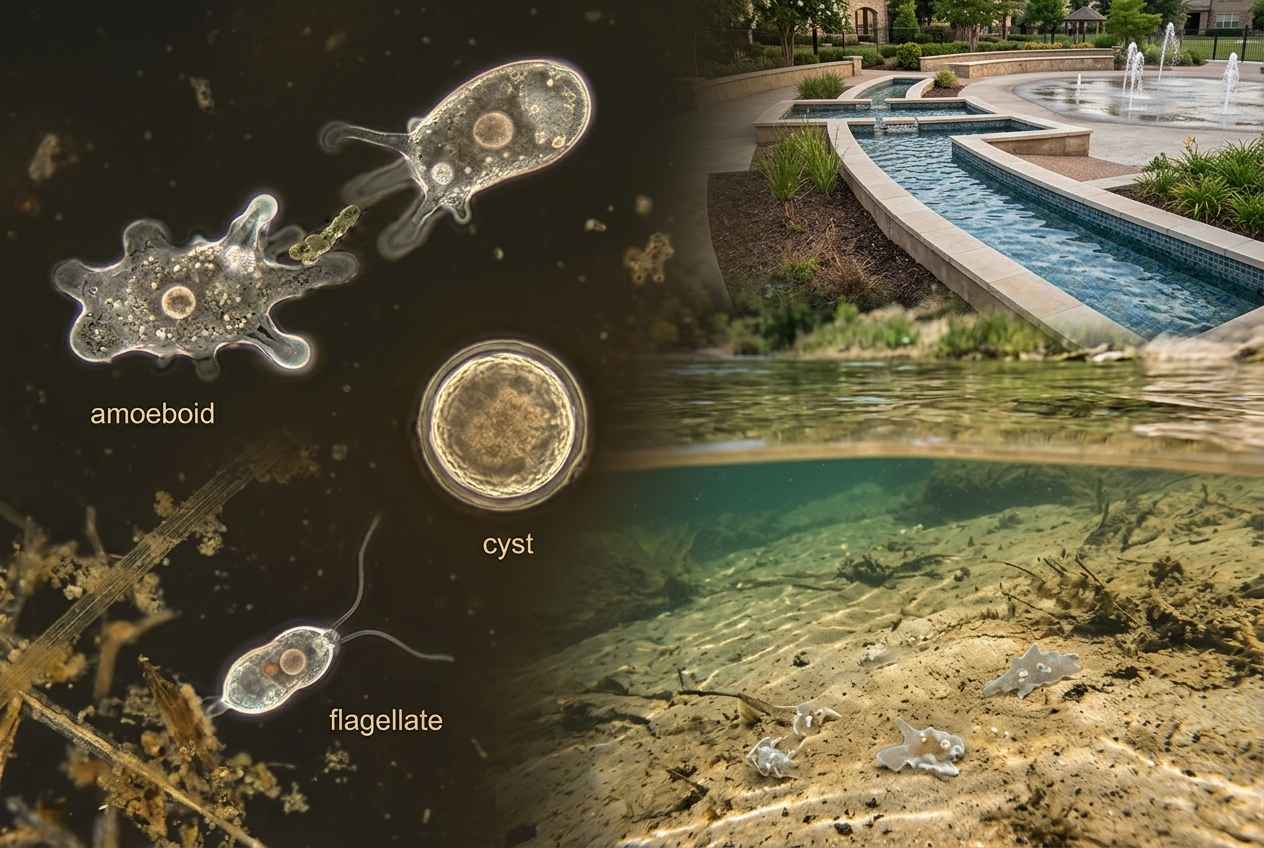
Investigators ultimately traced the infection to a water feature outside El Futuro, a community-based mental health nonprofit in Durham County. According to reporting on the investigation, the teenager had splashed water on his face at the feature — a man-made creek and splash-pad style structure built as part of the facility’s green space — on August 13. Naegleria fowleri was detected specifically in the storage water tank connected to that feature, rather than in the other exposure sites the family identified.
NCDHHS said the teenager was critically ill in the days before his death, noting that “once symptoms start, the disease progresses rapidly and usually causes death within about five days.” In a statement, the department said: “We extend our condolences to the family, friends and community impacted by this loss.” His mother later shared through a GoFundMe campaign that his first symptom had been a severe headache.
How Naegleria Fowleri Actually Infects the Brain
This is the detail that surprises most people learning about the illness for the first time: you cannot get infected by drinking contaminated water. Naegleria fowleri only causes infection when water containing the amoeba is forced up the nose with enough force to reach the olfactory nerve, which the organism then travels along to reach the brain.
Common ways this happens include:
- Jumping or diving into warm freshwater
- Water skiing or other high-speed water sports
- Submerging your head while playing or swimming in shallow, warm water
- Using contaminated tap or well water for sinus rinsing or nasal irrigation without properly boiling, filtering, or using distilled water first
- Splashing water forcefully on the face from a source where the amoeba is present, as appears to have happened in the North Carolina case
Swallowing water containing the amoeba does not cause infection, and the disease cannot spread from person to person. This is also why swimming pools that are properly maintained and chlorinated are considered extremely low-risk — standard chlorine levels kill the organism.
Brain-Eating Amoeba Symptoms
Primary amebic meningoencephalitis symptoms typically begin between one and twelve days after exposure, though five days is most common, and the disease progresses extremely quickly once symptoms start.
Early Symptoms (Days 1–5 After Exposure)
- Severe headache
- Fever
- Nausea and vomiting
- In some cases, changes in sense of smell or taste
Later Symptoms (As the Infection Progresses)
- Stiff neck
- Confusion and disorientation
- Loss of balance
- Seizures
- Hallucinations
- Coma
Because early symptoms closely resemble bacterial meningitis, PAM is notoriously difficult to diagnose quickly, and confirmation often requires specialized lab testing that only a small number of facilities in the country, including the CDC, are equipped to run. In some cases, diagnosis isn’t confirmed until after a patient has died. Anyone who develops a sudden, severe headache with fever and vomiting after recent freshwater swimming, diving, or nasal irrigation should seek emergency medical care immediately and specifically mention the water exposure to their provider, since it can help guide faster testing.
How Rare Is Brain-Eating Amoeba, Really?
Despite the frightening headlines, PAM remains one of the rarest infectious diseases tracked in the United States. According to CDC data, a total of 180 cases were diagnosed in the U.S. from 1937 through 2025, averaging between zero and eight cases per year. A separate CDC dataset covering 1937–2025 similarly counts 173 cases by state of exposure, with Texas and Florida reporting the most, followed by Virginia and California — though cases have occurred in northern states as well.
For comparison, drowning killed more than 34,000 people in the U.S. in just the ten years between 2001 and 2010 alone, a useful reminder that conventional water safety risks remain far more statistically significant than Naegleria fowleri exposure, even during the same summer swimming season.
CDC data also shows the infection disproportionately affects boys and male teenagers, who make up roughly three-quarters of confirmed cases, likely reflecting higher rates of the kind of vigorous water play — diving, splashing, submerging the head — that creates the conditions for infection.
Where Naegleria Fowleri Is Found
The amoeba thrives in warm freshwater and soil, and grows best as water temperatures rise, which is why most cases cluster in the hottest months of summer. Common environments include:
- Lakes and ponds
- Rivers and streams, particularly slower-moving or stagnant sections
- Hot springs
- Poorly maintained or under-chlorinated swimming pools
- Soil, especially near warm freshwater sources
- Man-made water features, splash pads, and storage tanks that aren’t properly treated or maintained, as in the North Carolina case
It is not found in properly treated tap water in most municipal systems, and it cannot survive in salt water, meaning ocean swimming carries essentially no risk of Naegleria fowleri infection.
Man-Made Water Features: An Overlooked Risk
The North Carolina case highlights a risk factor that gets far less public attention than lakes and rivers: decorative or recreational water features built outside their original intended use, particularly ones that recirculate stored water rather than using a continuous fresh supply. Investigators determined Naegleria fowleri was present specifically in the storage water tank feeding the El Futuro splash-pad-style structure, conditions that can develop when a feature isn’t chlorinated or maintained to the same standard as a public swimming pool.
This isn’t an isolated concern. A separate CDC-linked study earlier this year found traces of the amoeba in freshwater at several well-known national parks, and public health researchers have increasingly flagged that any warm, standing, or poorly circulated water source — not just natural bodies of water — deserves the same precautions typically reserved for lake and river swimming.
How the CDC Recommends Preventing Infection
Because there’s no way to test every body of warm freshwater in advance, prevention focuses on limiting how water can reach the nose with force. The CDC’s core recommendations include:
- Hold your nose shut, use nose clips, or keep your head above water when jumping or diving into warm freshwater
- Avoid putting your head underwater in hot springs and other untreated warm geothermal water
- Avoid digging in or stirring up sediment in shallow, warm freshwater, since the amoeba concentrates near the bottom
- Choose times of lower water temperature and higher water levels when possible, since risk increases during prolonged heat and low water conditions
- If rinsing sinuses or performing nasal irrigation, use distilled, sterile, or previously boiled and cooled water — never water straight from the tap
- Ensure home and recreational water features that recirculate stored water are properly chlorinated and maintained, rather than assuming decorative or nonprofit-installed structures meet swimming pool standards
None of these steps make freshwater swimming risk-free in an absolute sense, but given how rare the infection is to begin with, they meaningfully reduce an already very low risk rather than requiring people to avoid warm freshwater altogether.
Treatment and Survival Odds
PAM is treated with a combination of antimicrobial and antifungal medications, most often including amphotericin B, azithromycin, fluconazole, rifampin, and miltefosine, sometimes alongside therapies to manage brain swelling such as targeted temperature management. Despite treatment, the fatality rate remains extraordinarily high: more than 97% of people diagnosed with PAM in the U.S. have died from the infection, and by some counts the fatality rate runs as high as 98.5%.
There have been only five well-documented PAM survivors in North America to date, and researchers who studied the earliest surviving case found some evidence the specific strain involved may have been less aggressive in laboratory testing than strains recovered from fatal cases — one possible explanation, among several being studied, for why outcomes can differ so dramatically between patients.
Because the disease progresses so quickly — often causing death within five days of symptom onset, and rarely more than eighteen — early recognition and immediate emergency care give patients their best, though still limited, chance.
Other Recent Brain-Eating Amoeba Cases
The North Carolina case is tragically not isolated. In recent years, confirmed or suspected PAM cases and deaths have also been reported in South Carolina, Maryland, Florida, and elsewhere, generally following freshwater swimming, diving, or water sports during warm summer months. Health departments in affected states have repeatedly used these cases to reissue the same core prevention guidance: assume any warm freshwater carries some low level of risk, and take simple precautions like nose clips when diving or jumping in.
While each case is a genuine tragedy for the families involved, health officials are consistent in noting that the disease’s overall incidence has not meaningfully increased over recent decades — cases remain rare year to year, even though any individual case tends to generate significant news coverage given how severe the outcome usually is.
Brain-Eating Amoeba vs. Other Water-Related Illnesses
Naegleria fowleri gets outsized attention, but it’s worth understanding how it compares to other water-related health risks people may have heard of:
| Illness | Cause | How You’re Exposed | Typical Severity |
|---|---|---|---|
| Primary amebic meningoencephalitis (PAM) | Naegleria fowleri amoeba | Water forced up the nose in warm freshwater | Extremely rare, but fatal in more than 97% of cases |
| “Flesh-eating” bacteria infections | Various bacteria, including Vibrio vulnificus | Open wounds exposed to warm seawater or brackish water | Rare, can be severe or fatal, especially with pre-existing conditions |
| Recreational water illness (RWI) | Various bacteria, parasites, chemicals | Swallowing or contact with contaminated pool, lake, or ocean water | Common, usually mild gastrointestinal illness |
| Swimmer’s ear | Bacterial or fungal growth in the ear canal | Water trapped in the ear after swimming | Common, uncomfortable but rarely serious |
The comparison underscores an important point: Naegleria fowleri is far rarer than most other water-related risks, but its near-total fatality rate is what makes it disproportionately alarming whenever a case is confirmed.
How AI Search Is Answering “Brain-Eating Amoeba” Questions
Search interest in brain-eating amoeba spikes sharply every time a new case makes headlines, and a growing share of that traffic is now being answered directly by AI-generated overviews rather than a traditional list of links. A few things shape how those systems handle a fast-moving public health story like this one:
- Authoritative sources get prioritized. For a medical topic like this, AI systems and search engines alike lean heavily on official public health sources — CDC, state health departments, and established medical references — over general news aggregation, particularly for anything touching on symptoms, prevention, or statistics.
- Location-specific queries need location-specific facts. A search like “brain eating amoeba north carolina” or “nc brain eating amoeba” is looking for the specific, confirmed local case and investigation details, not a generic national overview — which is why accurately naming the counties, dates, and agency statements involved matters for both readers and AI summarization.
- Risk statistics need context, not just numbers. Because the raw fatality rate (over 97%) sounds alarming in isolation, well-structured content that also states how rare the infection is (fewer than 10 U.S. cases most years) gives both readers and AI systems the fuller picture needed for an accurate, non-alarmist answer.
- Symptom and prevention questions favor clear, listable answers. Direct queries like “brain eating amoeba symptoms” or “how to prevent brain eating amoeba” are best answered with scannable, clearly labeled lists rather than dense paragraphs — the format this guide uses throughout.
The Biology Behind the Name
Naegleria fowleri exists in three life stages: a dormant cyst form that can survive unfavorable conditions, an amoeboid feeding form that moves through water and soil consuming bacteria, and, in rare cases, a temporary flagellate form that can swim more actively through water. It’s the amoeboid form that’s capable of causing infection if it reaches the nasal passages. The organism thrives particularly well in water between roughly 80–115°F (25–46°C), which is why infections cluster so heavily in the hottest weeks of summer, when shallow lakes, ponds, and poorly circulated water features warm up the most. It’s also part of a broader group known as “free-living amebae” — organisms that survive independently in the environment rather than as parasites — and Naegleria fowleri is one of only a handful of such organisms known to cause human disease, a group the National Park Service also tracks given how many parks include warm freshwater recreation areas.
Common Myths About Brain-Eating Amoeba, Debunked
- Myth: Any contact with the amoeba causes infection. Reality: the amoeba must be forced up the nose specifically, in sufficient quantity, and reach the olfactory nerve. Simply having water containing the organism touch your skin, or even swallowing it, does not cause PAM.
- Myth: It’s becoming dramatically more common. Reality: CDC surveillance data shows case counts have stayed within a similar range (0–8 U.S. cases per year) for decades. Individual cases generate significant news attention because of how severe the outcome typically is, not because the underlying rate is rising sharply, though warming water temperatures in some regions are an area of ongoing research interest.
- Myth: It only happens in southern states. Reality: while Texas and Florida have reported the most cases historically, confirmed infections have occurred in northern states as well, and any sufficiently warm freshwater body carries some baseline risk.
- Myth: Chlorinated pools are just as risky as lakes. Reality: properly maintained pools with standard chlorine levels are considered very low risk, since chlorine effectively kills the organism. Risk rises specifically in pools or water features that are poorly maintained or under-chlorinated.
- Myth: Drinking contaminated water is dangerous. Reality: the digestive tract route does not lead to infection. The only documented route into the brain is through the nose.
What Parents and Caregivers Should Know
Because CDC data shows children and teenage boys make up a disproportionate share of confirmed PAM cases, likely tied to more frequent diving, splashing, and head-submerging play in warm freshwater, parents and caregivers of kids swimming in lakes, ponds, or rivers this time of year may want to take a few extra, low-effort precautions without needing to avoid freshwater activities altogether:
- Pack nose clips for lake or river trips, especially for kids who like to jump or dive in
- Discourage digging in or stirring up mud and sediment at the bottom of shallow, warm water areas
- Ask about water source and maintenance before letting kids play in splash pads, decorative fountains, or other man-made water features that aren’t clearly part of a professionally maintained public pool system
- Know the early warning signs — sudden severe headache, fever, nausea, and vomiting following recent freshwater exposure — and seek emergency care immediately if they appear, mentioning the water exposure specifically to the treating physician
- Avoid using tap water for a child’s sinus rinsing or neti pot use; stick to distilled, sterile, or boiled-and-cooled water
None of this is intended to discourage swimming or water play generally — given how rare PAM remains, these are minor adjustments rather than reasons to avoid freshwater recreation, which carries far greater overall benefit than risk for most families.
A Global Pattern, Not Just a U.S. Story
While this guide focuses on U.S. cases and CDC guidance, Naegleria fowleri infections have been documented worldwide, including a notable cluster of cases in Kerala, India, in recent years that drew significant local public health attention and response. The organism’s basic biology and the routes of infection are consistent globally — it’s a naturally occurring inhabitant of warm freshwater and soil wherever conditions are favorable, not a region-specific phenomenon. Public health responses in different countries have generally converged on the same core prevention guidance the CDC recommends: limit forceful water entry into the nose during warm freshwater activities, and ensure any recirculated or stored water source used for swimming or nasal rinsing is properly treated.
Why This Case Is Getting Extra Attention
Beyond the tragedy itself, the North Carolina case has drawn heightened interest for a specific reason: the confirmed exposure site wasn’t a natural lake or river, the setting most public health messaging focuses on, but a man-made water feature at a community nonprofit. That distinction matters for how people think about risk. Many families who are careful about lake and river swimming may not think to apply the same caution to a decorative splash pad, backyard water feature, or similar structure, particularly if it looks clean or is located somewhere that doesn’t register as a “swimming” location in the traditional sense. Public health officials investigating the case have used it as an opportunity to broaden prevention messaging beyond the usual lake-and-river framing to include any warm, standing, or recirculated water source.
How Health Agencies Respond to a Confirmed Case
When a PAM case is confirmed or strongly suspected, state health departments typically move quickly to identify every possible exposure site the patient or their family can recall, since pinpointing the exact source is critical both for the individual investigation and for warning the public about a specific, ongoing risk. In the North Carolina case, NCDHHS worked with the family to identify four candidate locations across three counties, and the CDC then collected and tested water samples from each site — a process that ultimately isolated the amoeba to one specific storage tank rather than a broader natural water source. This kind of rapid, multi-site environmental investigation is standard practice for confirmed PAM cases, both to close any ongoing exposure risk (such as shutting down or treating a contaminated water feature) and to refine public prevention guidance based on where and how the exposure actually happened.
Facilities found to be a confirmed exposure source are generally required to drain, clean, and properly disinfect the water system before it can be used again, and in the case of a decorative or recreational water feature, ongoing maintenance and chlorination standards are typically reviewed going forward.
Diagnosis Challenges
One of the most difficult aspects of PAM from a medical standpoint is how closely its early symptoms mimic bacterial meningitis, a far more common and more survivable condition. Standard tests for bacterial meningitis won’t detect Naegleria fowleri, which means clinicians need to specifically suspect a free-living amoeba infection — often prompted by a recent history of warm freshwater exposure — before ordering the specialized testing needed to confirm it. Because only a small number of labs nationwide, including the CDC’s Free-Living and Intestinal Amebas Lab, can perform confirmatory testing, and because the disease progresses so rapidly, a meaningful share of cases are only confirmed after death, through post-mortem tissue analysis. This diagnostic lag is part of why recent freshwater exposure history is such an important detail for anyone with sudden, severe meningitis-like symptoms to volunteer to their treating physician, even if the doctor doesn’t ask directly.
Does chlorine in my home tap water protect me from brain-eating amoeba?
Most municipal tap water systems in the U.S. are treated in a way that makes Naegleria fowleri extremely unlikely to be present. Risk with tap water specifically arises around nasal irrigation or sinus rinsing, where the CDC recommends using distilled, sterile, or boiled-and-cooled water rather than water straight from the tap, particularly in areas with private well water or less rigorous municipal treatment.
Are there any warning signs a lake or pond might have brain-eating amoeba?
There’s no way to visually tell whether a specific body of water contains Naegleria fowleri. The organism doesn’t change water color, clarity, or smell in a way that would serve as a warning sign, which is why prevention focuses on how you enter and interact with warm freshwater rather than trying to identify “safe-looking” versus “risky-looking” water.
Frequently Asked Questions
What is brain-eating amoeba?
Brain-eating amoeba is the common nickname for Naegleria fowleri, a microscopic organism found in warm freshwater and soil that can, in rare cases, cause a fatal brain infection called primary amebic meningoencephalitis (PAM) if it enters the nose with force and travels to the brain.
What are the symptoms of brain-eating amoeba infection?
Early symptoms include severe headache, fever, nausea, and vomiting, typically starting one to twelve days after exposure. As the infection progresses, symptoms can include stiff neck, confusion, loss of balance, seizures, hallucinations, and coma.
Can you get brain-eating amoeba from swallowing water?
No. Infection only occurs when contaminated water is forced up the nose with enough force to reach the olfactory nerve. Swallowing water containing the amoeba does not cause infection.
Can brain-eating amoeba spread from person to person?
No. Naegleria fowleri infections cannot be transmitted between people.
How common is brain-eating amoeba infection in the U.S.?
It’s extremely rare. CDC data shows 180 confirmed U.S. cases between 1937 and 2025, averaging fewer than 10 cases per year, most often in warmer states like Texas and Florida.
What happened in the North Carolina brain-eating amoeba case?
A Central North Carolina teenager was hospitalized on August 22, 2026, and died on August 31 after being exposed to Naegleria fowleri at a water feature outside El Futuro, a mental health nonprofit in Durham County, where he had splashed water on his face on August 13. The amoeba was found specifically in the storage tank feeding that water feature.
Is brain-eating amoeba survivable?
Survival is rare but not impossible. There have been only five well-documented survivors of PAM in North America, and the overall U.S. fatality rate exceeds 97%.
Can you get brain-eating amoeba in a swimming pool?
Properly maintained and chlorinated swimming pools are considered very low risk, since standard chlorine levels kill the organism. Risk increases significantly in poorly maintained or under-chlorinated pools and water features.
Can brain-eating amoeba live in salt water or the ocean?
No. Naegleria fowleri cannot survive in salt water, so ocean swimming does not carry a risk of this specific infection.
How can I protect myself and my family from brain-eating amoeba?
Use nose clips or hold your nose when jumping or diving into warm freshwater, avoid submerging your head in hot springs, avoid stirring up sediment in shallow warm water, and use only distilled, sterile, or boiled-and-cooled water for sinus rinsing rather than water straight from the tap.
How quickly does brain-eating amoeba infection progress?
Very quickly. Once symptoms begin, the disease typically causes death within about five days, with most cases resolving (usually fatally) between one and eighteen days after symptom onset.
Related Reading
For another recent look at how a fast-moving public health story develops and how officials respond, see our coverage of the Pennsylvania measles outbreak and deaths. For official, continuously updated guidance, the CDC maintains a dedicated Naegleria fowleri infection resource covering symptoms, causes, and data, along with a specific prevention guide for swimmers and families. Background on the underlying condition, including treatment approaches, is also available via Wikipedia’s entry on primary amoebic meningoencephalitis, and ongoing local coverage of the North Carolina case is available from WRAL’s reporting.