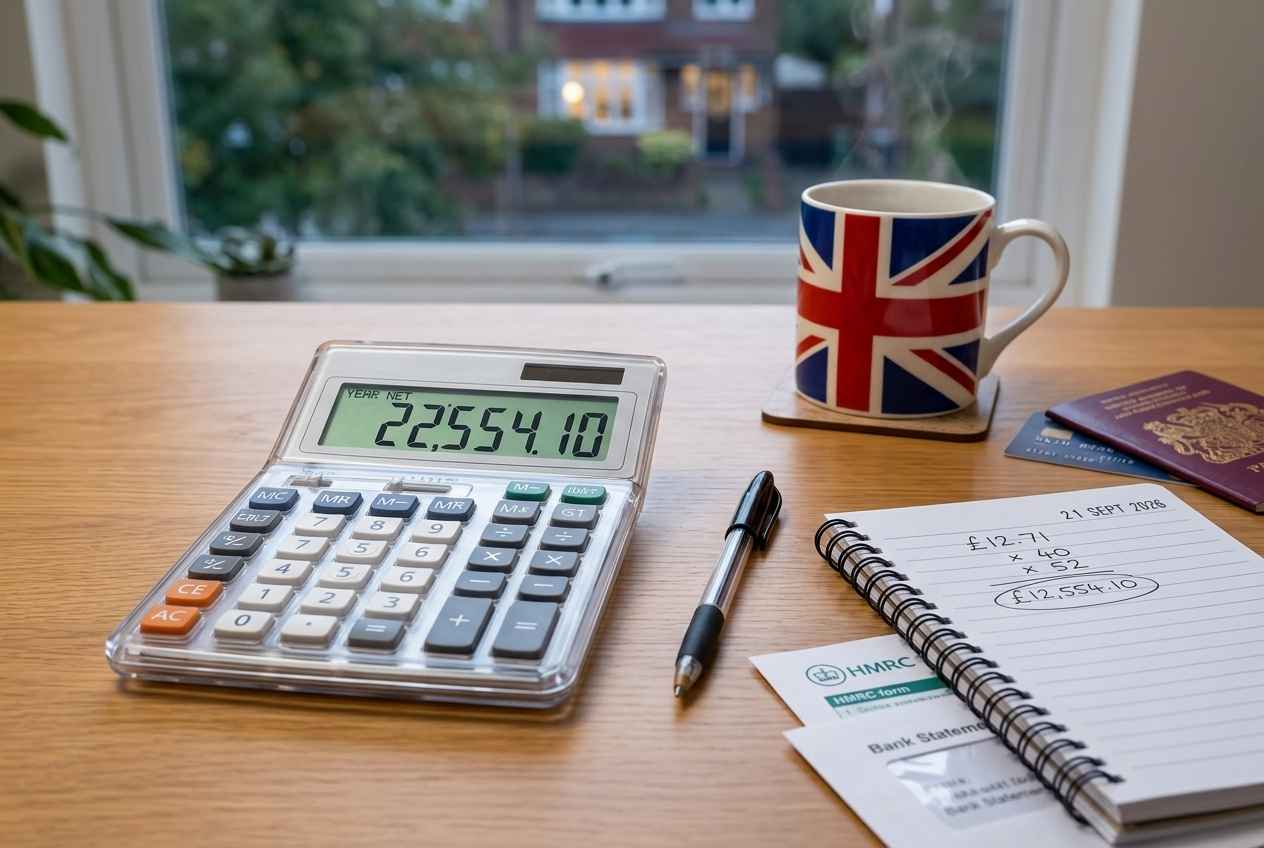

National Living Wage 2026 take-home pay is the amount left in your pocket after tax and National Insurance once the new £12.71 hourly rate begins on 1 April 2026. For a standard 40-hour week, that gross rate is £26,436.80 a year, and take-home pay comes to about £22,554.10 a year, or £1,879.51 a month, in England, Wales and Northern Ireland.
The National Living Wage is the legal minimum hourly pay for workers aged 21 and over in the UK. Consequently, this rise affects millions of workers in retail, hospitality, social care and cleaning. This guide sets out National Living Wage 2026 take-home pay at full-time and part-time hours, in Scotland, with pensions and student loans, and after every deduction that applies.
Quick answer: National Living Wage 2026 take-home pay
- Gross pay (40 hours a week): £26,436.80 a year, or £508.40 a week, at £12.71 an hour.
- Take-home pay (England, Wales, NI): £22,554.10 a year, £1,879.51 a month.
- Take-home pay (Scotland): £22,593.77 a year.
- Total deductions: 14.7% of gross pay goes to tax and National Insurance.
- 37.5-hour week: £24,784.50 gross, £21,364.44 take-home.
Want your own hours? Use our hourly to salary and take-home pay calculator.
Last updated: . Rates: UK 2026/27 tax year (6 April 2026 to 5 April 2027). Written by the Every Tools editorial team.

In this guide
- What is the National Living Wage in 2026?
- All National Minimum Wage rates from April 2026
- National Living Wage 2026 take-home pay by hours
- Take-home pay in Scotland
- Income tax, National Insurance and other deductions
- Pension and student loans
- Take-home pay for younger workers and apprentices
- How much more will you take home in 2026?
- Your rights and what to check
- Common mistakes when estimating take-home pay
- How we calculated these figures
- Frequently asked questions
- Summary
- Sources
What is the National Living Wage in 2026?
The National Living Wage (NLW) is the legal minimum hourly rate for workers aged 21 and over in the UK. From 1 April 2026, it rises to £12.71 an hour. That is a 50p increase on the 2025 rate of £12.21, a rise of 4.1%. The independent Low Pay Commission recommends the rate each year, and the government confirms it through the GOV.UK minimum wage rates page.
Employers must pay at least this rate for every hour worked by eligible staff. As a result, National Living Wage 2026 take-home pay is the real number that matters to workers, because it shows what actually reaches their bank account once tax and National Insurance are deducted.
The NLW is different from the voluntary Real Living Wage set by the Living Wage Foundation. The Real Living Wage is higher and is not a legal requirement, so only some employers choose to pay it. Always check your own payslip and contract for the rate you are actually paid.
All National Minimum Wage rates from April 2026
The April 2026 increase covers every age band, not only the National Living Wage. The table below lists every confirmed rate.
| Category | April 2025 rate | April 2026 rate | Increase |
|---|---|---|---|
| National Living Wage (21 and over) | £12.21 | £12.71 | +50p (4.1%) |
| 18 to 20 years old | £10.00 | £10.85 | +85p (8.5%) |
| 16 to 17 years old | £7.55 | £8.00 | +45p (6.0%) |
| Apprentice rate | £7.55 | £8.00 | +45p (6.0%) |
Notably, the 18-20 rate rises by 85p, an 8.5% increase, which is a larger percentage rise than the NLW itself. This narrows the pay gap between younger and older workers. The apprentice rate and the under-18 rate both increase by 45p to £8.00.
National Living Wage 2026 take-home pay by hours
Take-home pay depends heavily on how many hours you work each week, because the £12,570 tax-free personal allowance covers a bigger share of part-time pay. The table below shows National Living Wage 2026 take-home pay in England, Wales and Northern Ireland at common weekly hours.
| Hours per week | Yearly gross | Income tax | National Insurance | Yearly take-home | Monthly take-home |
|---|---|---|---|---|---|
| 40 hours | £26,436.80 | £2,773.36 | £1,109.34 | £22,554.10 | £1,879.51 |
| 37.5 hours | £24,784.50 | £2,442.90 | £977.16 | £21,364.44 | £1,780.37 |
| 35 hours | £23,132.20 | £2,112.44 | £844.98 | £20,174.78 | £1,681.23 |
| 30 hours | £19,827.60 | £1,451.52 | £580.61 | £17,795.47 | £1,482.96 |
| 25 hours | £16,523.00 | £790.60 | £316.24 | £15,416.16 | £1,284.68 |
| 20 hours | £13,218.40 | £129.68 | £51.87 | £13,036.85 | £1,086.40 |
| 16 hours | £10,574.72 | £0.00 | £0.00 | £10,574.72 | £881.23 |
| 10 hours | £6,609.20 | £0.00 | £0.00 | £6,609.20 | £550.77 |
Notice that a 16-hour week produces no income tax or National Insurance, because yearly gross pay of £10,574.72 sits below the £12,570 personal allowance. In contrast, a 40-hour week loses 14.7% of gross pay to deductions.
Pay by period at 40 hours a week
Whichever pay cycle your employer uses, the yearly total is the same. The table below breaks National Living Wage 2026 take-home pay down by hour, day, week, four weeks and month.
| Period | Gross pay | Take-home pay |
|---|---|---|
| Per hour | £12.71 | £10.84 |
| Per day (8 hours) | £101.68 | £86.75 |
| Per week | £508.40 | £433.73 |
| Every 4 weeks | £2,033.60 | £1,734.93 |
| Per month | £2,203.07 | £1,879.51 |
| Per year | £26,436.80 | £22,554.10 |
National Living Wage 2026 take-home pay in Scotland
Scotland sets its own income tax bands, though National Insurance stays the same across the whole UK. As a result, National Living Wage 2026 take-home pay in Scotland differs slightly from the rest of the UK. Scotland uses six income tax bands, starting at 19% and rising to 48% on the highest incomes, as set out on the Scottish Income Tax page.
| Item | England, Wales, NI | Scotland |
|---|---|---|
| Gross pay (year) | £26,436.80 | £26,436.80 |
| Income tax | £2,773.36 | £2,733.69 |
| National Insurance | £1,109.34 | £1,109.34 |
| Take-home pay (year) | £22,554.10 | £22,593.77 |
At £12.71 an hour for 40 hours a week, a worker in Scotland actually pays £39.67 less income tax than a worker in England, Wales or Northern Ireland. This is because most of the taxable pay falls in Scotland’s lower 19% and 20% bands. However, higher earners in Scotland usually pay more overall than elsewhere in the UK.
Income tax, National Insurance and other deductions explained
Three deductions typically reduce National Living Wage 2026 take-home pay: income tax, National Insurance and, for some workers, student loan repayments or a pension contribution.
First, the £12,570 personal allowance lets you earn that much tax-free, according to GOV.UK income tax rates. Above that, the basic rate of income tax is 20% up to £50,270 of total income. Second, employee National Insurance is 8% on earnings between £12,570 and £50,270, and 2% above that. These thresholds are frozen until April 2031.
Applying these rules to a 40-hour week at £12.71 an hour: gross pay is £26,436.80, taxable income after the allowance is £13,866.80, income tax is £2,773.36, and National Insurance is £1,109.34. That leaves £22,554.10 in take-home pay.
| Item | Per year | Per month |
|---|---|---|
| Gross pay | £26,436.80 | £2,203.07 |
| Income tax (20%) | -£2,773.36 | -£231.11 |
| National Insurance (8%) | -£1,109.34 | -£92.45 |
| Take-home pay | £22,554.10 | £1,879.51 |
To confirm you are on the right tax code, check your payslip against the government’s guide to tax codes. Most workers with one job and no benefits use code 1257L. Full details of what your payslip should show are on the GOV.UK payslips page.
Pension contributions and student loans
Workplace pensions reduce National Living Wage 2026 take-home pay, but they also build retirement savings. Under automatic enrolment, most employers must enrol eligible staff into a pension scheme. A 5% employee contribution on a 40-hour week at £12.71 an hour is £1,321.84 a year, which lowers take-home pay to about £21,496.63 under a typical net pay arrangement.
Student loan repayments only apply once your pay passes a plan threshold, so most National Living Wage earners on a 40-hour week repay little or nothing. The table shows every plan, using the thresholds on the GOV.UK student loan repayment page.
| Loan plan | Yearly threshold | Rate above threshold | Yearly repayment | Take-home after repayment |
|---|---|---|---|---|
| Plan 1 | £26,900.00 | 9% | £0.00 | £22,554.10 |
| Plan 2 | £29,385.00 | 9% | £0.00 | £22,554.10 |
| Plan 4 (Scotland) | £33,795.00 | 9% | £0.00 | £22,554.10 |
| Plan 5 | £25,000.00 | 9% | £129.31 | £22,424.79 |
| Postgraduate loan | £21,000.00 | 6% | £326.21 | £22,227.89 |
If you need help managing a student loan account, our guide to Student Finance England contact options lists the ways to get in touch.
Take-home pay for younger workers and apprentices in 2026
Workers under 21 earn a lower legal minimum, so their National Living Wage 2026 take-home pay comparison looks different. The table below shows gross and net pay for each age band at a 40-hour week.
| Age band | Hourly rate | Yearly gross | Tax + NI | Yearly take-home |
|---|---|---|---|---|
| National Living Wage (21+) | £12.71 | £26,436.80 | £3,882.70 | £22,554.10 |
| 18 to 20 years old | £10.85 | £22,568.00 | £2,799.44 | £19,768.56 |
| 16 to 17 / apprentice | £8.00 | £16,640.00 | £1,139.60 | £15,500.40 |
Workers on the apprentice or under-18 rate pay little or no income tax at 40 hours a week, because their gross pay sits close to the £12,570 personal allowance. As these workers turn 21, or complete their first year of an apprenticeship while 19 or over, employers must move them onto the higher rate that applies. The government’s guide to minimum wage for different types of work explains apprentice pay rules in full.
How much more will you take home in 2026?
The rise from £12.21 to £12.71 adds £20.00 a week in gross pay for a 40-hour worker, or £1,040.00 a year. After tax and National Insurance at the basic rate, roughly 78p of every extra £1 reaches take-home pay for a worker already earning above the personal allowance. That means the increase adds about £748.80 a year to National Living Wage 2026 take-home pay for a full-time worker in England, Wales and Northern Ireland.
| Item | 2025/26 (£12.21) | 2026/27 (£12.71) | Increase |
|---|---|---|---|
| Gross pay (year) | £25,396.80 | £26,436.80 | +£1,040.00 |
| Take-home pay (year) | £21,805.30 | £22,554.10 | +£748.80 |
For a 37.5-hour week, the yearly gross increase is £975.00. Employers must update payroll systems by 1 April 2026, and any worker still paid the old rate after that date is being underpaid.
Your rights and what to check on your payslip
Every worker aged 21 and over is legally entitled to at least £12.71 an hour from April 2026, regardless of company size or sector. Use this checklist to confirm you are receiving the correct National Living Wage 2026 take-home pay:
- Check your hourly rate on your payslip matches at least £12.71 from 1 April 2026, if you are 21 or over.
- Confirm your tax code is 1257L, unless you have more than one job or receive benefits.
- Ask your employer for a written payslip that shows gross pay, deductions and net pay, as required by UK pay and work rights rules.
- Review your holiday entitlement, since most workers get at least 5.6 weeks of paid leave a year.
- If you are married or in a civil partnership and one of you earns below the personal allowance, check whether Marriage Allowance could reduce your household tax bill.
If you believe you are being paid below the legal minimum, our guide on UK workers’ rights and what to do if you are underpaid explains the next steps. Wider household budgeting context is in our overview of the UK economy in 2026, and typical UK pay levels by sector appear in our finance pay rate guide.
What the 2026 rise means for employers
Employers must budget for higher wage costs from 1 April 2026, and payroll systems need updating before that date. Beyond the headline hourly rate, employer National Insurance contributions and pension costs also rise in line with gross pay, so total staffing costs increase by more than the 4.1% hourly rise alone. Businesses in retail, hospitality and social care, where many staff earn close to the National Living Wage, typically feel this increase most. Employers who fail to pay at least £12.71 an hour to eligible staff after 1 April 2026 risk enforcement action and financial penalties from HMRC.
Employers should also review staff who are close to a birthday or an anniversary that moves them into a higher age band or off the apprentice rate, since National Living Wage 2026 take-home pay calculations change automatically once a worker qualifies for a higher rate.
Common mistakes when estimating National Living Wage 2026 take-home pay
Small errors change your yearly estimate by hundreds of pounds. Watch out for these when you calculate National Living Wage 2026 take-home pay:
- Using the 2025/26 rate. The £12.71 rate only applies from 1 April 2026, not before.
- Forgetting National Insurance. Income tax alone understates your real deduction.
- Ignoring pension auto-enrolment. Most workers are automatically enrolled unless they opt out.
- Assuming four weeks equal a month. A year has 52 weeks, or 4.33 weeks a month, not 4.
- Mixing up gross and net pay when comparing job offers or payslips.
- Overlooking a second job, which is usually taxed at a higher rate because the personal allowance only applies once.
How we calculated these figures
Every table in this guide uses the same formulas as our own calculator, so the numbers stay consistent throughout. We made the following assumptions:
- The tax year is 2026/27, running from 6 April 2026 to 5 April 2027.
- Workers have a standard tax code of 1257L and no other income.
- Employee Class 1 National Insurance uses category A rates.
- Pay covers 52 weeks a year, including paid holiday.
- Scottish figures use the six Scottish income tax bands for 2026/27.
- Pension figures use a simple net pay arrangement at 5% of gross pay.
- All results are rounded to the nearest penny.
We will update this article if the government revises the National Living Wage, tax bands or National Insurance thresholds before April 2026. Even so, these figures are estimates. Your own payslip, tax code and benefits are the final word, so speak to your employer or a qualified adviser about your exact pay.
Frequently asked questions about National Living Wage 2026 take-home pay
What is National Living Wage 2026 take-home pay at 40 hours a week?
At £12.71 an hour for a 40-hour week, gross pay is £26,436.80 a year. After income tax and National Insurance in England, Wales and Northern Ireland, take-home pay is about £22,554.10 a year, or £1,879.51 a month. In Scotland, take-home pay is about £22,593.77 a year.
When does the £12.71 National Living Wage start?
The new rate takes effect on 1 April 2026, replacing the 2025/26 rate of £12.21 an hour. It applies to workers aged 21 and over.
How much is National Living Wage 2026 take-home pay per month?
For a 40-hour week, gross pay is £2,203.07 a month. After tax and National Insurance in England, Wales and Northern Ireland, take-home pay is about £1,879.51 a month.
How much is National Living Wage 2026 take-home pay for a 37.5-hour week?
Gross pay is £24,784.50 a year, and take-home pay is about £21,364.44 a year in England, Wales and Northern Ireland, which is £1,780.37 a month.
Does the National Living Wage apply to under-21s?
No. Workers aged 21 and over get the National Living Wage of £12.71 an hour. Workers aged 18 to 20 get £10.85 an hour, and under-18s and most apprentices get £8.00 an hour from April 2026.
How much tax do you pay on the National Living Wage?
At 40 hours a week, a National Living Wage worker pays 20% income tax on earnings above the £12,570 personal allowance, plus 8% employee National Insurance on earnings between £12,570 and £50,270. Together, that is 14.7% of gross pay.
Does a National Living Wage worker pay a student loan?
Usually not at 40 hours a week, because gross pay of £26,436.80 sits below the Plan 1, Plan 2 and Plan 4 thresholds. A Plan 5 borrower repays £129.31 a year, since that plan’s threshold is lower.
How much more is National Living Wage 2026 take-home pay compared with 2025?
The hourly rate rises by 50p, adding £20.00 a week or £1,040.00 a year in gross pay for a 40-hour worker. After tax and National Insurance, take-home pay rises by about £748.80 a year.
Is the National Living Wage the same as the Real Living Wage?
No. The National Living Wage is the legal minimum set by the government. The Real Living Wage is a higher, voluntary rate set by the Living Wage Foundation that only some employers choose to pay.
How accurate are these National Living Wage 2026 take-home pay figures?
They are estimates based on the 2026/27 tax year, a standard 1257L tax code and no other income. Your own payslip may differ because of your tax code, pension contributions, benefits or pay period.
Summary: National Living Wage 2026 take-home pay
From 1 April 2026, the National Living Wage rises to £12.71 an hour for workers aged 21 and over. At 40 hours a week, that is £26,436.80 a year before tax and about £22,554.10 after tax and National Insurance in England, Wales and Northern Ireland, or £22,593.77 in Scotland. Part-time workers on 16 hours a week pay no tax at all, while pensions and student loans lower take-home pay further for those who make contributions. Younger workers and apprentices earn less under the National Minimum Wage, with take-home pay scaled accordingly.
Check your own National Living Wage 2026 take-home pay with our free hourly to salary, overtime and take-home pay calculator. It covers weekly, monthly and yearly pay, plus tax and National Insurance for the UK and FICA and federal tax for the US.
Related guides on Every Tools:
- Hourly to salary, overtime and take-home pay calculator
- Hours calculator: a complete guide to accurate time tracking
- Finance pay rate in the UK: complete salary guide for 2026
- UK workers’ rights, pay checks and what to do if you are underpaid
- UK bank holidays 2026 dates
- UK economy 2026: key issues affecting British households
Sources and further reading
- National Minimum Wage and National Living Wage rates (GOV.UK)
- Low Pay Commission
- Income Tax rates and Personal Allowances (GOV.UK)
- Scottish Income Tax (GOV.UK)
- National Insurance rates and categories (GOV.UK)
- Repaying your student loan (GOV.UK)
- Workplace pensions (GOV.UK)
- Tax codes (GOV.UK)
- Minimum wage for different types of work (GOV.UK)
- Pay and work rights (GOV.UK)
- Calculate your holiday entitlement (GOV.UK)
- Marriage Allowance (GOV.UK)
- Payslips (GOV.UK)
This article is for general information only. It is not tax, legal or financial advice, and Every Tools is not affiliated with HMRC, the Low Pay Commission or the UK government.