
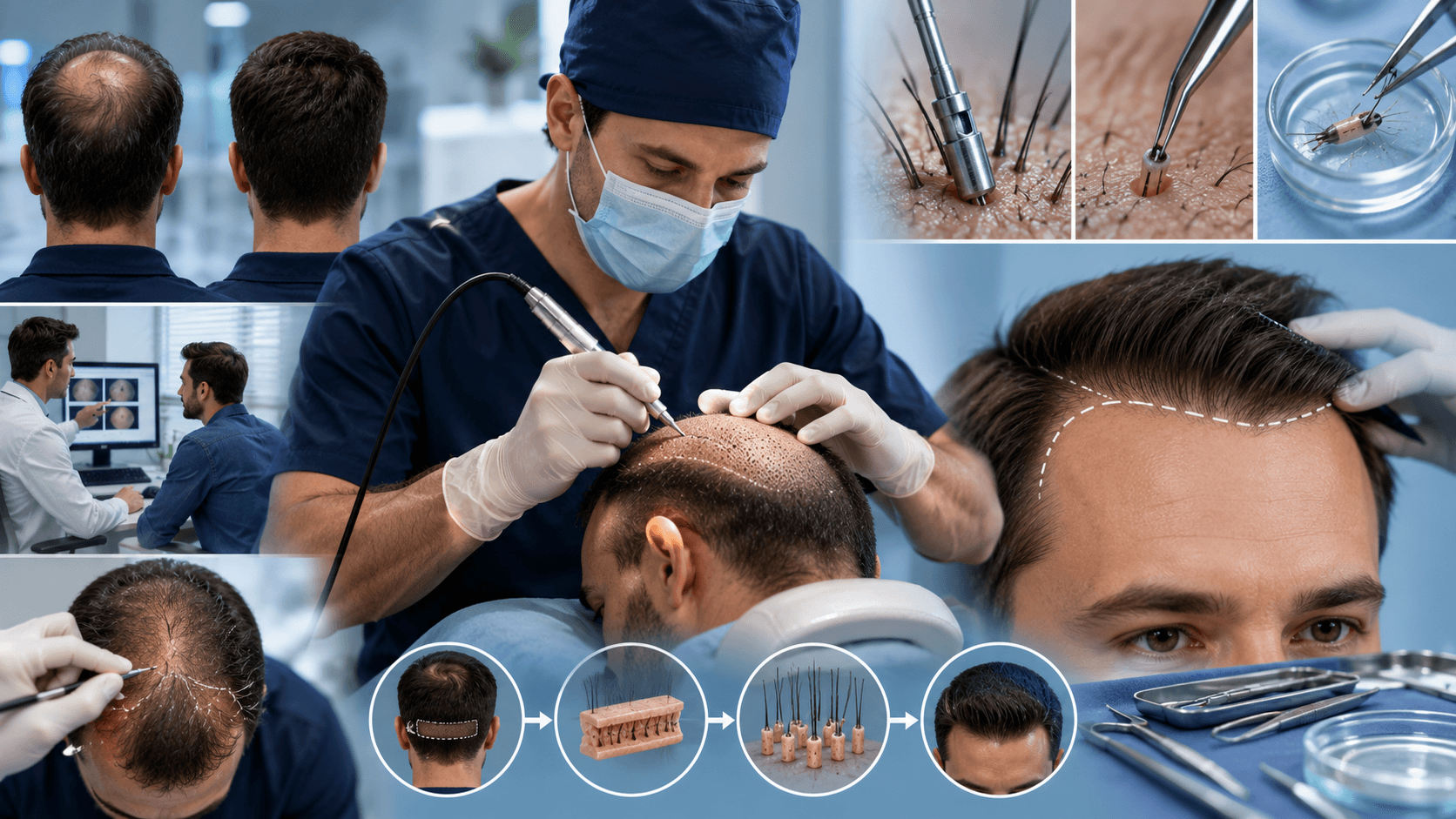
A hair transplant moves hair follicles from areas resistant to hair loss, usually the back and sides of the scalp, to thinning or bald areas. The main techniques are FUE and FUT, and final results appear after about 12 to 18 months. It does not stop hair loss elsewhere, so many people also need medicines, and choosing a qualified, regulated surgeon is essential.
Key takeaways
- Find the cause of hair loss first, because some types are temporary or treatable with medicine.
- Minoxidil and finasteride have the best evidence for pattern hair loss, but must be used long term.
- Hair transplants take 12 to 18 months to show final results, and carry risks such as scarring and poor growth.
- Choose a qualified surgeon who performs the key steps, avoid very cheap packages, and consider a second opinion.
In this guide
- Common Causes of Hair Loss
- When to See a Doctor
- Non-Surgical Treatments That Have Evidence
- What Is a Hair Transplant?
- The Two Main Techniques
- Am I a Good Candidate?
- What to Expect: Recovery and Results Timeline
- Risks and Side Effects
- How to Choose a Safe Clinic
- Looking After Your Hair and Scalp
- Emotional Wellbeing
- Finding a Specialist
- Frequently Asked Questions
Last updated: October 2026
Losing hair can affect confidence, and the market is full of promises, from shampoos and supplements to clinics offering permanent results. The truth is more nuanced. Some hair loss is temporary, some is treatable with medicines, and some may be helped by a hair transplant, but results depend on the cause, your age, and realistic expectations. This guide explains the main causes of hair loss, the evidence-based treatments, how hair transplants work, the risks, and how to choose a clinic safely. It is general information, not medical advice.
Common Causes of Hair Loss
| Cause | What happens |
|---|---|
| Androgenetic alopecia (pattern hair loss) | The most common cause. Hair follicles gradually shrink because of genetics and hormones, causing a receding hairline and thinning crown in men and diffuse thinning in women |
| Telogen effluvium | Temporary shedding after stress, illness, surgery, childbirth, rapid weight loss, or some medicines |
| Alopecia areata | An autoimmune condition causing patchy hair loss |
| Scarring (cicatricial) alopecias | Inflammation permanently destroys follicles |
| Medical causes | Thyroid problems, iron or other nutrient deficiencies, hormonal conditions such as PCOS, and some skin conditions |
| Hair pulling or tight hairstyles | Physical damage, sometimes called traction alopecia |
Because the causes are so different, a correct diagnosis comes first. The NHS hair loss guidance and the American Academy of Dermatology explain the main types.
When to See a Doctor
- Sudden or patchy hair loss
- Hair loss with a red, scaly, painful, or scarred scalp
- Hair loss together with fatigue, weight change, or other symptoms
- Hair loss in children or at a very young age
- Hair loss after starting a new medicine
A doctor may examine your scalp, ask about your history and family, and arrange blood tests to check for causes such as thyroid problems or low iron. Treating an underlying condition can sometimes reverse the hair loss.
Non-Surgical Treatments That Have Evidence
- Minoxidil: a topical treatment for pattern hair loss in men and women that can slow loss and help some regrowth. It must be used continuously, and any gains are lost if you stop.
- Finasteride: a prescription tablet for men that reduces the hormone that shrinks follicles. It has potential side effects, including sexual side effects in a small number of users, so discuss the risks with a doctor.
- Other prescription options: specialists may use other medicines for specific conditions, including alopecia areata.
- Low-level light therapy and platelet-rich plasma (PRP): some studies suggest benefit for some people, but the evidence is mixed, and results vary.
- Camouflage options: hair fibres, concealers, wigs, and styling can help while you decide on treatment.
Be cautious about products promising miracle regrowth. Supplements do not help unless you have a deficiency, and some, such as high-dose biotin, can interfere with blood tests.
What Is a Hair Transplant?
A hair transplant moves hair follicles from areas of the scalp where they are resistant to hair loss, usually the back and sides, to thinning or bald areas. Because the transplanted follicles keep the characteristics of the donor area, the new hair can grow for many years. However, it does not stop hair loss elsewhere on the scalp, so many people also need medicines to protect their existing hair.
The Two Main Techniques
| Technique | How it works | Points to consider |
|---|---|---|
| FUE (follicular unit extraction) | Individual follicles are taken from the donor area with a small punch and then implanted | Tiny dot-like scars, shorter recovery, and shaving of the donor area is often needed |
| FUT (follicular unit transplantation, or strip method) | A strip of scalp is removed, and follicles are separated and implanted | A linear scar that can be hidden by longer hair, and it may allow many grafts in one session |
Robotic systems and other tools may assist some procedures, but the surgeon’s skill and planning remain the most important factors.
Am I a Good Candidate?
- You have a stable, healthy donor area with enough hair density.
- Your hair loss pattern is established, ideally with a clear diagnosis of pattern hair loss.
- You are in good general health, and have realistic expectations.
- You understand that you may need further sessions and long-term medical treatment.
Transplants are usually not suitable for people with active scarring alopecia, uncontrolled alopecia areata, very limited donor hair, or unrealistic expectations. Younger patients need extra caution, because their hair loss may progress.
What to Expect: Recovery and Results Timeline
| Time after surgery | What usually happens |
|---|---|
| First days | Redness, scabs, and some swelling, with specific care instructions for washing and sleeping position |
| 2 to 4 weeks | The transplanted hairs often shed, which is a normal stage |
| 3 to 4 months | New growth begins |
| 6 to 9 months | Visible improvement, with hair gradually thickening |
| 12 to 18 months | Final results are usually seen |
Risks and Side Effects
- Swelling, itching, numbness, and redness, which usually settle
- Infection or inflammation of follicles (folliculitis)
- Scarring that is more visible than expected
- Shock loss, the temporary loss of existing hair near the transplant
- Poor growth, an unnatural-looking hairline, or uneven density
- Anaesthetic or other medicine reactions
Serious problems are uncommon with experienced surgeons, but poorly performed procedures can leave lasting damage.
How to Choose a Safe Clinic
- Check that the surgeon is a qualified, registered doctor. In the UK, you can check the General Medical Council register, and you can check whether the clinic is regulated by the Care Quality Commission. Organisations such as the International Society of Hair Restoration Surgery and the American Board of Hair Restoration Surgery provide information on training and standards.
- Make sure the surgeon is performing the key parts of the operation and not leaving it to unqualified technicians.
- Ask to see real before-and-after results of patients with similar hair types.
- Get an in-person or detailed consultation. Be wary of clinics that quote without examining you.
- Beware of very low prices and package deals that include flights or hotels. Cheap, high-volume clinics can cut corners.
- Understand the full cost and aftercare, including follow-up, medication, and what happens if results are poor. Budget carefully, using our guide to financial planning.
- Consider a second opinion before you commit.
Looking After Your Hair and Scalp
- Eat a balanced diet with enough protein, iron, and other nutrients. See our guide to ancient grains for whole-food ideas.
- Avoid very tight hairstyles and harsh chemical treatments.
- Manage stress and prioritise sleep, which can influence hair shedding. See our guide to better sleep.
- Be gentle when brushing and washing, and use heat styling sparingly.
- Do not smoke, which can affect healing and general health.
Emotional Wellbeing
Hair loss can be distressing, particularly if it is sudden or affects appearance and self-esteem. Talking to a doctor, counsellor, or support group can help, and you do not have to decide on treatment quickly. Take the time to learn your options and choose what feels right for you.
Finding a Specialist
Links in this section are sponsored and are not endorsements. Always check credentials, reviews, and results independently: multispecialty clinic and Plastic Surgeon.
Frequently Asked Questions
Common causes include genetic pattern hair loss, stress or illness, hormonal and thyroid problems, nutrient deficiencies, autoimmune conditions, and some medicines.
Follicles are taken from the donor area of the scalp and implanted into thinning areas, where they keep growing for years.
FUE removes individual follicles with a tiny punch, leaving small dot scars. FUT removes a strip of scalp, leaving a linear scar.
New growth begins at around 3 to 4 months, with final results usually seen by 12 to 18 months.
Transplanted follicles usually keep growing for many years, but other hair can continue to thin, so many people also use medicines.
Check the surgeon qualifications and registration, make sure the surgeon performs the key steps, ask for real results, and avoid very cheap packages.
This article is general information, not medical advice. Treatment suitability varies, so see a qualified doctor. Sponsored links are not endorsements.
Related Guides
- Robotic Hair Transplant: What It Is, How It Works, and What to Expect – What robotic hair transplant is, how the technology works, and what to expect from the procedure.
- Joint Pain Explained: Causes, Treatments, and When Arthroscopy or Surgery Helps – Joint pain explained: common causes, self-care, physiotherapy, injections, when arthroscopy or joint replac…
- Visceral Hypersensitivity: Causes, Symptoms, and Treatment Options – Visceral hypersensitivity explained: what it is, conditions like IBS linked to it, why it happens, red-flag…
- Why Choose RF Microneedling Boynton Beach for Natural-Looking Skin Rejuvenation – Why RF Microneedling in Boynton Beach is a popular choice for natural-looking skin rejuvenation.