
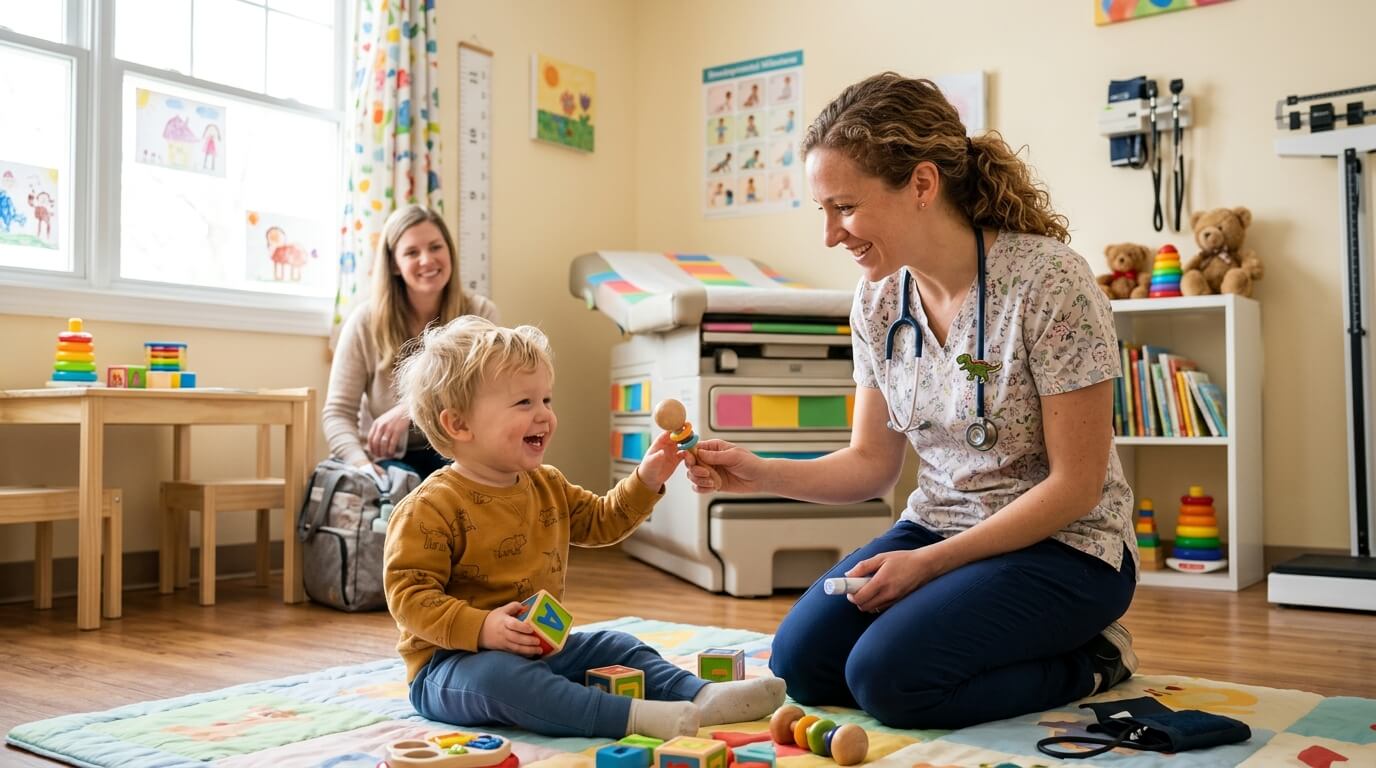
Child development milestones are skills that most children reach by a certain age, such as smiling at 2 months, sitting at about 9 months, walking by about 18 months, and speaking in short sentences by age 3. Every child develops at their own pace, but losing skills, no response to sound, or marked delays in speech or movement should be discussed with a doctor.
Key takeaways
- Milestones cover social and emotional, language, thinking, and movement skills.
- Children develop at different rates, so checklists are guides, not tests.
- Loss of skills, hearing concerns, and marked delays should be discussed with a doctor or health visitor.
- Talking, reading, play, routines, and good sleep support development, and early help improves outcomes.
In this guide
- What Are Developmental Milestones?
- Typical Milestones by Age
- Signs to Discuss With a Doctor or Health Visitor
- How to Support Your Child's Development
- Health Checks and Safety
- Premature Babies and Special Circumstances
- Common Parent Worries
- Questions to Ask at a Child Health Check
- Finding Support
- Frequently Asked Questions
Last updated: October 2026
Every child grows and learns at their own pace, but there are general patterns in how skills appear. Developmental milestones are the things most children can do by a certain age, such as smiling, sitting, walking, or putting words together. Knowing them helps parents celebrate progress, support learning, and spot possible delays early, when help makes the biggest difference. This guide gives typical milestones from birth to age five, practical ways to support development, and signs that deserve a conversation with a doctor. It is general information, not a diagnosis.
What Are Developmental Milestones?
Milestones cover several areas of development:
- Social and emotional: smiling, bonding, taking turns, and managing feelings.
- Language and communication: cooing, babbling, first words, sentences, and understanding.
- Thinking and learning (cognitive): curiosity, problem-solving, and memory.
- Movement and physical development: head control, rolling, crawling, walking, and fine motor skills such as grasping.
Checklists differ slightly between countries and organisations. Well-known sources include the US CDC’s Learn the Signs, Act Early programme, the American Academy of Pediatrics’ HealthyChildren.org, and the NHS baby development pages.
Typical Milestones by Age
These examples reflect common checklists. Many children reach them a little earlier or later and are still developing normally.
| Age | Social and language | Movement and learning |
|---|---|---|
| 2 months | Smiles at people, calms when comforted, looks at faces | Holds head up briefly during tummy time, watches you move |
| 4 months | Smiles on their own, copies some sounds and expressions, chuckles | Holds head steady, reaches for toys, brings hands to mouth |
| 6 months | Takes turns making sounds, responds to their name, likes looking at themselves in a mirror | Rolls over, sits with support, passes toys from hand to hand |
| 9 months | Makes different sounds such as “mamama”, may be wary of strangers | Sits without support, crawls or moves around, picks up small items with fingers |
| 12 months | Waves bye-bye, calls a parent “mama” or “dada”, responds to simple requests | Pulls up to stand, may take first steps, drinks from a cup with help |
| 18 months | Tries to say several words, points to show interest, plays simple pretend games | Walks without holding on, scribbles, tries to use a spoon |
| 2 years | Says two-word phrases, follows simple instructions, copies others | Kicks a ball, runs, begins to stack blocks |
| 3 years | Talks in short sentences, takes turns in games, shows a range of emotions | Climbs well, pedals a tricycle, draws a circle |
| 4 years | Tells simple stories, plays cooperatively, understands counting basics | Hops, catches a large ball, uses scissors under supervision |
| 5 years | Speaks clearly in longer sentences, follows rules in games, understands simple stories | Hops on one foot, draws a person with several body parts, dresses with little help |
Signs to Discuss With a Doctor or Health Visitor
Talk to your child’s doctor, nurse, or health visitor if your child:
- Loses skills they previously had, such as words or movements, at any age
- Does not respond to loud sounds, or does not seem to hear well
- Has little eye contact, smiling, or interest in people
- Is not sitting by about 9 months, or not walking by about 18 months
- Has no single words by around 16 months, or no two-word phrases by about 2 years
- Seems very stiff or very floppy, or favours one side of the body
- Has difficulty feeding, or is not gaining weight as expected
- Is very difficult to soothe, or very limited in play and interaction
You do not need to wait for a routine check. Trust your instincts if you are worried. Early support, sometimes called early intervention, can improve outcomes for many developmental differences, including speech delay, autism, and motor problems. In the US, free early intervention services are available through each state. In the UK, health visitors and the 2 to 2.5 year review support early identification.
How to Support Your Child’s Development
Talk, Read, and Sing
Talk to your baby from birth, describe what you are doing, and respond to their sounds. Read together every day, even for a few minutes, and sing songs and rhymes. Back-and-forth “serve and return” interaction builds brain connections, as explained by the Center on the Developing Child at Harvard University.
Play
- Tummy time for babies, while awake and supervised, strengthens the neck and shoulders.
- Offer safe objects to explore, such as soft toys, blocks, and containers.
- Encourage pretend play, drawing, building, and outdoor play as children grow.
Routines, Sleep, and Nutrition
Regular routines for meals, play, and bedtime help children feel secure. Sleep is important for growth and learning, and our guide to choosing bedding for better sleep may help create a calm bedroom. Offer a variety of healthy foods, and see our meal ideas in weekly meal planning and our guide to ancient grains.
Screen Time
Guidance from health bodies generally advises avoiding screens for babies under about 18 months apart from video calls, and limiting and choosing high-quality content for young children, while keeping screens out of mealtimes and bedtimes. Real-life play and conversation matter more for early development.
Emotional Skills and Resilience
Help children name feelings, offer comfort when they are upset, and let them try tasks that are slightly challenging. Our guide on raising resilient kids explains how to build coping skills.
Health Checks and Safety
- Attend routine health and development checks, and keep vaccinations up to date.
- Have hearing and vision checked if you have concerns.
- Use age-appropriate car seats, safe sleep practices, and supervision around water and stairs.
- Childproof your home as your child becomes mobile.
Premature Babies and Special Circumstances
Babies born early often reach milestones later, and doctors may adjust expectations based on the baby’s corrected age, which is calculated from the due date rather than the birth date. Children with certain medical conditions or disabilities may follow different patterns, and their care team can provide personalised guidance.
Common Parent Worries
- “My child is not talking as much as another child.” Language varies widely, but check with a professional if you are concerned about words, understanding, or hearing.
- “My child walks late.” Some healthy children walk anywhere between about 9 and 18 months. See a doctor if there are other concerns or no walking by 18 months.
- “My child is shy.” Shyness is common. Concern arises when a child seems to avoid most interaction or does not respond to others.
- “Should I compare siblings?” Siblings often develop differently, so use checklists rather than comparing children.
Questions to Ask at a Child Health Check
- Is my child developing as expected for their age?
- Which milestones should I look for next?
- Should we check hearing or vision?
- What activities can I do to support speech and movement?
- Who can I contact if I have concerns between visits?
Finding Support
Choose paediatricians and therapists who are properly registered in your country. Links in this section are sponsored and are not endorsements. Always check credentials and reviews independently: Child Development Center and 24×7 Pediatric Hospital.
Frequently Asked Questions
They are skills most children can do by a certain age, across areas such as social, language, thinking, and movement.
Speak to a doctor if your child loses skills, does not respond to sound, has very little eye contact, is not walking by about 18 months, or has no words or phrases when expected.
Many babies take their first steps between about 9 and 15 months, and most walk without help by around 18 months, but there is a normal range.
Talk, read, and sing every day, play together, offer tummy time, keep routines, and make sure your child gets enough sleep and nutrition.
Often, yes. Doctors usually use corrected age, calculated from the due date, when assessing development.
Health guidance generally advises avoiding screens for babies under about 18 months except video calls, and limiting and choosing high-quality content for young children.
This article is general information, not medical advice. Children develop at different rates, so see a doctor or health visitor if you have concerns. Sponsored links are not endorsements.