
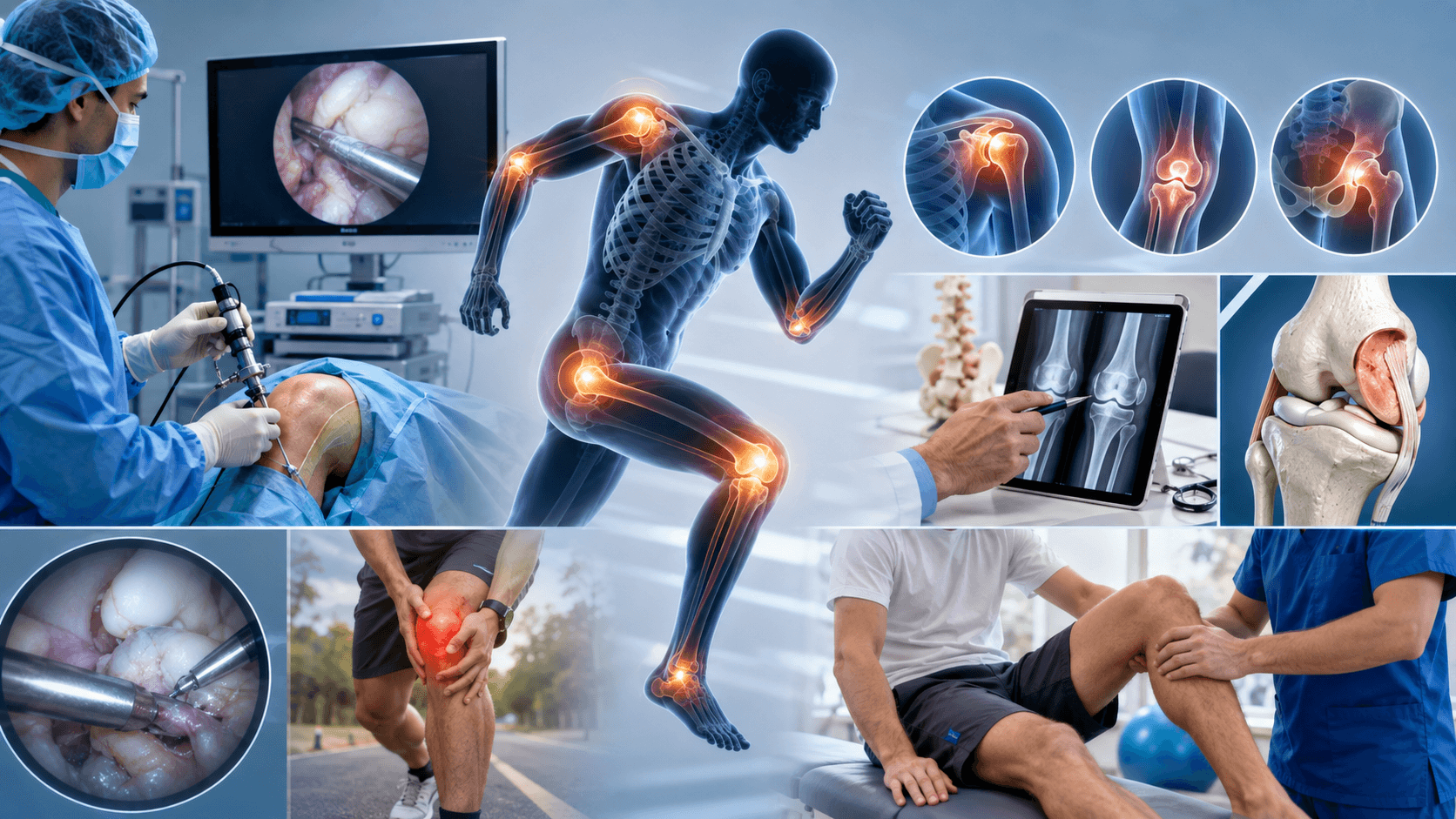
Joint pain is commonly caused by osteoarthritis, inflammatory arthritis, gout, sprains, meniscus tears, and tendon problems. Most cases improve with activity, strengthening, weight management, and physiotherapy. Arthroscopy (keyhole surgery) helps in selected problems such as locking meniscus tears and ligament repairs, but it is generally not recommended for knee osteoarthritis pain alone.
Key takeaways
- Stay active, build strength, manage weight, and try physiotherapy before considering surgery.
- Arthroscopy helps for specific problems, but not for wear-related knee osteoarthritis pain alone.
- A hot, swollen joint with fever, or inability to bear weight, needs urgent medical help.
- Joint replacement can greatly help advanced arthritis when other treatments have not worked.
In this guide
- Common Causes of Joint Pain
- When to Get Urgent Medical Help
- Self-Care and Everyday Management
- Physiotherapy and Other Non-Surgical Treatments
- What Is Arthroscopy?
- When Does Arthroscopy Help, and When Does It Not?
- Joint Replacement
- Recovery After Joint Surgery
- Preventing Joint Problems
- Questions to Ask Your Doctor or Surgeon
- Finding a Specialist
- Frequently Asked Questions
Last updated: October 2026
Joint pain is one of the most common reasons people visit a doctor. It can follow an injury, build up slowly with age, or come from conditions such as arthritis. Many people improve with simple measures, exercise, and physiotherapy, while some need injections or surgery. This guide explains common causes of joint pain, self-care that works, when arthroscopy and joint surgery can help, what the evidence says, and warning signs that need urgent care. It is general information, not medical advice.
Common Causes of Joint Pain
| Cause | What it is | Typical features |
|---|---|---|
| Osteoarthritis | Wear and thinning of joint cartilage over time | Pain and stiffness that worsen with activity, common in knees, hips, hands, and spine |
| Rheumatoid arthritis | An autoimmune disease that inflames the joint lining | Morning stiffness lasting over 30 minutes, swollen joints on both sides of the body, fatigue |
| Gout | Uric acid crystals building up in a joint | Sudden, severe pain, redness, and swelling, often in the big toe |
| Sprains, strains, and ligament injuries | Damage to ligaments or muscles after a twist or fall | Pain, swelling, bruising, and instability |
| Meniscus tears | Damage to the cartilage cushions of the knee | Pain, swelling, and sometimes locking or catching |
| Tendon and bursa problems | Inflammation of tendons or fluid sacs | Pain on movement, tenderness, often from overuse |
| Infection | Bacteria inside a joint (septic arthritis) | A hot, swollen, very painful joint, often with fever, and an emergency |
For clear patient guides, see the NHS joint pain page, Versus Arthritis, the Arthritis Foundation, and OrthoInfo from the American Academy of Orthopaedic Surgeons.
When to Get Urgent Medical Help
- A hot, red, swollen joint, especially with fever or feeling very unwell
- Inability to put weight on a leg, or a visibly deformed joint after injury
- Severe pain after a fall or accident
- Numbness, tingling, or weakness in a limb
- A painful, swollen calf, which could be a blood clot
- Joint pain with chest pain or breathing difficulty
See your doctor if pain lasts for more than a few weeks, keeps coming back, wakes you at night, or limits daily activities.
Self-Care and Everyday Management
- Stay active. Gentle, regular movement, such as walking, swimming, or cycling, helps most joint problems. Avoid long periods of complete rest.
- Strengthen supporting muscles. Strong muscles around a joint reduce load on it.
- Lose excess weight if you are overweight. Every kilogram lost reduces the load on the knees considerably.
- Use heat or cold. Warmth can ease stiffness, while cold packs can help with swelling after an injury.
- Take pain relief sensibly. Paracetamol, and topical or oral anti-inflammatory medicines can help some people, but they are not suitable for everyone, so read labels and ask a pharmacist or doctor.
- Protect joints. Use good technique when lifting, supportive footwear, and ergonomic equipment.
- Look after sleep. Poor sleep can make pain feel worse. See our guide to better sleep and bedding.
For a recent injury, many clinicians now suggest the “PEACE and LOVE” approach: protect, elevate, avoid anti-inflammatories in the first days, compress, and educate, followed by load, optimism, vascularisation (cardio exercise), and exercise.
Physiotherapy and Other Non-Surgical Treatments
- Physiotherapy: exercise programmes, manual therapy, and advice on movement are among the best-supported treatments for osteoarthritis and many injuries.
- Braces, supports, and walking aids: useful for some people.
- Corticosteroid injections: can give short-term relief of pain and inflammation in some joints, but repeated injections are not advised.
- Other injections: evidence for hyaluronic acid or platelet-rich plasma in osteoarthritis is mixed, and guidelines vary.
- Disease-modifying treatments: inflammatory arthritis, such as rheumatoid arthritis, needs specialist medicines to prevent joint damage.
If you need hands-on help for back or neck pain, you may also be interested in our guide to what a chiropractor does.
What Is Arthroscopy?
Arthroscopy is keyhole surgery in which a surgeon inserts a small camera and instruments through tiny cuts to look inside a joint and treat certain problems. It is most commonly used on the knee and shoulder, and also on the hip, ankle, and wrist. Recovery is usually quicker than with open surgery, but the operation is only helpful for the right conditions.
When Does Arthroscopy Help, and When Does It Not?
| Situation | Role of arthroscopy |
|---|---|
| Torn meniscus with locking or catching | Can help in selected cases, usually after non-surgical treatment has been tried |
| ACL reconstruction | Often performed using arthroscopic techniques |
| Rotator cuff and some shoulder problems | Commonly used for certain repairs |
| Loose bodies or some cartilage problems | May be treated arthroscopically |
| Knee osteoarthritis with pain only | Washing out or smoothing the joint is generally not recommended, as studies show it does not help most people |
Guidelines such as the NICE osteoarthritis guideline advise against arthroscopic lavage and debridement for knee osteoarthritis, unless there are mechanical symptoms such as true locking. If surgery is suggested, ask what the expected benefit is, and whether exercise and physiotherapy have been fully tried first.
Joint Replacement
For advanced arthritis that has not responded to other treatments, joint replacement surgery, such as a hip or knee replacement, can greatly reduce pain and improve movement. The damaged joint surfaces are replaced with a metal and plastic or ceramic implant. Most people stay in hospital for a short time, and recovery with physiotherapy takes weeks to months. Risks include infection, blood clots, stiffness, and implant wear, so decisions should be made with an orthopaedic surgeon after considering your symptoms, general health, and goals.
Recovery After Joint Surgery
- Follow the surgeon’s instructions on weight-bearing, wound care, and medicines.
- Do the prescribed exercises. Rehabilitation is as important as the operation.
- Prepare your home. Remove trip hazards, and arrange help with shopping and transport.
- Watch for warning signs: increasing redness, discharge, fever, a hot swollen joint, or a painful swollen calf.
- Return to activity gradually, including sports. See our training advice in rugby sevens training for how to build load safely.
Preventing Joint Problems
- Warm up before exercise, and increase training gradually.
- Mix different activities, and include strength and balance work.
- Keep a healthy weight.
- Use correct technique and protective equipment in sport and work.
- Treat injuries properly, and do not return to sport too early.
Questions to Ask Your Doctor or Surgeon
- What is causing my joint pain, and how do you know?
- Which non-surgical treatments should I try first?
- What is the likely benefit of surgery, and what are the risks?
- What happens if I wait or choose not to have surgery?
- What will recovery involve, and how long will it take?
- How many of these operations do you perform, and what are the outcomes?
Finding a Specialist
Choose orthopaedic surgeons and physiotherapists who are properly qualified and registered in your country. Links in this section are sponsored and are not endorsements. Always verify credentials and outcomes independently: Arthroscopic Surgeon and Best Orthopedic Surgeon.
Frequently Asked Questions
Common causes include osteoarthritis, rheumatoid arthritis, gout, injuries such as sprains and meniscus tears, tendon problems, and, rarely, infection.
Stay active, strengthen supporting muscles, manage your weight, use heat or cold, and take pain relief as advised by a pharmacist or doctor.
For selected problems such as meniscus tears with locking, ligament reconstruction, and some shoulder repairs, usually after non-surgical treatment has been considered.
Generally not. Guidelines advise against washing out or smoothing the knee for osteoarthritis pain unless there are mechanical symptoms such as true locking.
If pain lasts more than a few weeks, keeps returning, wakes you at night, limits daily life, or comes with swelling, redness, or fever. See urgent care for a hot swollen joint or inability to bear weight.
Most people leave hospital within days, with recovery and rehabilitation taking weeks to months, depending on the joint and the person.
This article is general information, not medical advice. See a qualified doctor for diagnosis and treatment. Sponsored links are not endorsements.
Related Guides
- Hair Loss and Hair Transplant: Causes, Treatments, Results, and How to Choose a Clinic – Hair loss and hair transplant guide: causes, evidence-based treatments, FUE vs FUT, results timeline, risks…
- Visceral Hypersensitivity: Causes, Symptoms, and Treatment Options – Visceral hypersensitivity explained: what it is, conditions like IBS linked to it, why it happens, red-flag…
- Laparoscopic Surgery: What It Is, How It Works, and What to Expect – What laparoscopic (keyhole) surgery is, how it works, and what patients can expect from the procedure.
- Head and Neck Surgery: What It Treats, How It Works, and What to Expect – What head and neck surgery treats, how it works, and what patients can expect during recovery.