
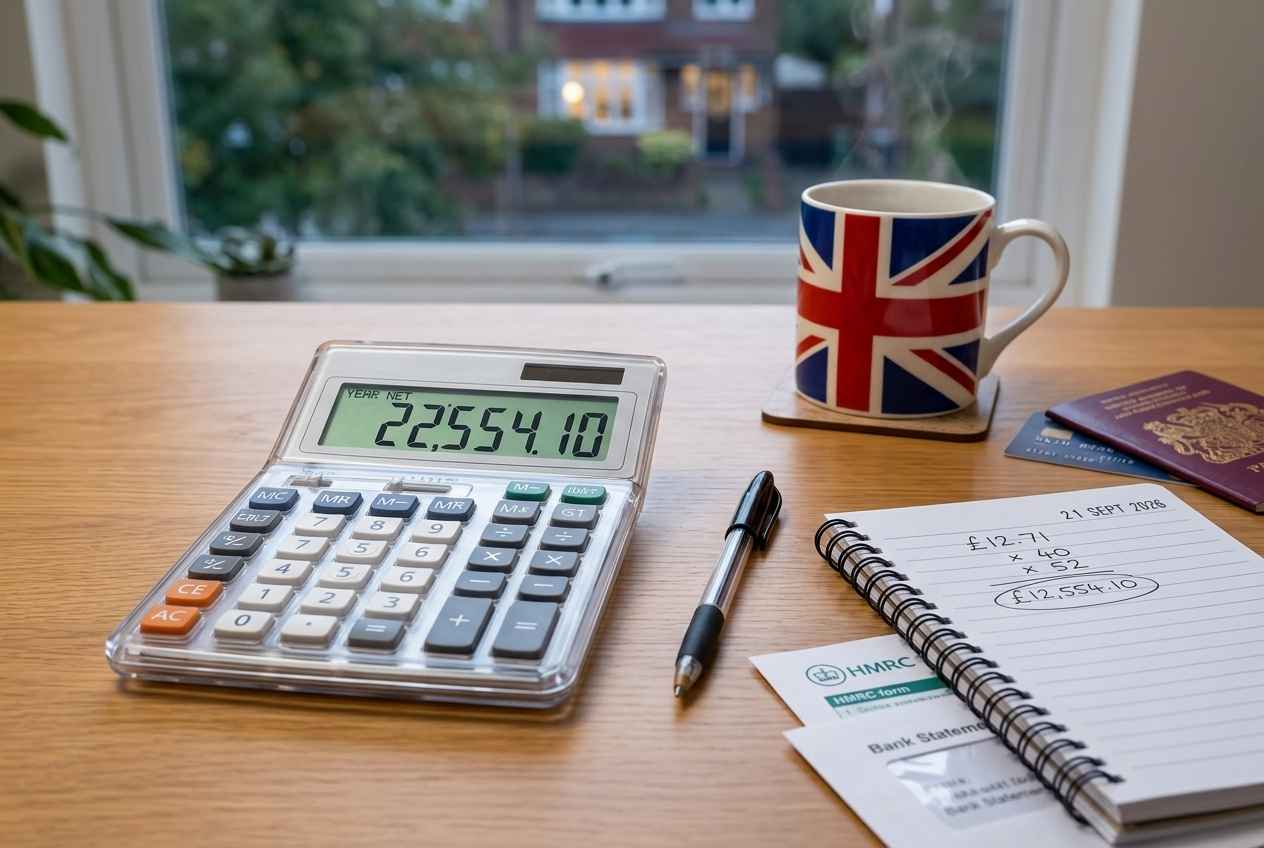
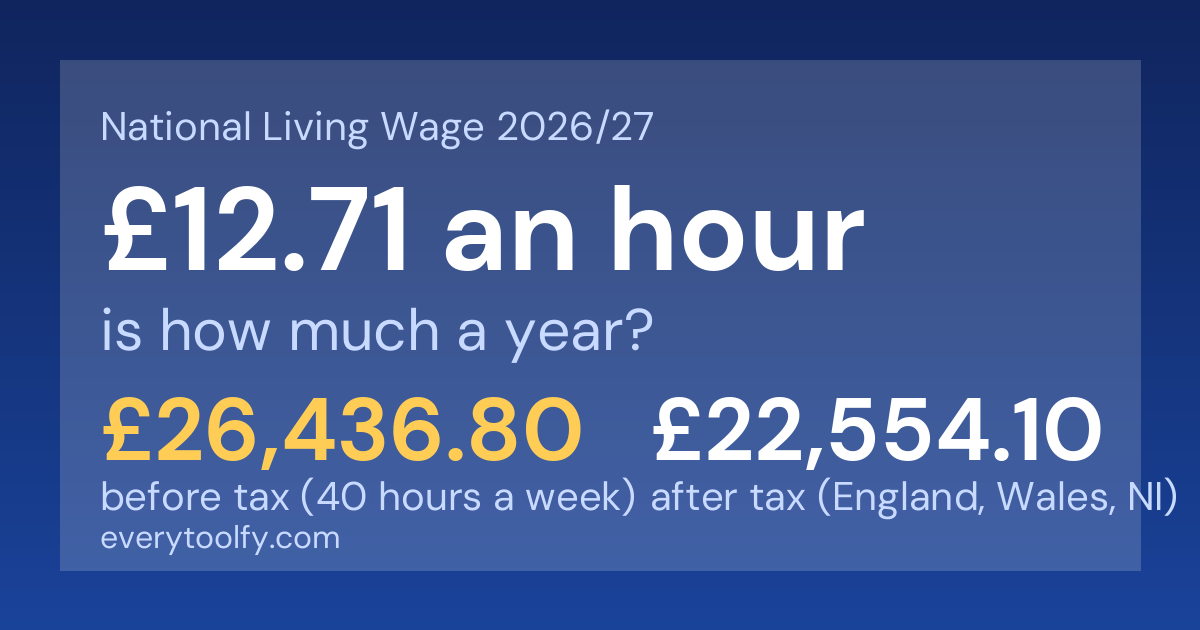
£12.71 an hour is how much a year? For a standard 40-hour week, £12.71 an hour comes to £26,436.80 a year before tax. After income tax and National Insurance in England, Wales and Northern Ireland, you take home about £22,554.10 a year. That is £1,879.51 a month in the 2026/27 tax year.
This rate matters because £12.71 is the National Living Wage. It applies to workers aged 21 and over from 1 April 2026. Therefore, this guide answers the question for millions of full-time and part-time workers. It covers gross pay, take-home pay, monthly and weekly pay, student loans, pensions and overtime. In addition, every figure uses the 2026/27 UK tax rates, so the numbers are current.
Quick answer: £12.71 an hour is how much a year?
- Before tax (40 hours a week): £26,436.80 a year, £2,203.07 a month and £508.40 a week.
- After tax (England, Wales and Northern Ireland): £22,554.10 a year, £1,879.51 a month and £433.73 a week.
- After tax (Scotland): £22,593.77 a year.
- 37.5 hours a week: £24,784.50 before tax and £21,364.44 after tax.
- Formula: £12.71 × hours per week × 52 weeks.
Need a different number of hours? Use our hourly to salary calculator to check your own pay.
Last updated: . Rates: UK 2026/27 tax year (6 April 2026 to 5 April 2027). Written by the Every Tools editorial team.
In this guide
- £12.71 an hour before tax
- £12.71 an hour after tax
- The National Living Wage in 2026
- Weekly, monthly and daily pay
- How to work out the yearly salary
- Overtime at £12.71 an hour
- Is £12.71 an hour a good wage?
- Key terms explained
- Common mistakes
- How we calculated the figures
- Summary
- Frequently asked questions
- Sources
£12.71 an hour is how much a year before tax?
First, gross pay is your pay before any deductions. To find it, multiply your hourly rate by your weekly hours and by 52 weeks. This is the standard hourly to salary formula, and it works for any hourly wage.
Here is the calculation for a full-time job. £12.71 × 40 hours × 52 weeks = £26,436.80. A full-time year has 2,080 paid hours, so you can also multiply £12.71 by 2,080 to get the same answer.
However, not every job uses 40 hours. Many UK employers set 37.5 or 35 hours a week instead. As a result, the yearly figure changes. The table below shows £12.71 an hour is how much a year at each common working pattern.
| Hours per week | Weekly | Monthly | Yearly |
|---|---|---|---|
| 40 hours | £508.40 | £2,203.07 | £26,436.80 |
| 37.5 hours | £476.63 | £2,065.38 | £24,784.50 |
| 35 hours | £444.85 | £1,927.68 | £23,132.20 |
| 30 hours | £381.30 | £1,652.30 | £19,827.60 |
| 25 hours | £317.75 | £1,376.92 | £16,523.00 |
| 20 hours | £254.20 | £1,101.53 | £13,218.40 |
| 16 hours | £203.36 | £881.23 | £10,574.72 |
| 10 hours | £127.10 | £550.77 | £6,609.20 |
Notice that each weekly hour adds £660.92 to your yearly gross pay. So an extra five hours a week adds £3,304.60 a year. Overall, that is a useful shortcut when you compare job offers.
However, these figures assume you are paid for all 52 weeks. That is normally true for UK workers, because paid holiday counts as paid time. Most workers get at least 5.6 weeks of paid leave, according to the government’s holiday entitlement calculator. Our guide to UK bank holidays in 2026 shows which days off you can expect during the year.
Some calculators use 52.14 weeks, because a year has 365 days. That method adds about £72.63 to the yearly total for a 40-hour week. Most payroll teams still use 52 weeks, so we do too.
£12.71 an hour after tax: what you take home in 2026/27
Take-home pay, also called net pay, is what reaches your bank account. It is your gross pay minus income tax, National Insurance and any other deductions. So the after-tax answer is always lower than the before-tax answer. Therefore, £12.71 an hour is how much a year after tax depends on your tax code and your hours.
In short, three rules decide your deductions in England, Wales and Northern Ireland. First, the personal allowance lets you earn £12,570 tax-free, according to the GOV.UK income tax rates page. Second, you pay 20% income tax on taxable income up to £37,700 above that allowance. Third, you pay 8% employee National Insurance on earnings between £12,570 and £50,270. The government has frozen these thresholds until April 2031, so they should not change soon.
Now apply those rules to a 40-hour week. Your gross pay is £26,436.80. After the £12,570 allowance, £13,866.80 is taxable. Income tax at 20% is £2,773.36. National Insurance at 8% is £1,109.34. Therefore, you keep £22,554.10 a year.
| Item | Per year | Per month | Per week |
|---|---|---|---|
| Gross pay | £26,436.80 | £2,203.07 | £508.40 |
| Income tax (20%) | -£2,773.36 | -£231.11 | -£53.33 |
| National Insurance (8%) | -£1,109.34 | -£92.45 | -£21.33 |
| Take-home pay | £22,554.10 | £1,879.51 | £433.73 |
In total, £3,882.70 leaves your pay in tax and National Insurance. That is 14.7% of your gross pay. In other words, you keep about 85.3% of every pound you earn. On a per-hour basis, your net pay is £10.84 for each of the 2,080 hours.
However, your payslip may differ slightly from this figure. For example, your employer may apply a different tax code, or you may receive benefits in kind. To understand your own payslip, read the government’s guide to payslips and check your tax code. Also, most people with one job use code 1257L.
£12.71 an hour is how much a year for part-time and full-time hours?
Part-time workers pay much less tax, because the personal allowance covers a bigger share of their pay. At 16 hours a week, for example, your yearly pay sits below £12,570. Consequently, you pay no income tax and no National Insurance on those earnings. The table below shows the after-tax answer for each schedule.
| Hours per week | Yearly gross | Income tax | National Insurance | Yearly take-home | Monthly take-home |
|---|---|---|---|---|---|
| 40 hours | £26,436.80 | £2,773.36 | £1,109.34 | £22,554.10 | £1,879.51 |
| 37.5 hours | £24,784.50 | £2,442.90 | £977.16 | £21,364.44 | £1,780.37 |
| 35 hours | £23,132.20 | £2,112.44 | £844.98 | £20,174.78 | £1,681.23 |
| 30 hours | £19,827.60 | £1,451.52 | £580.61 | £17,795.47 | £1,482.96 |
| 25 hours | £16,523.00 | £790.60 | £316.24 | £15,416.16 | £1,284.68 |
| 20 hours | £13,218.40 | £129.68 | £51.87 | £13,036.85 | £1,086.40 |
| 16 hours | £10,574.72 | £0.00 | £0.00 | £10,574.72 | £881.23 |
| 10 hours | £6,609.20 | £0.00 | £0.00 | £6,609.20 | £550.77 |
Still, these are annual estimates. Actual National Insurance is calculated each pay period, so your payslip can differ by a few pounds. Also, if you have more than one job, HMRC applies your personal allowance only once. As a result, tax on a second job is usually higher.
£12.71 an hour is how much a year in Scotland?
Scotland sets its own income tax bands. As a result, the same £12.71 an hour gives a slightly different take-home figure. Scotland has six bands, starting with a 19% starter rate and a 20% basic rate. The Scottish income tax guide on GOV.UK lists all the rates. Also, National Insurance is the same across the UK.
| Item | England, Wales and Northern Ireland | Scotland |
|---|---|---|
| Gross pay (year) | £26,436.80 | £26,436.80 |
| Income tax | £2,773.36 | £2,733.69 |
| National Insurance | £1,109.34 | £1,109.34 |
| Take-home pay (year) | £22,554.10 | £22,593.77 |
At this pay level, a full-time worker in Scotland pays £39.67 less income tax than a worker in England. The gap is small because most of the pay falls in the 19% and 20% bands. However, Scottish workers on higher salaries usually pay more than workers elsewhere in the UK.
Student loans and pensions at £12.71 an hour
Student loan repayments only start above a plan threshold. Because £12.71 an hour is a modest full-time income, most plans take nothing. Specifically, Plan 1 starts at £26,900, Plan 2 at £29,385 and Plan 4 at £33,795. Plan 5 starts at £25,000, and postgraduate loans start at £21,000. You can confirm the thresholds on the GOV.UK student loan repayment page.
| Loan | Yearly threshold | Rate above threshold | Yearly repayment | Take-home after repayment |
|---|---|---|---|---|
| Plan 1 | £26,900.00 | 9% | £0.00 | £22,554.10 |
| Plan 2 | £29,385.00 | 9% | £0.00 | £22,554.10 |
| Plan 4 (Scotland) | £33,795.00 | 9% | £0.00 | £22,554.10 |
| Plan 5 | £25,000.00 | 9% | £129.31 | £22,424.79 |
| Postgraduate loan | £21,000.00 | 6% | £326.21 | £22,227.89 |
So, at 40 hours a week, a Plan 5 borrower repays £129.31 a year, while a postgraduate loan takes £326.21. Meanwhile, Plan 1, Plan 2 and Plan 4 borrowers repay nothing yet. Plan 5 takes 9% of earnings above the threshold, and a postgraduate loan takes 6%. If you need help with a loan account, our guide to Student Finance England contact options explains where to get support.
Pensions also change the picture. Under workplace pension auto-enrolment, many employers deduct a percentage of your pay. If you pay 5% of your gross pay into a pension, that is £1,321.84 a year. Your take-home then falls to about £21,496.63, because the pension comes out before income tax under a net pay arrangement. Real schemes often use a band of earnings, so your own figure may be lower.
What is the National Living Wage in 2026?
The National Living Wage is the legal minimum hourly pay for workers aged 21 and over. From 1 April 2026, it is £12.71 an hour. So £12.71 an hour is how much a year for a typical adult worker? Roughly £26,000 before tax at full-time hours. The new rate is 50p more than the previous rate of £12.21, which is a rise of 4.1%. The GOV.UK minimum wage rates page lists every rate, and the independent Low Pay Commission recommends the yearly changes.
| Group | Hourly rate |
|---|---|
| 21 and over (National Living Wage) | £12.71 |
| Ages 18 to 20 | £10.85 |
| Under 18 | £8.00 |
| Apprentice (under 19, or in the first year) | £8.00 |
| Accommodation offset (per day) | £11.10 |
For example, the rise adds £20.00 a week for a 40-hour worker. Over a year, that is £1,040.00 in extra gross pay. For a 37.5-hour worker, the yearly gain is £975.00. Therefore, the April 2026 increase is worth roughly £1,000 a year before tax to many full-time workers.
However, do not confuse the National Living Wage with the voluntary Real Living Wage. The Living Wage Foundation sets the Real Living Wage, and employers choose whether to pay it. Some employers pay more than the legal minimum, so always check your contract.
Also, employers must pay at least the legal minimum for the hours you work. Special rules apply to some pay types, such as salaried hours and output work. The government explains them on its page about minimum wage for different types of work. If you think an employer is underpaying you, read our guide on UK workers’ rights and pay checks.
£12.71 an hour is how much a week, a month and a day?
People often want a pay figure that matches their pay cycle. Whichever cycle you use, the answer to £12.71 an hour is how much a year stays the same. Weekly, four-weekly and monthly pay all use the same yearly total, but they divide it differently. The table shows gross and net pay for each period at 40 hours a week.
| Period | Gross pay | Take-home pay |
|---|---|---|
| Per hour | £12.71 | £10.84 |
| Per day (8 hours) | £101.68 | £86.75 |
| Per week | £508.40 | £433.73 |
| Every 2 weeks | £1,016.80 | £867.47 |
| Every 4 weeks | £2,033.60 | £1,734.93 |
| Per month | £2,203.07 | £1,879.51 |
| Per year | £26,436.80 | £22,554.10 |
Monthly pay is your yearly total divided by 12. In contrast, four-weekly pay is your weekly pay times four, which gives 13 pay days a year. As a result, monthly workers see slightly more on each payslip than four-weekly workers, but the yearly total is identical. If you get paid weekly, you receive 52 payments.
Daily pay depends on the length of your shift. An 8-hour day at £12.71 an hour pays £101.68, while a 7.5-hour day pays £95.33. Similarly, a 12-hour shift pays £152.52 before tax.
£12.71 an hour is how much a year? A five-step way to work it out
You can convert any hourly wage to a yearly salary in five steps. Follow them in order, and you will avoid the most common errors.
- Confirm your weekly hours. Check your contract for paid hours, and exclude unpaid breaks.
- Choose the number of paid weeks. Use 52 unless you take unpaid leave.
- Multiply. Take £12.71 × hours per week × paid weeks.
- Subtract tax and National Insurance. Use the 2026/27 rates shown above, or run the numbers in our calculator.
- Adjust for pensions and student loans. Subtract these deductions to reach your take-home pay.
For example, imagine a 32-hour week. £12.71 × 32 hours × 52 weeks = £21,149.44 before tax. After tax and National Insurance, that becomes £18,747.19 a year.
You can also reverse the formula. Divide a yearly salary by your yearly hours to get an hourly rate. So £26,436.80 divided by 2,080 hours gives back £12.71. This trick helps when a job advert shows only a salary and you want to compare it with an hourly rate.
If your hours change each week, use an average. First, track your hours for a month. Then divide the total by the number of weeks. Our guide to the hours calculator explains how to add up shifts accurately. Alternatively, enter your average weekly hours into the hourly to salary calculator.
£12.71 an hour and overtime pay
Overtime is pay for hours beyond your normal contract hours. It also changes the answer to £12.71 an hour is how much a year, because extra hours raise your yearly total. UK law does not give a general right to higher overtime rates, so your contract or employer policy decides. However, your average pay must still meet the National Living Wage for the hours you work.
Many employers pay time and a half. At £12.71 an hour, that is £19.07 for each overtime hour. Double time would be £25.42 an hour. The table shows what different amounts of weekly overtime add to your yearly pay at time and a half.
| Overtime hours per week | Overtime pay per week | Extra gross pay per year | Extra take-home per year (about 72%) |
|---|---|---|---|
| 2 hours | £38.13 | £1,982.76 | £1,427.59 |
| 5 hours | £95.33 | £4,956.90 | £3,568.97 |
| 10 hours | £190.65 | £9,913.80 | £7,137.94 |
Overtime does not push you into a special tax rate. Instead, HMRC adds it to your other pay and taxes it in the normal way. At this pay level, that means 20% income tax plus 8% National Insurance. So you keep about 72p of every extra £1 you earn. Only when your total pay passes £50,270 does the 40% higher rate begin.
Want to test your own overtime? Use the Overtime tab in our overtime pay calculator. It handles time and a half, double time and different weekly hours in one place.
Is £12.71 an hour a good wage?
£12.71 an hour is the legal minimum for over-21s, so it is a floor rather than a benchmark. Whether it is enough depends on where you live, your household costs and your other income. For a wider view of household budgets, read our overview of the UK economy in 2026. For comparison, see typical salaries in our finance pay rate guide for the UK.
There are practical ways to check that you are getting everything you should. Consider these steps:
- Check your tax code on your payslip. The standard code is 1257L.
- Confirm your holiday pay and sick pay in your contract.
- Ask about pay progression, training and regular pay reviews.
- Look at the Marriage Allowance if you are married or in a civil partnership. It can transfer up to £1,260 of allowance, but only some couples qualify.
- Use the government’s income tax estimator to compare your payslip.
These checks will not change your hourly rate. Still, they help you keep more of the pay you have already earned.
Key terms explained
- Gross pay: your total pay before tax and other deductions.
- Net pay (take-home pay): the money you receive after all deductions.
- Personal allowance: the amount of income you can earn tax-free each year, currently £12,570 for most people.
- Tax code: a code that tells your employer how much tax-free pay to give you. The standard code is 1257L.
- National Insurance: a payroll contribution that builds your entitlement to benefits such as the State Pension.
- National Living Wage: the legal minimum hourly rate for workers aged 21 and over.
- Net pay arrangement: a pension method that takes your contribution before income tax.
Common mistakes when converting £12.71 an hour to a yearly salary
Small errors can change your answer to £12.71 an hour is how much a year by hundreds of pounds. Watch out for these seven mistakes.
- Counting unpaid breaks. If your lunch break is unpaid, remove it from your weekly hours.
- Using four weeks per month. A year has 52 weeks, which is 4.33 weeks a month, not 4.
- Mixing gross and net. Always check whether an advert quotes pay before or after tax.
- Using the wrong tax year. Rates change each April, so use 2026/27 figures until April 2027.
- Forgetting pension and student loans. These deductions lower your take-home pay.
- Assuming overtime is automatic. Your contract decides whether you receive extra pay.
- Ignoring irregular hours. With zero-hours contracts, use your average hours over several weeks.
To avoid these errors, compare your result with the payslip figure. The government’s pay and work rights guidance also explains what your employer must provide.
How we calculated the figures for £12.71 an hour
We built every table that answers £12.71 an hour is how much a year with the same formulas as our own calculator. That keeps the numbers consistent across the whole article. We made the following assumptions:
- We use the 2026/27 tax year, which runs from 6 April 2026 to 5 April 2027.
- Each worker has a standard tax code of 1257L and no other income.
- Employee Class 1 National Insurance uses category A rates.
- Pay covers 52 weeks a year, including paid holiday.
- Scottish figures use the six Scottish income tax bands for 2026/27.
- Pension figures use a simple net pay arrangement at 5% of gross pay.
- We round each result to the nearest penny.
We update this article when the government changes a rate or threshold. As a result, the tax and National Living Wage figures stay current. Even so, these numbers are estimates. Your payslip is always the final word, so speak to your employer or a qualified adviser about your own situation.
Summary: £12.71 an hour is how much a year?
In short, the answer to £12.71 an hour is how much a year depends on your weekly hours. At 40 hours, it is £26,436.80 before tax and £22,554.10 after tax in England, Wales and Northern Ireland. In Scotland, the after-tax figure is £22,593.77. At 37.5 hours, it is £24,784.50 before tax. Overtime, student loans and pensions can then change your take-home pay.
Frequently asked questions about £12.71 an hour
£12.71 an hour is how much a year?
For 40 hours a week over 52 weeks, £12.71 an hour is £26,436.80 a year before tax. Working 37.5 hours a week gives £24,784.50, and 35 hours a week gives £23,132.20.
How much is £12.71 an hour after tax per year?
In England, Wales and Northern Ireland, £26,436.80 becomes £22,554.10 after income tax and National Insurance in 2026/27. In Scotland, the same pay becomes £22,593.77.
How much is £12.71 an hour per month?
Before tax, £12.71 an hour is £2,203.07 a month for a 40-hour week. After tax, it is £1,879.51 a month in England, Wales and Northern Ireland.
How much is £12.71 an hour per week?
A 40-hour week at £12.71 an hour pays £508.40 before tax and £433.73 after tax.
Is £12.71 an hour the minimum wage in the UK?
Yes, for workers aged 21 and over. £12.71 is the National Living Wage from 1 April 2026. Younger workers have lower minimum rates: £10.85 for ages 18 to 20, and £8.00 for under-18s and apprentices.
£12.71 an hour is how much a year for 37.5 hours a week?
It is £24,784.50 a year before tax and £21,364.44 after tax. That works out at £1,780.37 a month after tax in England, Wales and Northern Ireland.
£12.71 an hour is how much a year for 20 hours a week?
A 20-hour week pays £13,218.40 a year before tax and £13,036.85 after tax, because part-time pay uses more of the tax-free personal allowance.
Do I pay student loan repayments on £12.71 an hour?
Only some borrowers do. At 40 hours a week, Plan 1, Plan 2 and Plan 4 borrowers repay nothing. A Plan 5 borrower repays £129.31 a year, and a postgraduate loan takes £326.21.
How much is overtime at £12.71 an hour?
Time and a half is £19.07 an hour, and double time is £25.42 an hour. UK law does not guarantee higher overtime rates, so your contract decides what you receive.
How accurate are these figures for £12.71 an hour?
They are estimates based on the 2026/27 rates, a standard tax code and no other income. Your payslip may differ because of your tax code, pension, benefits or pay period.
Check £12.71 an hour is how much a year for your own hours
Every worker has different hours, deductions and goals. Therefore, the fastest way to check your own pay is to use our free hourly to salary calculator. It converts hourly pay into weekly, monthly and yearly pay. It also shows overtime pay and take-home pay for the UK and the US. Type in £12.71 or any other rate, and you will see the result instantly.
Related guides on Every Tools:
- Hourly to salary, overtime and take-home pay calculator
- Hours calculator: a complete guide to accurate time tracking
- Finance pay rate in the UK: complete salary guide for 2026
- UK workers’ rights, pay checks and what to do if you are underpaid
- UK bank holidays 2026 dates
- UK economy 2026: key issues affecting British households
Sources and further reading
- National Minimum Wage and National Living Wage rates (GOV.UK)
- Low Pay Commission
- Income Tax rates and Personal Allowances (GOV.UK)
- Scottish Income Tax (GOV.UK)
- National Insurance rates and categories (GOV.UK)
- Repaying your student loan (GOV.UK)
- Workplace pensions (GOV.UK)
- Tax codes (GOV.UK)
- Calculate your holiday entitlement (GOV.UK)
- Marriage Allowance (GOV.UK)
- Pay and work rights (GOV.UK)
This article is for general information only. It is not tax, legal or financial advice, and Every Tools is not affiliated with HMRC or the UK government.