

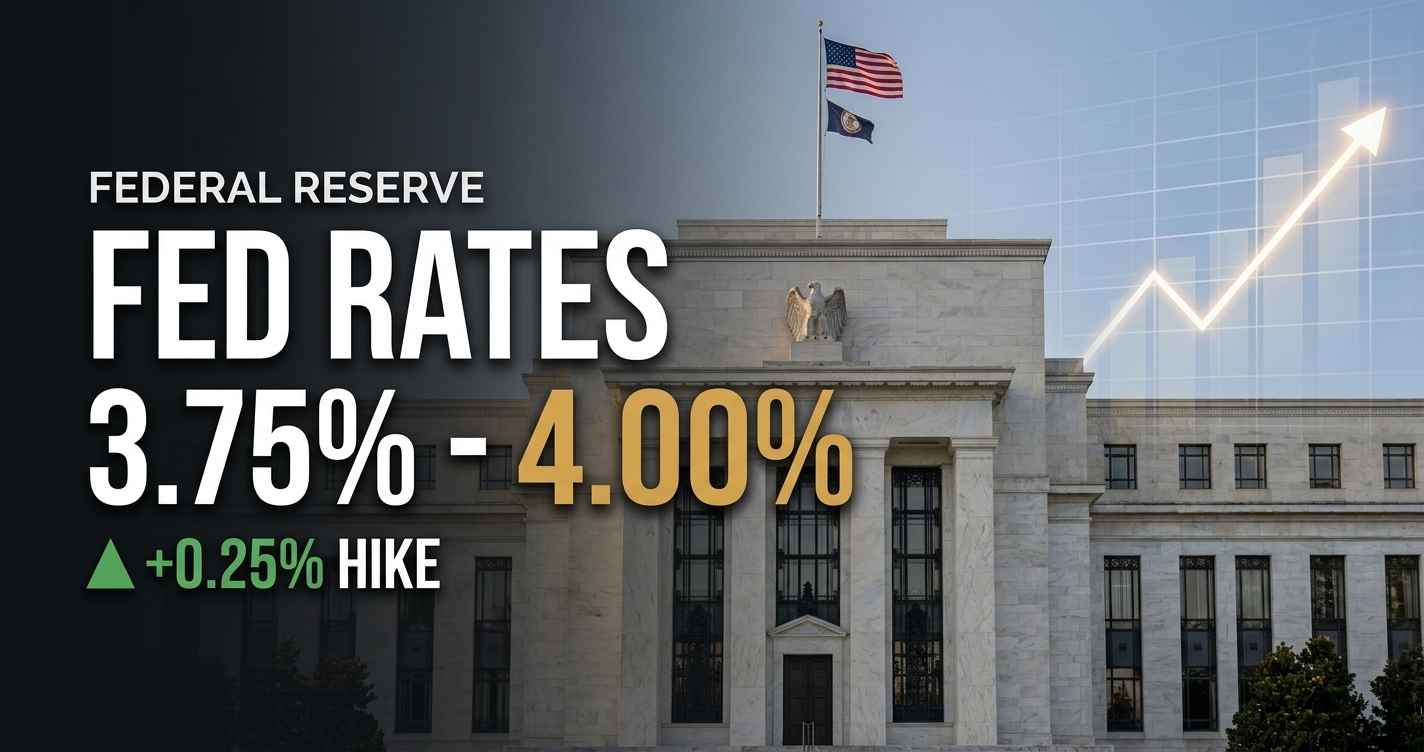
The Federal Reserve raised its benchmark interest rate by a quarter percentage point on Wednesday, September 16, 2026, pushing the federal funds target range to 3.75%–4%. It was the central bank’s first rate hike in more than three years, and it landed after months of speculation about whether Fed Chair Kevin Warsh would side with financial markets or with President Donald Trump, who has repeatedly pushed for lower borrowing costs.
If you’ve been searching “fed rates” today, here is the short version: the Federal Open Market Committee (FOMC) voted 12-0 to raise rates, cited persistently elevated inflation, and signaled that at least one more increase could be on the way before the end of the year. Below, we break down exactly what happened, why it happened, and — most importantly — what it means for your mortgage, credit cards, savings account, and the broader economy.
What the Fed Just Decided
At 2:00 p.m. Eastern Time on September 16, 2026, the FOMC announced it was raising the federal funds rate by 25 basis points, moving the target range from 3.5%–3.75% up to 3.75%–4%. The vote was unanimous — all twelve voting members, including Chair Warsh, backed the increase. That unanimity is notable: at the Fed’s July meeting, three regional bank presidents had dissented from a decision to hold rates steady, pushing instead for an immediate hike. By September, that hawkish view had become the consensus.
In its post-meeting statement, the committee said inflation “remains elevated” and that “today’s policy action will support a timelier return to the Committee’s 2 percent goal.” The FOMC also noted that economic activity is “expanding at a solid pace,” even as “uncertainty remains elevated owing, in part, to geopolitical developments.”
Why the Fed Raised Rates Now
Several forces pushed the Fed toward this decision:
- Persistent inflation. A string of stronger-than-expected inflation readings, including the August Consumer Price Index report, showed price pressures well above the Fed’s 2% target. Prices for goods alone jumped 1.1% in a single month, a sharp reversal from a 0.4% decline the month before.
- Energy prices. Oil prices have been elevated for months, driven in part by the ongoing Iran war and broader Middle East instability. Chair Warsh acknowledged the Fed “cannot affect any individual price, whether it be oil prices, whether it be food,” but said the rate hike was aimed at preventing those price increases from broadening into the rest of the economy.
- Tariffs. Lingering effects from tariff policy have also added to cost pressures across a range of goods, according to Fed officials.
- A stabilizing labor market. With hiring holding up and unemployment expectations actually revised down to 4.1% (a 0.2 percentage point improvement from June’s projection), the Fed had less reason to worry that a rate hike would tip the economy into a sharp slowdown.
The Dot Plot: What’s Next for Rates
Alongside the rate decision, the Fed released its quarterly Summary of Economic Projections (SEP), which includes the closely watched “dot plot” — a chart showing where each FOMC member expects rates to land. The September dot plot signaled that the committee expects to raise rates a second time before the end of 2026, potentially pushing the federal funds rate to around 4.1%.
That’s a meaningfully more hawkish path than what the Fed signaled back in June, when the dot plot implied just one quarter-point hike for the year. The shift reflects how much the inflation picture has changed over the summer.
Notably, Chair Warsh did not submit his own dot on the projection chart, as he did at the June meeting too. He has said he doesn’t want to be bound to what is “essentially an estimate,” preferring to let incoming data guide each decision rather than commit to a path in advance.
Who Is Kevin Warsh, and Why Does His Approach Matter?
Kevin Warsh became Federal Reserve Chair on May 22, 2026, appointed by President Trump with the express goal of steering the central bank toward lower interest rates. That makes Wednesday’s decision especially notable: barely four months into the job, the chair Trump handpicked to cut rates instead voted to raise them.
Warsh has repeatedly emphasized a “minimalist communication” style, reducing the Fed’s reliance on forward guidance and putting more weight on incoming economic data. At the Fed’s Jackson Hole symposium in late August, he signaled that stubborn inflation might require a hike, telling attendees that if prices didn’t start coming down, “the Federal Reserve would have to step in and act.” That speech raised market expectations for a September move — expectations he ultimately followed through on.
His approach has also put him at odds with the White House. President Trump has publicly pushed for the Fed to cut rates or hold them steady, and reports have surfaced of multiple phone calls between Trump and Warsh since he took the role. Despite that pressure, Wednesday’s unanimous vote suggests the committee — including its Trump-appointed chair — ultimately sided with the data over political preference.
How the September Rate Hike Affects You
When the Fed raises its benchmark rate, it doesn’t directly set the interest rate on your mortgage or credit card — but it influences the cost of borrowing throughout the economy. Here’s how different areas are likely to be affected.
Mortgage Rates
Mortgage rates don’t move in lockstep with the federal funds rate; they tend to track the 10-year Treasury yield more closely, and that yield often reacts to the Fed’s outlook well before (and sometimes more than) the rate decision itself. In the run-up to September’s meeting, the 10-year Treasury yield had already climbed toward 5% — a level not seen in roughly three years — pushing the average 30-year fixed mortgage rate to around 6.66%, according to Freddie Mac.
If the Fed follows through on the second hike suggested by its dot plot later this year, mortgage rates could face further upward pressure, particularly if long-term inflation expectations stay elevated. Homebuyers weighing whether to lock in a rate now versus waiting should keep an eye on upcoming inflation data and the Fed’s November and December meetings.
Credit Cards and Personal Loans
Most credit cards carry variable interest rates tied to the prime rate, which moves in tandem with the federal funds rate. A 25 basis point Fed hike typically translates into a similar increase in credit card APRs within one to two billing cycles. If you’re carrying a balance, this is a good moment to consider a balance transfer to a lower-rate card, or to prioritize paying down high-interest debt before further hikes materialize.
Auto Loans
Auto loan rates, especially for new financing, also tend to drift upward following a Fed rate hike, though the relationship is looser than with credit cards. Buyers financing a vehicle in the coming months may see slightly higher monthly payments compared to earlier in the year.
Savings Accounts and CDs
There’s a silver lining for savers. Online high-yield savings accounts and certificates of deposit (CDs) tend to respond to Fed hikes by offering better yields, since banks compete harder for deposits when their own borrowing costs rise. Shopping around for the best savings APY is worth doing after a hike like this one.
Business Borrowing
For small businesses and corporations, higher rates mean higher costs on lines of credit, new debt issuance, and variable-rate loans. Businesses that had been waiting for cheaper financing to fund expansion may need to revisit their timelines, or consider locking in fixed-rate financing before any additional hikes later this year.
Market Reaction
The rate decision was largely priced in by markets ahead of time — surveys had shown better than a 90% probability of a hike — which limited the scale of any immediate shock. Still, longer-term interest rates had already been climbing for weeks in anticipation. The 10-year Treasury yield pushed toward 4.68%, and the 30-year yield surged past 5.19%, its highest level in nearly two decades, as investors adjusted to a higher-for-longer rate environment.
Stock markets, which had spent the days before the meeting digesting the likelihood of a hike, focused most of their attention on Chair Warsh’s 2:30 p.m. press conference for clues about the pace of any further increases, rather than the decision itself.
A Quick Timeline: How We Got Here
- Late 2025: The Fed had been cutting rates, bringing the federal funds rate down to the 3.5%–3.75% range amid a cooling labor market.
- January 2026: The Fed held rates steady at 3.5%–3.75%, in line with expectations, after three consecutive cuts the year before.
- May 2026: Kevin Warsh is sworn in as Federal Reserve Chair, succeeding Jerome Powell (who remains on the Fed’s Board of Governors).
- July 29, 2026: The FOMC holds rates steady at 3.5%–3.75%, but three regional presidents — Beth Hammack (Cleveland), Neel Kashkari (Minneapolis), and Lorie Logan (Dallas) — dissent, pushing for an immediate hike. It was the first time since September 2016 that three FOMC members dissented with a unified hawkish stance.
- Late August 2026: At the Jackson Hole economic symposium, Warsh signals that persistent inflation may force the Fed’s hand on rates.
- September 15–16, 2026: The FOMC meets and votes 12-0 to raise rates to 3.75%–4%, its first hike since 2023.
What Happens at the Next Fed Meeting
The Fed’s rate decisions follow a set schedule of eight meetings per year, roughly every six weeks. Based on the current calendar, the next scheduled FOMC meeting will take place in late October or early November 2026, followed by a final meeting in December. Given the dot plot’s signal of one more hike before year-end, markets will be watching incoming inflation and labor data closely over the next several weeks for hints about which of those meetings might bring the next move.
Roughly three weeks after each meeting, the Fed also releases detailed minutes that offer a more granular look at the debate among policymakers — often providing more color than the brief post-meeting statement itself.
Understanding the Federal Funds Rate: A Quick Primer
For readers new to the topic, it helps to understand what “the Fed rate” actually is. The federal funds rate is the interest rate at which banks lend reserve balances to each other overnight, on an uncollateralized basis. It’s not a rate you or I ever pay directly — but it’s the foundation on which nearly every other interest rate in the U.S. economy is built.
The Federal Open Market Committee doesn’t set a single number; it sets a target range — currently 3.75% to 4% — and then uses tools like interest paid on reserve balances to keep the actual rate banks charge each other within that band. When people talk about “the Fed rate” or “fed rates” in everyday conversation, they usually mean this target range, or sometimes the effective federal funds rate, which is the actual weighted average rate at which these overnight loans occur.
Why does this one number matter so much? Because banks price nearly everything else off of it, directly or indirectly:
- The prime rate, which many credit cards and home equity lines of credit are pegged to, typically sits about three percentage points above the federal funds rate.
- Short-term Treasury yields move closely with the federal funds rate, since they compete for the same pool of short-term capital.
- Longer-term rates, including the 10-year Treasury yield that heavily influences mortgage pricing, are driven more by expectations of where the Fed rate is headed over the next several years, plus inflation expectations and investor demand for safety.
- Bank deposit rates, including savings accounts and CDs, tend to rise (with a lag) as banks compete for funding when their own borrowing costs increase.
This is also why market participants obsess over the dot plot and the Fed’s forward-looking language almost as much as the rate decision itself: it’s the expected future path of rates, not just today’s number, that ultimately gets priced into mortgages, business loans, and stock valuations.
A Closer Look at the Inflation Data Behind the Decision
The Fed’s dual mandate is to pursue both stable prices (generally interpreted as roughly 2% annual inflation) and maximum sustainable employment. For most of the run-up to the September meeting, the inflation side of that mandate was flashing red.
The August Consumer Price Index report, released in the weeks before the meeting, showed price growth running well above the Fed’s target. Goods prices alone jumped 1.1% in a single month — a sharp reversal from a 0.4% decline in goods prices the month before. That kind of swing suggested to many economists that cost pressures from tariffs and energy prices were feeding through into a broader range of consumer products, not just the categories most directly exposed to import costs or fuel.
Energy has been a particularly stubborn source of inflation throughout 2026. Oil prices have stayed elevated for months, a dynamic Fed officials have linked in part to the ongoing conflict involving Iran and broader instability in the Middle East. Because energy costs ripple through transportation, manufacturing, and even food production, sustained high oil prices tend to show up in inflation readings well beyond the price at the pump.
Chair Warsh was candid about the limits of what the Fed can actually do about this. “We cannot affect any individual price, whether it be oil prices, whether it be food,” he told reporters after the meeting. Instead, he framed the rate hike as an effort to prevent those specific price increases from “broadening out” into a more generalized, self-reinforcing inflation cycle — the scenario central bankers fear most, since it’s much harder to unwind once expectations shift.
The Labor Market Side of the Equation
Inflation isn’t the only variable the Fed weighs. If the labor market were showing signs of serious strain, policymakers would likely have been far more reluctant to raise rates, since higher borrowing costs tend to slow hiring and business investment over time.
Instead, the picture heading into September was one of relative stability. The Fed’s updated projections actually lowered its unemployment rate forecast to 4.1%, an improvement of 0.2 percentage points from the June projection. That gave the committee more confidence that the economy could absorb a rate increase without tipping into a sharp downturn — though officials acknowledged that a labor market that’s “too strong” alongside high inflation can itself become a policy dilemma, since it gives workers more bargaining power to demand wage increases that keep inflation elevated.
The FOMC’s own statement struck a similarly balanced tone, describing economic activity as “expanding at a solid pace” while flagging that “uncertainty remains elevated owing, in part, to geopolitical developments” — a nod to the energy and trade dynamics discussed above.
The Political Backdrop
It’s difficult to separate this rate decision from the political drama surrounding it. President Trump appointed Kevin Warsh in May 2026 specifically with the goal of steering the Fed toward lower interest rates, and the administration has continued to publicly push for cuts or, at minimum, a hold. Reports have also surfaced that Trump and Warsh have spoken by phone multiple times since Warsh took over — an unusual level of direct contact given the Fed’s traditional independence from day-to-day political influence.
The backdrop has also included a renewed administration effort to remove Fed Governor Lisa Cook from her seat, adding to broader questions about the central bank’s independence during Warsh’s tenure.
Against that backdrop, Wednesday’s unanimous 12-0 vote to raise rates is notable. Economist Adam Posen, president of the Peterson Institute for International Economics, had argued in the lead-up to the meeting that Warsh had effectively boxed himself in with his hawkish Jackson Hole remarks: “You are basically setting yourself up so that if you don’t hike in September, people may ask what’s going on.” In the end, Warsh and the rest of the committee followed through, siding with market expectations and their own inflation data over the administration’s preference for lower rates.
How This Rate Hike Compares Historically
To put the September 2026 move in context, it helps to look at where the federal funds rate has been over the past several years:
- 2022–2023: The Fed, then under Chair Jerome Powell, ran one of the most aggressive rate-hiking campaigns in decades to combat post-pandemic inflation, eventually pushing the federal funds rate to its highest level in over 20 years.
- 2023–2025: As inflation cooled, the Fed pivoted to cuts, gradually lowering the target range, including three consecutive cuts that brought the rate down to the 3.5%–3.75% range by late 2025.
- January 2026: The Fed held rates steady at 3.5%–3.75%.
- July 2026: The Fed held again, but with an unusually hawkish dissent from three regional bank presidents pushing for an immediate hike — the first three-way hawkish dissent since September 2016.
- September 2026: The Fed hikes for the first time since 2023, moving to 3.75%–4%, with its dot plot signaling one more possible increase this year.
Seen this way, the September decision doesn’t come out of nowhere — it’s the culmination of a gradual hawkish shift that had been building since at least the July meeting’s dissents.
Sector-by-Sector: Where Higher Rates Bite Hardest
Beyond the consumer-facing effects already covered above, a Fed rate hike ripples through specific sectors of the economy in fairly predictable ways.
Housing and Real Estate
Beyond mortgage rates themselves, higher borrowing costs tend to cool overall housing demand, as fewer buyers qualify for the loan size they want and existing homeowners become more reluctant to sell (and give up a lower rate on their current mortgage) to buy again at a higher one — a dynamic sometimes called “rate lock-in.” Homebuilders with variable-rate construction loans also face higher financing costs, which can slow new housing supply.
Technology and Growth Stocks
Growth-oriented companies, particularly in technology, tend to be more sensitive to interest rate changes than more established, cash-generating businesses. That’s because a large share of their expected value comes from profits far in the future, and higher rates reduce the present-day value of those future earnings. Expect continued volatility in growth stock valuations as markets digest the prospect of another hike later this year.
Banks and Financial Services
Higher rates can be a mixed bag for banks: they typically widen the margin between what banks pay on deposits and what they earn on loans (at least initially), but they can also slow loan demand and increase the risk of defaults on existing variable-rate debt.
International Markets and the Dollar
Higher U.S. rates tend to make dollar-denominated assets more attractive to global investors, which can strengthen the dollar relative to other currencies. A stronger dollar makes U.S. exports more expensive for foreign buyers and can pressure emerging-market economies that hold significant dollar-denominated debt.
What Financial Advisors Are Telling Clients
In the wake of decisions like this one, financial advisors generally recommend a few practical steps rather than dramatic portfolio changes:
- Revisit variable-rate debt. If you’re carrying a home equity line of credit, adjustable-rate mortgage, or credit card balance tied to the prime rate, this is a good moment to model out how another potential hike later this year would affect your payments.
- Shop savings and CD rates. Online banks and credit unions often adjust deposit rates faster than large national banks. A rate hike is a good prompt to compare current offers rather than assuming your existing savings account is still competitive.
- Avoid overreacting in equity portfolios. Because this hike was widely anticipated, much of its effect was likely already reflected in asset prices before the announcement. Advisors generally caution against making large, reactive trades based on a single Fed decision.
- Watch the next two meetings closely. With the dot plot pointing to a possible additional hike before year-end, the Fed’s final two scheduled meetings of 2026 are likely to carry outsized market attention.
As always, this article is for general information, not personalized financial advice — a conversation with a licensed financial advisor is the right next step for decisions specific to your situation.
Frequently Asked Questions About Fed Rates
What is the current Fed interest rate?
As of September 16, 2026, the federal funds target range is 3.75%–4%, following a 25 basis point increase announced by the FOMC.
Why did the Fed raise interest rates in September 2026?
The Fed cited persistently elevated inflation, driven in part by high energy prices linked to the Iran war and lingering tariff effects, along with a labor market that has remained stable enough to absorb higher borrowing costs.
Will the Fed raise rates again in 2026?
The Fed’s September dot plot suggests one more quarter-point hike could come before the end of 2026, which would bring the federal funds rate to around 4.1%. This is a projection, not a guarantee, and will depend on incoming inflation and employment data.
How does a Fed rate hike affect mortgage rates?
The Fed’s rate doesn’t set mortgage rates directly, but it influences the 10-year Treasury yield, which mortgage rates closely track. Following weeks of anticipation ahead of the September hike, the average 30-year fixed mortgage rate stood at around 6.66%.
Is now a good time to lock in a mortgage rate?
This isn’t individual financial advice, but with the Fed signaling further hikes are possible this year, many buyers are choosing to lock in rates sooner rather than wait for a potentially higher-rate environment. Speak with a mortgage advisor about your specific situation.
Who is the current Federal Reserve Chair?
Kevin Warsh has served as Federal Reserve Chair since May 22, 2026, appointed by President Trump. His predecessor, Jerome Powell, remains on the Fed’s Board of Governors.
What is the dot plot?
The dot plot is part of the Fed’s quarterly Summary of Economic Projections. Each dot represents one FOMC member’s anonymous projection for where the federal funds rate should be at the end of a given year. It’s released four times a year — after the March, June, September, and December meetings — and gives markets a rough sense of the committee’s collective thinking, even though it isn’t a formal commitment.
How often does the Fed meet to decide on interest rates?
The FOMC holds eight regularly scheduled meetings per year, roughly every six weeks, and can also convene emergency meetings if conditions require it. Detailed minutes from each meeting are released about three weeks later.
Does a Fed rate hike affect the stock market?
Yes, though often in ways that are already partly priced in before the announcement. Growth and technology stocks tend to be more sensitive to rate changes than value-oriented or dividend-paying stocks, since higher rates reduce the present value of future earnings.
Key Terms Glossary
- Federal funds rate: The target interest rate range at which banks lend reserves to one another overnight.
- FOMC (Federal Open Market Committee): The Fed’s twelve-member policy-setting body that meets to decide on interest rates.
- Basis point: One-hundredth of one percentage point; 25 basis points equals 0.25%.
- Dot plot: A chart showing each FOMC member’s individual projection for future rate levels.
- Summary of Economic Projections (SEP): The Fed’s quarterly forecast for growth, unemployment, and inflation, released alongside the dot plot.
- Prime rate: The benchmark rate banks use for many consumer loans, typically set about three percentage points above the federal funds rate.
- Hawkish / dovish: Shorthand for leaning toward higher rates to fight inflation (hawkish) versus lower rates to support growth (dovish).
The Bottom Line
Wednesday’s decision marks a turning point in the Fed’s rate cycle — the first hike in more than three years, arriving after a stretch of cuts and holds. For consumers, the practical impact will show up gradually: slightly higher costs on new credit card balances, auto loans, and mortgages, offset somewhat by better returns on savings accounts and CDs. For the broader economy, the move signals that the Fed, under a chair who was appointed specifically to bring rates down, is prioritizing its inflation mandate over near-term political pressure.
With one more possible hike still on the table for 2026, according to the Fed’s own projections, this is a story worth continuing to watch — particularly heading into the Fed’s final two meetings of the year.
Sources: Federal Reserve press releases and Summary of Economic Projections, FOMC statements, and reporting from CNBC, CNN, PBS News, and Kiplinger.