Use this Plan 5 student loan repayment calculator guide to work out exactly what you will repay in 2026/27, the first tax year that Plan 5 repayments actually begin. Plan 5 applies to English students who started an undergraduate course, or an advanced learner loan course, on or after 1 August 2023. If your income is above £25,000 a year, you repay 9% of everything above that threshold.
Plan 5 is brand new to payroll in April 2026, so many borrowers and even some employers are unfamiliar with how it works, and how it differs from the older Plan 1, Plan 2 and Plan 4 loans. This guide covers the exact threshold, the repayment formula, worked examples at common salaries, how Plan 5 compares with other plans, interest rates, and what happens if you also have a postgraduate loan.
Quick answer: Plan 5 student loan repayments, 2026/27
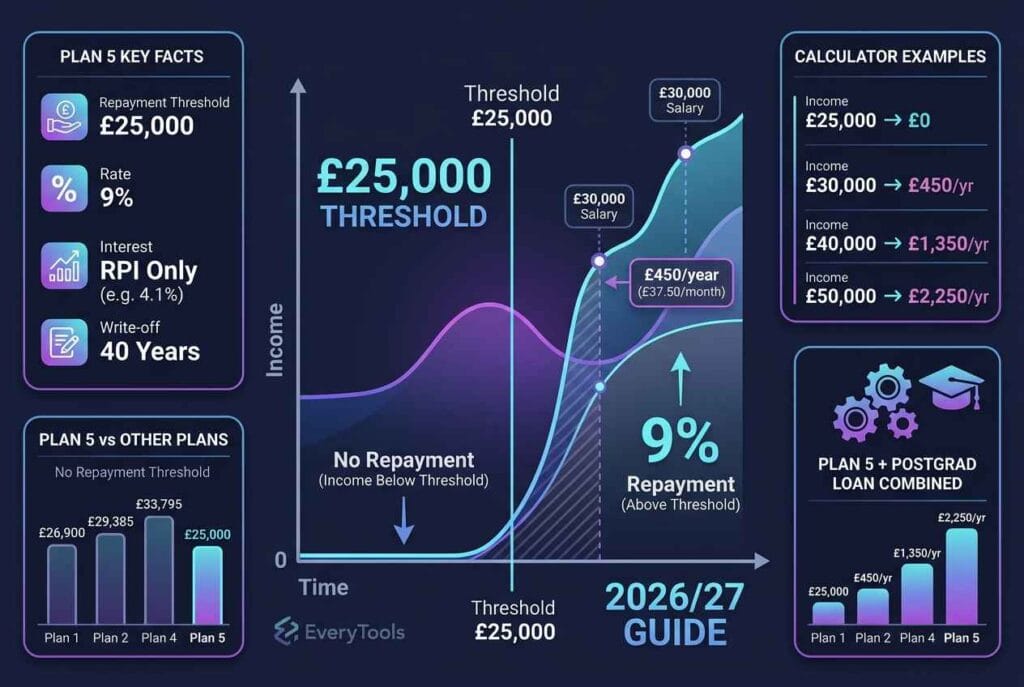
- Repayment threshold: £25,000 a year, £2,083 a month, or £480 a week.
- Repayment rate: 9% of income above the threshold.
- Example: on a £30,000 salary, you repay 9% of £5,000, which is £450 a year, or £37.50 a month.
- Interest rate: RPI only, currently 4.1% (September 2026 to August 2027), with no extra percentage added on top.
- Write-off: any remaining balance is cancelled after 40 years.
Want your exact take-home pay including your student loan? Use our free hourly to salary and take-home pay calculator.
Last updated: . Rates: UK 2026/27 tax year (6 April 2026 to 5 April 2027). Written by the Every Tools editorial team.
In this guide
- What is Plan 5, and who is on it?
- Plan 5 repayment threshold for 2026/27
- How to calculate your Plan 5 repayment
- Plan 5 repayments by salary
- Weekly and monthly repayment thresholds
- Plan 5 vs Plan 1, Plan 2 and Plan 4
- Plan 5 interest rates
- Plan 5 and a postgraduate loan together
- How long until a Plan 5 loan is written off?
- Voluntary and early repayments
- Common mistakes about Plan 5 repayments
- How we calculated these figures
- Frequently asked questions
- Summary
- Sources
What is Plan 5, and who is on it?
Plan 5 is the newest UK student loan repayment plan, introduced for English undergraduate students, and some advanced learner loan borrowers, who started their course on or after 1 August 2023. If you started your course before that date, you are very likely on Plan 2 instead, not Plan 5. Plan 5 replaced Plan 2 for new English borrowers going forward, following changes to student finance announced by the Department for Education.
Because Plan 5 courses only began in the 2023/24 academic year, and most courses run three or four years, most Plan 5 borrowers only started earning after graduation from around 2026 or 2027 onward. As a result, April 2026 marks the very first tax year in which Plan 5 repayments are actually collected through payroll, according to GOV.UK’s student loan repayment guidance.
Plan 5 repayment threshold for 2026/27
For the 2026/27 tax year, the Plan 5 repayment threshold is £25,000 a year. This is the lowest threshold of any current UK student loan plan, which means Plan 5 borrowers start repaying at a lower income than Plan 1, Plan 2 or Plan 4 borrowers. From April 2027 onward, the threshold is set to rise in line with the Retail Price Index (RPI) each year, rather than staying frozen, according to guidance confirmed by HMRC and reported by UK payroll industry sources.
How to calculate your Plan 5 repayment
The Plan 5 repayment formula is straightforward:
Yearly repayment = (yearly income − £25,000) × 9%
You only pay 9% of the amount above the threshold, never 9% of your whole salary. For example, if you earn £35,000 a year, you repay 9% of the £10,000 above the £25,000 threshold, which is £900 a year, or £75 a month. If your income is at or below £25,000, you make no Plan 5 repayments at all that year.
Plan 5 repayments by salary
The table below shows Plan 5 yearly and monthly repayments across a range of common salaries.
| Yearly salary | Plan 5 repayment/year | Plan 5 repayment/month |
|---|---|---|
| £22,000.00 | £0.00 | £0.00 |
| £25,000.00 | £0.00 | £0.00 |
| £27,000.00 | £180.00 | £15.00 |
| £28,000.00 | £270.00 | £22.50 |
| £30,000.00 | £450.00 | £37.50 |
| £32,000.00 | £630.00 | £52.50 |
| £35,000.00 | £900.00 | £75.00 |
| £40,000.00 | £1,350.00 | £112.50 |
| £45,000.00 | £1,800.00 | £150.00 |
| £50,000.00 | £2,250.00 | £187.50 |
| £60,000.00 | £3,150.00 | £262.50 |
Notice that for every extra £1,000 you earn above the £25,000 threshold, your Plan 5 repayment rises by £90 a year, or £7.50 a month. This is a simple, predictable relationship, unlike income tax, which uses several different bands.
Weekly and monthly repayment thresholds
If you are paid weekly or monthly, your employer applies a pro-rated version of the £25,000 annual threshold to each pay period through PAYE, rather than waiting until the end of the tax year.
| Pay period | Threshold | 9% applies above |
|---|---|---|
| Yearly | £25,000 | |
| Monthly | £2,083 | pay above £2,083 that month |
| Weekly | £480 | pay above £480 that week |
This means your Plan 5 repayment can vary from month to month if your income varies, such as with irregular overtime or bonuses, since each pay period is assessed independently against its own threshold, then reconciled against your annual income if needed.
Plan 5 vs Plan 1, Plan 2 and Plan 4
Understanding which plan you are on matters enormously, because the thresholds differ significantly, and paying the wrong plan’s rate can mean over- or under-repaying. The table below compares all the main undergraduate plans for the 2026/27 tax year.
| Plan | Who it applies to | Threshold | Rate | Write-off term |
|---|---|---|---|---|
| Plan 1 | Started course before Sept 2012 (England/Wales), or NI/Scotland pre-Plan 4 rules | £26,900 | 9% | 25 years |
| Plan 2 | English/Welsh students, Sept 2012 – July 2023 course start | £29,385 | 9% | 30 years |
| Plan 4 | Scottish students | £33,795 | 9% | 30 years |
| Plan 5 | English students, course started 1 Aug 2023 onward | £25,000 | 9% | 40 years |
Plan 5’s lower threshold means Plan 5 borrowers start repaying sooner than borrowers on other plans, even at identical salaries. For example, someone earning £27,000 a year would repay nothing on Plan 2 (since £27,000 is below the £29,385 Plan 2 threshold), but would repay 9% of £2,000 on Plan 5, which is £180 a year.
If you are unsure which plan applies to you, check your account on the student loan online repayment service, or check when you started your course: Plan 5 only applies if you started on or after 1 August 2023 in England.
Plan 5 interest rates
Plan 5 uses a simpler interest structure than Plan 2. While studying and after graduation, Plan 5 loans accrue interest at the Retail Price Index (RPI) rate only, with no extra percentage added on top, regardless of income. For September 2026 to August 2027, the applicable RPI rate is 4.1%, according to Student Loans Company figures reported in UK press coverage of the 2026/27 announcement. This differs from Plan 2, where interest can rise as high as RPI plus 3% for higher earners, though a temporary 6% cap currently applies to Plan 2 for the same period. Because Plan 5 never adds an income-linked extra percentage, its interest rate is more predictable than Plan 2’s.
Plan 5 and a postgraduate loan together
If you have both a Plan 5 undergraduate loan and a postgraduate master’s or doctoral loan, you may repay both at the same time, since they use separate thresholds and rates. The postgraduate threshold is £21,000 a year, with a 6% repayment rate, on top of the Plan 5 threshold and 9% rate.
| Yearly salary | Postgraduate (6% above £21,000) | Plan 5 (9% above £25,000) | Combined yearly repayment |
|---|---|---|---|
| £22,000.00 | £60.00 | £0.00 | £60.00 |
| £23,000.00 | £120.00 | £0.00 | £120.00 |
| £25,000.00 | £240.00 | £0.00 | £240.00 |
| £27,000.00 | £360.00 | £180.00 | £540.00 |
| £30,000.00 | £540.00 | £450.00 | £990.00 |
| £35,000.00 | £840.00 | £900.00 | £1,740.00 |
Because the postgraduate threshold is lower than the Plan 5 threshold, if your income is between £21,000 and £25,000, you may make postgraduate repayments while making no Plan 5 repayments yet. Once your income passes £25,000, both repayments apply together, for a combined 15% of income above £25,000, plus 6% of income between £21,000 and £25,000.
How long until a Plan 5 loan is written off?
Plan 5 loans are written off 40 years after the April you were first due to repay, regardless of how much of the loan remains outstanding at that point. This is considerably longer than Plan 1’s 25-year term or Plan 2’s 30-year term, reflecting Plan 5’s lower monthly repayments and lower interest structure. Because of the long term and RPI-only interest, many Plan 5 borrowers, particularly those with lower lifetime earnings, are expected to have some or all of their loan written off rather than fully repaid, similar to the pattern already seen with Plan 2 borrowers.
Voluntary and early repayments
You can make additional voluntary repayments to the Student Loans Company (SLC) at any time, on top of the automatic deductions taken through your payroll. However, because student loan interest rates are relatively low and any remaining balance is eventually written off, voluntary overpayments are not automatically the best financial decision for every borrower; the right choice depends on your expected lifetime income, other debts, and personal circumstances, so it is worth considering carefully or seeking independent financial guidance before making large voluntary payments.
Plan 5 repayments if you are self-employed
If you are self-employed, Plan 5 repayments are not deducted automatically through payroll the way they are for employees. Instead, HMRC calculates your student loan repayment as part of your annual Self Assessment tax return, based on your total self-employed income for the year. The same £25,000 threshold and 9% rate apply, but the repayment is due alongside your Self Assessment tax bill, typically by 31 January following the end of the tax year, rather than being spread across each pay period as it would be for an employee. If you have both employed and self-employed income, HMRC combines both sources when working out your total Plan 5 liability for the year, which can sometimes mean a larger repayment is due through Self Assessment even if some was already collected through PAYE on your employed income.
Self-employed borrowers should budget for this repayment throughout the year, since it is easy to forget when income arrives without automatic deductions. Setting aside roughly 9% of any income above the monthly or weekly equivalent of the £25,000 threshold, in the same way many self-employed people set aside money for income tax, can help avoid an unexpectedly large bill when the Self Assessment return is due.
Plan 5 repayments if you move abroad
Moving abroad does not cancel your obligation to repay a Plan 5 loan. If you live outside the UK, you must tell the Student Loans Company, who will then assess your repayments based on an overseas threshold specific to the country you live in, rather than the UK’s £25,000 figure, since living costs and income levels vary significantly by country. Repayments while living abroad are usually collected directly by the Student Loans Company rather than through a UK employer’s payroll system, so borrowers moving overseas should contact the Student Loans Company promptly to set up the correct repayment arrangement and avoid falling into arrears.
Whichever way you repay, check your annual statement from the Student Loans Company each year to confirm your balance, interest charged and repayments received match what you expect from your payslips or Self Assessment return, and query any discrepancy promptly rather than waiting until the following tax year.
Common mistakes about Plan 5 repayments
- Assuming everyone on Plan 5 immediately started repaying in April 2026. You only repay if your income is above £25,000 that year; below that, repayments simply do not start.
- Confusing Plan 5 with Plan 2. Only English students who started their course on or after 1 August 2023 are on Plan 5; earlier starters are usually on Plan 2, with a higher £29,385 threshold.
- Forgetting Plan 5 and postgraduate loans can apply together, using two separate thresholds and rates, not one combined calculation.
- Ignoring the effect of a bonus or overtime. A one-off high-income pay period can trigger a Plan 5 deduction for that period, even if your average annual salary is below £25,000.
- Assuming a higher salary always means paying off the loan faster. Because of the long 40-year term and RPI-only interest, many borrowers will never fully repay before write-off, regardless of how quickly they pay each month.
- Not telling a new employer your correct plan type. If your employer is not told which plan you are on, they may apply the wrong threshold, so always confirm your plan type when starting a new job.
How we calculated these figures
Every table in this guide uses the confirmed 2026/27 HMRC thresholds and the standard 9% Plan 5 repayment formula. We made the following assumptions:
- The tax year is 2026/27, running from 6 April 2026 to 5 April 2027.
- The Plan 5 threshold is £25,000 a year, £2,083 a month and £480 a week, as confirmed by HMRC for 2026/27.
- The repayment rate is a flat 9% of income above the threshold, with no upper limit.
- Figures assume income from employment only, calculated on gross pay before tax and National Insurance.
- The postgraduate loan combination example assumes both loans are active simultaneously.
- All results are rounded to the nearest penny.
Student loan thresholds, interest rates and rules can change from year to year, so always confirm current figures on GOV.UK or your Student Loans Company account before making financial decisions based on this guide.
Frequently asked questions about Plan 5 student loan repayments
What is the Plan 5 student loan repayment threshold for 2026/27?
The Plan 5 threshold for the 2026/27 tax year is £25,000 a year, £2,083 a month or £480 a week. You only repay on income above this amount.
How much do you repay on a Plan 5 student loan?
You repay 9% of your income above the £25,000 threshold. For example, a £30,000 salary means repaying 9% of £5,000, which is £450 a year.
Who is on Plan 5?
Plan 5 applies to English undergraduate and advanced learner loan students who started their course on or after 1 August 2023. Earlier starters are typically on Plan 2 instead.
When did Plan 5 repayments start?
Plan 5 repayments began in April 2026, as part of the 2026/27 tax year, the first year repayments were actually collected since the plan was introduced for courses starting in August 2023.
How does Plan 5 compare with Plan 2?
Plan 5 has a lower threshold (£25,000 versus £29,385 for Plan 2 in 2026/27), a longer 40-year write-off term compared with Plan 2’s 30 years, and RPI-only interest with no extra income-linked percentage, unlike Plan 2.
What interest rate applies to Plan 5 loans?
Plan 5 interest is set at the Retail Price Index (RPI) rate only, currently 4.1% for September 2026 to August 2027, with no additional percentage added regardless of income.
When is a Plan 5 loan written off?
Any remaining Plan 5 balance is written off 40 years after the April you were first due to start repaying, regardless of how much is still outstanding at that point.
Can you have a Plan 5 loan and a postgraduate loan at the same time?
Yes. They use separate thresholds and rates: 9% above £25,000 for Plan 5, and 6% above £21,000 for the postgraduate loan, and both can apply together once your income passes both thresholds.
Does a bonus or overtime affect Plan 5 repayments?
Yes, potentially. A high-income pay period can trigger a Plan 5 deduction for that specific period through PAYE, even if your average yearly salary is close to or below the £25,000 threshold.
Is it worth making voluntary extra repayments on a Plan 5 loan?
Not automatically. Because Plan 5 has relatively low interest and a long 40-year write-off term, many borrowers will not fully repay before write-off, so voluntary overpayments do not benefit every borrower. Consider your expected lifetime income and other financial priorities, or seek independent financial guidance.
Summary: Plan 5 student loan repayment calculator
Plan 5 applies to English students who started their course on or after 1 August 2023. For the 2026/27 tax year, the first year Plan 5 repayments actually begin, the threshold is £25,000 a year, and the repayment rate is 9% of income above that. A £30,000 salary means £450 a year in repayments; a £40,000 salary means £1,350 a year. Any remaining loan balance is written off after 40 years, and Plan 5’s RPI-only interest rate makes it more predictable than Plan 2.
Check your own take-home pay including student loan deductions with our free hourly to salary and take-home pay calculator.
Related guides on Every Tools:
- Hourly to salary, overtime and take-home pay calculator
- £12.71 an hour is how much a year after tax
- National Living Wage 2026 take-home pay
- Student Finance England contact options
- Hours calculator: a complete guide to accurate time tracking
Sources and further reading
- GOV.UK: Repaying your student loan, what you pay
- GOV.UK: Repaying your student loan
- GOV.UK: Manage your student loan balance
- GOV.UK: Student finance forms and contact
- GOV.UK: Payroll guidance for employers
This article is for general information only. It is not financial, tax or legal advice, and Every Tools is not affiliated with the Student Loans Company, Student Finance England or the UK government.