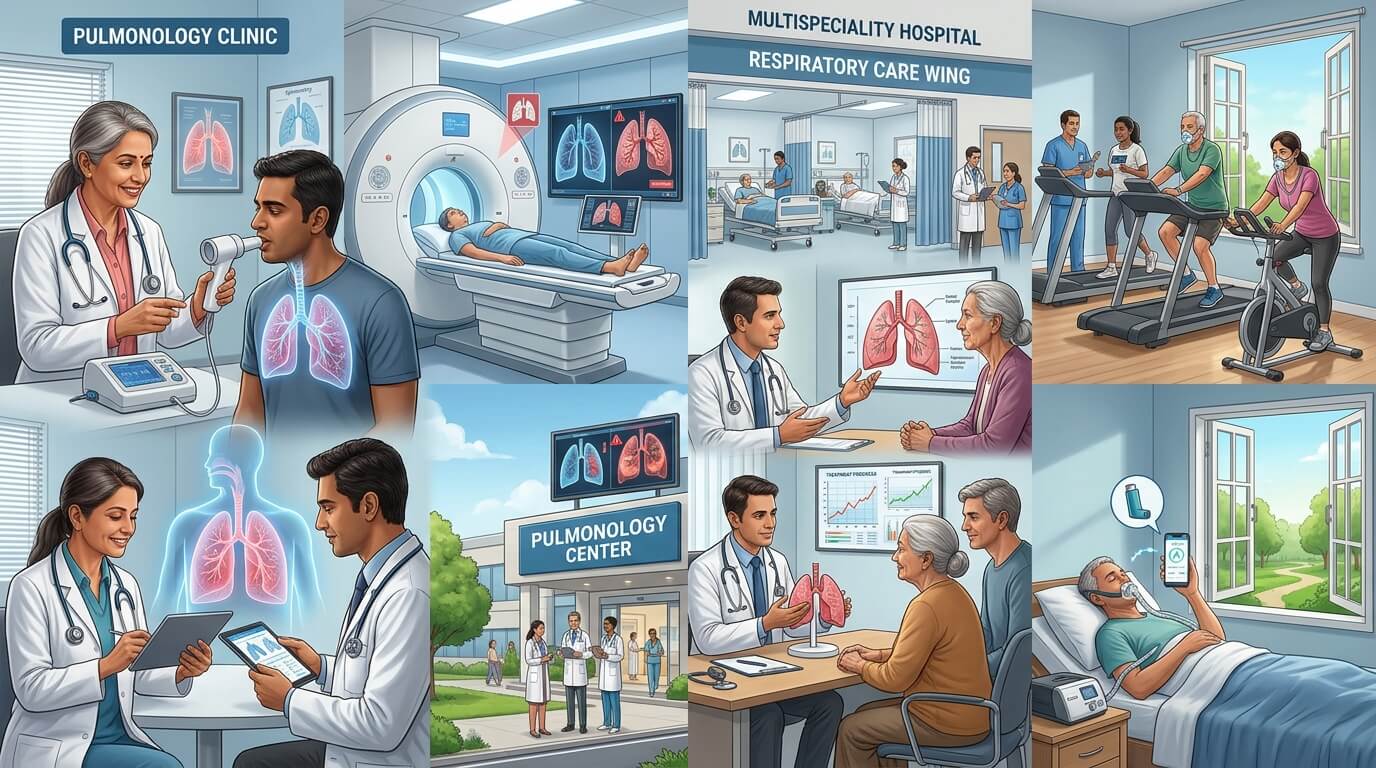
Lung health depends on clear airways, healthy air sacs, and good breathing mechanics. Common conditions include asthma, COPD, pneumonia, pulmonary fibrosis, tuberculosis, and lung cancer. Diagnosis often starts with a history, spirometry, and imaging, and treatment ranges from inhalers and pulmonary rehabilitation to vaccines, oxygen, and surgery. Not smoking is the most important way to protect your lungs.
Key takeaways
- Persistent cough, breathlessness, wheezing, or repeated chest infections should be checked by a doctor.
- Spirometry and imaging help diagnose asthma, COPD, fibrosis, and other lung conditions.
- Inhaler technique, pulmonary rehabilitation, vaccinations, and an action plan improve control of chronic lung disease.
- Do not smoke, reduce exposure to fumes and pollution, and stay active to protect your lungs.
In this guide
- How the Lungs Work
- Common Lung Conditions
- Warning Signs: When to Get Help
- How Lung Conditions Are Diagnosed
- Treatment Options
- Why a Specialist Can Help
- How to Protect Your Lung Health
- Living Well With a Long-Term Lung Condition
- Questions to Ask Your Doctor
- Finding a Specialist
- Frequently Asked Questions
Last updated: October 2026
We breathe about 20,000 times a day without thinking about it. Because the lungs work quietly, problems often go unnoticed until symptoms such as breathlessness or a long-lasting cough appear. This guide explains how healthy lungs work, the most common lung conditions, how they are diagnosed and treated, what you can do to protect your lungs, and when to see a doctor or a lung specialist (pulmonologist). It is general information, not medical advice.
How the Lungs Work
Air travels through the nose or mouth, down the windpipe (trachea), and into branching tubes called bronchi and bronchioles, ending in millions of tiny air sacs called alveoli. In the alveoli, oxygen passes into the blood, and carbon dioxide passes out to be breathed away. Muscles, especially the diaphragm, help move air in and out. Disease can affect the airways, the air sacs, the lung tissue, the blood vessels, or the lining around the lungs.
Common Lung Conditions
| Condition | What it is | Typical symptoms |
|---|---|---|
| Asthma | Long-term inflammation and narrowing of the airways, often triggered by allergens, exercise, or infections | Wheezing, cough (often at night), chest tightness, breathlessness |
| COPD (chronic obstructive pulmonary disease) | Progressive airflow limitation, usually from smoking or long-term exposure to irritants. Includes chronic bronchitis and emphysema | Long-term cough with phlegm, breathlessness, frequent chest infections |
| Pneumonia | Infection of the air sacs | Fever, cough with phlegm, chest pain, breathlessness |
| Pulmonary fibrosis | Scarring of lung tissue that makes the lungs stiff | Dry cough, breathlessness that slowly worsens, tiredness |
| Tuberculosis (TB) | A bacterial infection that mainly affects the lungs | Cough lasting weeks, weight loss, night sweats, fever |
| Lung cancer | Abnormal growth of cells in the lungs | Persistent cough, coughing up blood, weight loss, chest pain |
| Pulmonary embolism | A blood clot blocking a lung artery | Sudden breathlessness, chest pain, and sometimes coughing blood. An emergency |
Reliable patient information is available from the NHS, Asthma + Lung UK, the American Lung Association, and the CDC.
Warning Signs: When to Get Help
Call emergency services or go to hospital immediately if you have:
- Severe or sudden breathlessness, or you cannot speak in full sentences
- Chest pain or pressure, particularly with breathlessness
- Blue or grey lips or face
- Coughing up significant blood
- Confusion or drowsiness with breathing difficulty
See a doctor soon if you have a cough lasting more than three weeks, new or worsening breathlessness, wheezing, repeated chest infections, unexplained weight loss, or coughing up blood.
How Lung Conditions Are Diagnosed
| Test | What it does |
|---|---|
| Medical history and examination | Reviews symptoms, smoking, work exposures, allergies, and family history |
| Spirometry | Measures how much air you can breathe out and how fast, and is key to diagnosing asthma and COPD |
| Peak flow monitoring | Tracks how well air moves out of your lungs over time |
| Pulse oximetry and blood gases | Measure oxygen levels in the blood |
| Chest X-ray and CT scan | Show the structure of the lungs and detect infections, scarring, or tumours |
| Sputum and blood tests | Look for infection, inflammation, or allergies |
| Bronchoscopy and biopsy | Allow a doctor to see inside the airways and take samples |
Treatment Options
- Inhalers: reliever inhalers open the airways quickly, while preventer inhalers reduce inflammation. Correct technique matters, so ask a nurse or pharmacist to check how you use yours. International guidance such as the Global Initiative for Asthma and GOLD for COPD sets out evidence-based approaches.
- Medicines for specific diseases: antibiotics for bacterial infection, antifibrotic medicines for some types of pulmonary fibrosis, and anti-TB regimens that must be completed.
- Pulmonary rehabilitation: supervised exercise and education that improve breathlessness and quality of life in people with chronic lung disease.
- Oxygen therapy: for people with low blood oxygen levels.
- Vaccinations: annual flu vaccines, pneumococcal vaccines, and COVID-19 vaccines are commonly recommended for people with lung disease. Ask your doctor what applies to you.
- Surgery and other procedures: used in selected cases, such as lung cancer, severe emphysema, or transplantation.
Why a Specialist Can Help
A pulmonologist is a doctor who specialises in lung diseases. Your family doctor may refer you if your symptoms are unexplained, your condition is hard to control, you need specialised tests such as bronchoscopy, or you may have a rare or complex lung disease. Good lung care often involves a team, including nurses, physiotherapists, and, in some cases, hospital services for scans, oxygen assessment, and emergency care.
How to Protect Your Lung Health
- Do not smoke or vape, and avoid second-hand smoke. If you smoke, stopping is the single best step for your lungs, and your doctor or local service can help.
- Reduce exposure to dust, fumes, and pollution. Use proper protective equipment at work, and check local air quality reports.
- Improve indoor air. Ventilate your home, avoid damp and mould, and do not burn solid fuels without good ventilation.
- Stay active. Regular exercise strengthens breathing muscles and improves fitness.
- Get recommended vaccinations against flu, pneumonia, and COVID-19.
- Wash your hands and avoid close contact with people who are sick.
- Eat well and keep a healthy weight. Our guide to ancient grains offers whole-food ideas.
- Sleep well. See our tips on better sleep and bedding.
Cold weather can make breathing harder for some people. Our guide to winter weather advisories explains how to stay safe, and our article on kindling and safe fires explains how to keep indoor smoke low if you use a stove.
Living Well With a Long-Term Lung Condition
- Follow your written action plan for asthma or COPD, and know when to increase treatment or seek help.
- Take medicines as prescribed, and keep your inhalers where you can reach them.
- Pace yourself during activities, and use breathing techniques taught by a physiotherapist.
- Attend check-ups and review your treatment regularly.
- Look after your mental health, because breathlessness can cause anxiety. Support groups can help.
Questions to Ask Your Doctor
- What is causing my symptoms, and which tests do I need?
- Is my condition likely to be long term, and how will it be managed?
- How should I use my inhaler, and when should I use each one?
- What triggers should I avoid?
- Which vaccines do you recommend?
- What should I do if my symptoms suddenly get worse?
- Would pulmonary rehabilitation help me?
Finding a Specialist
Choose doctors and hospitals that are properly registered and accredited in your country. Links in this section are sponsored and are not endorsements. Always verify credentials and reviews independently: Best Pulmonologist and Multispeciality Hospital.
Frequently Asked Questions
Asthma, COPD, pneumonia, pulmonary fibrosis, tuberculosis, and lung cancer are among the most common, along with infections such as bronchitis.
See a doctor if a cough lasts more than three weeks, if breathlessness is new or worsening, or if you have wheezing, repeated chest infections, weight loss, or coughing up blood. Get emergency help for severe breathlessness or blue lips.
It is a breathing test that measures how much air you can blow out and how fast, used to diagnose and monitor asthma and COPD.
A pulmonologist is a doctor who specialises in diagnosing and treating lung diseases and may perform tests such as bronchoscopy.
Do not smoke, avoid fumes and pollution, stay active, keep vaccinations up to date, and follow your treatment plan if you have a lung condition.
It is a supervised programme of exercise and education that helps people with chronic lung disease breathe more easily and stay active.
This article is general information, not medical advice. See a doctor for diagnosis and treatment, and call emergency services for severe breathing difficulty. Sponsored links are not endorsements.