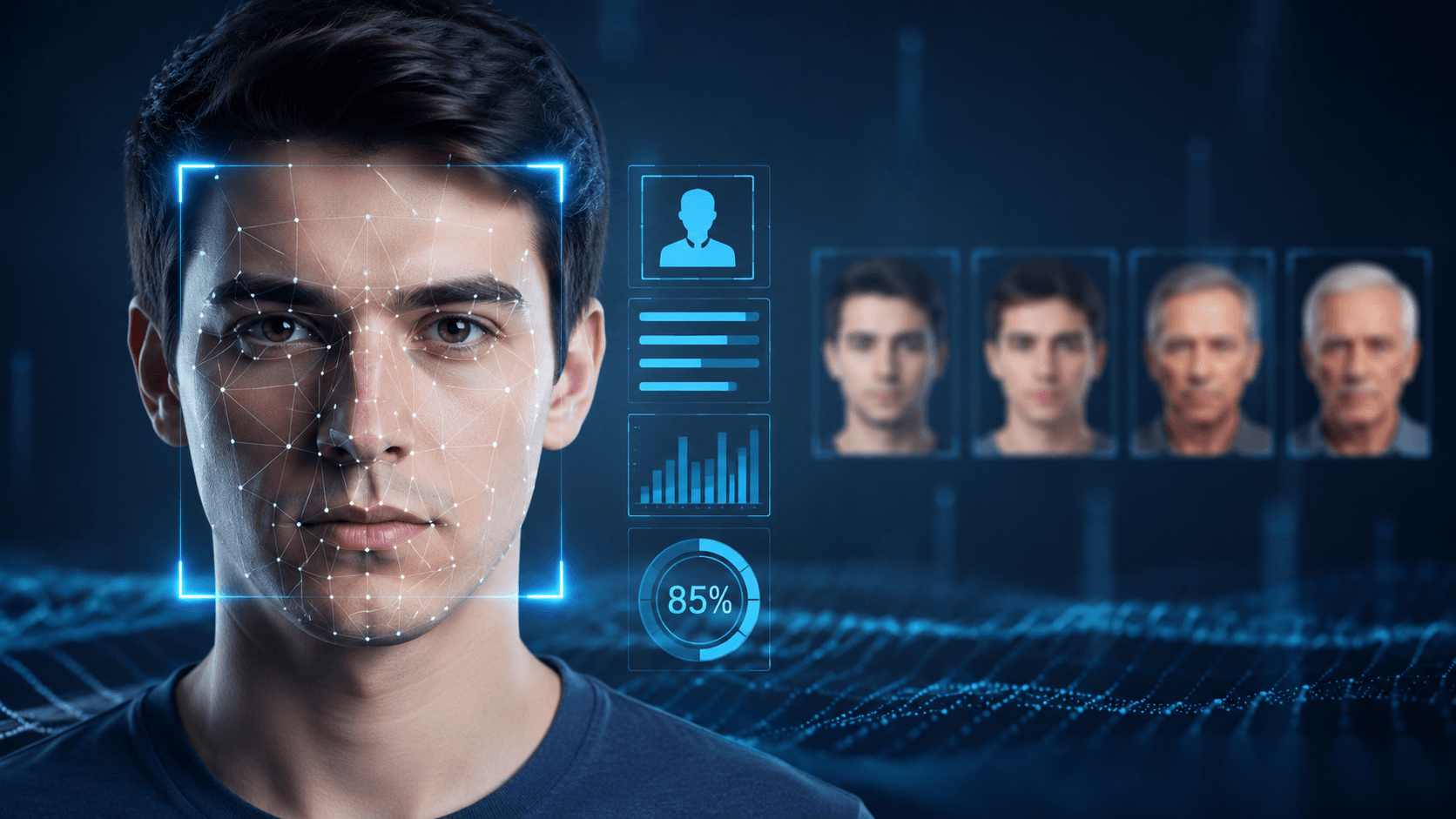
AI age estimation uses machine learning to estimate a person’s age, or check whether they are above an age limit, from a facial image or short video. It does not need to identify the person. Accuracy varies, so most services add a buffer and a fallback ID check for people near the age threshold.
Key takeaways
- Age estimation predicts an approximate age; age verification confirms an exact age with documents.
- Accuracy is lower near the age limit, so services use buffers and a second check.
- Liveness detection, fast image deletion, and independent testing are key safeguards.
- Privacy, bias, and local regulation must be reviewed before deployment.
In this guide
- What Is AI Age Estimation?
- Age Estimation vs Age Verification vs Age Assurance
- How AI Age Estimation Works
- Where It Is Used
- How Accurate Is It?
- Factors That Affect Accuracy
- Privacy, Fairness, and Ethics
- Regulation and Why Demand Is Growing
- Choosing an Age Estimation Solution
- Frequently Asked Questions
Last updated: October 2026
More websites, apps, and shops now need to know whether a customer is old enough to use their service, without collecting a full set of identity documents. AI age estimation is one answer: a camera and software work out an approximate age from a face. This guide explains how it works, how accurate it is, where it is used, and what to consider for privacy and fairness.
What Is AI Age Estimation?
AI age estimation uses a machine-learning model to estimate a person’s age, or check whether they are above or below a threshold, from a facial image or short video. The system does not need to know who the person is. It only produces an age estimate or a pass or fail result against a limit, such as 18 or 21.
Age Estimation vs Age Verification vs Age Assurance
| Term | Meaning | Example |
|---|---|---|
| Age estimation | Predicts approximate age from biometrics such as a face | Selfie check at self-service checkout |
| Age verification | Confirms exact age using trusted documents or records | Passport or driving licence check |
| Age assurance | Umbrella term covering all methods | Platform choosing from several checks |
How AI Age Estimation Works
- Capture: the user takes a selfie or short video, or a camera sees them at a kiosk.
- Liveness check: the system checks that a real person is present and not a photo, screen, or mask. See our guide to on-premise liveness detection.
- Analysis: a neural network trained on large sets of faces with known ages looks at features such as skin texture, face shape, and other patterns.
- Result: the model outputs an estimated age or a decision against a set threshold.
- Deletion: good systems delete the image straight away and keep only the result.
Where It Is Used
- Online platforms with age-restricted content
- Social media and gaming services protecting children
- Self-checkout and vending machines selling age-restricted goods
- Alcohol, vaping, and gambling services
- Digital identity and onboarding flows that need a quick age check
How Accurate Is It?
Accuracy depends on the model, the image quality, and the person. Providers usually report the average error in years, and accuracy tends to be best for people far from the threshold and lower for those close to it. To reduce mistakes, services often use a buffer, similar to “Challenge 25” rules in shops. For example, a system set to pass people estimated at 25 or older will send younger-looking users to a second check, such as an ID document.
Independent testing is important. Some providers are assessed by schemes such as the Age Check Certification Scheme, and the US National Institute of Standards and Technology (NIST) has evaluated age-estimation algorithms. Always ask a vendor for independent results, not just marketing claims.
Factors That Affect Accuracy
- Lighting, camera quality, and image sharpness
- Glasses, makeup, masks, and facial hair
- Differences between age groups, skin tones, and genders in the training data
- Attempts at spoofing with photos, filters, or deepfakes
Privacy, Fairness, and Ethics
- Data minimisation: only process what is needed and delete images promptly. In the UK, the Information Commissioner’s Office gives guidance on biometric data and age assurance, and similar rules exist under the GDPR.
- Bias: models can perform differently across demographic groups. Providers should publish tests and fix gaps.
- Consent and transparency: tell users what is happening, why, and what happens to their data.
- Alternatives: offer another route, such as an ID check, for people who cannot or do not want to use face scanning.
- Security: protect against spoofing and data breaches.
Regulation and Why Demand Is Growing
Regulators in several countries now expect online services to use effective age checks to protect children. In the UK, Ofcom has set out expectations under the Online Safety Act, and other regions are introducing their own rules. Requirements differ and change, so check current guidance in each country where you operate.
Choosing an Age Estimation Solution
- Ask for independent accuracy testing and bias results.
- Check liveness and anti-spoofing features.
- Confirm images are deleted and not used for other purposes.
- Look for a fallback to document-based verification. Our guide to KYC verification explains how ID checks work.
- Test the user experience, speed, and accessibility.
- Confirm compliance with local privacy and age-assurance rules.
Frequently Asked Questions
It is technology that estimates age from a face image or video, or checks whether someone is over a set age, without needing to identify them.
It depends on the model and image quality. It is usually most reliable for people well above or below the threshold and less certain near it, which is why buffers are used.
No. Age estimation predicts age only, while facial recognition identifies who a person is. Both involve sensitive data and should be handled carefully.
It can be, if images are processed quickly, not stored, and not reused. Always check the provider privacy policy and compliance with local laws.
Attempts include photos, screens, masks, and deepfakes. Liveness detection and anti-spoofing checks are used to reduce this risk.
Most services offer a backup option, such as uploading an ID document.
This article is for general information and is not legal advice. Privacy and age-assurance rules vary by country.