

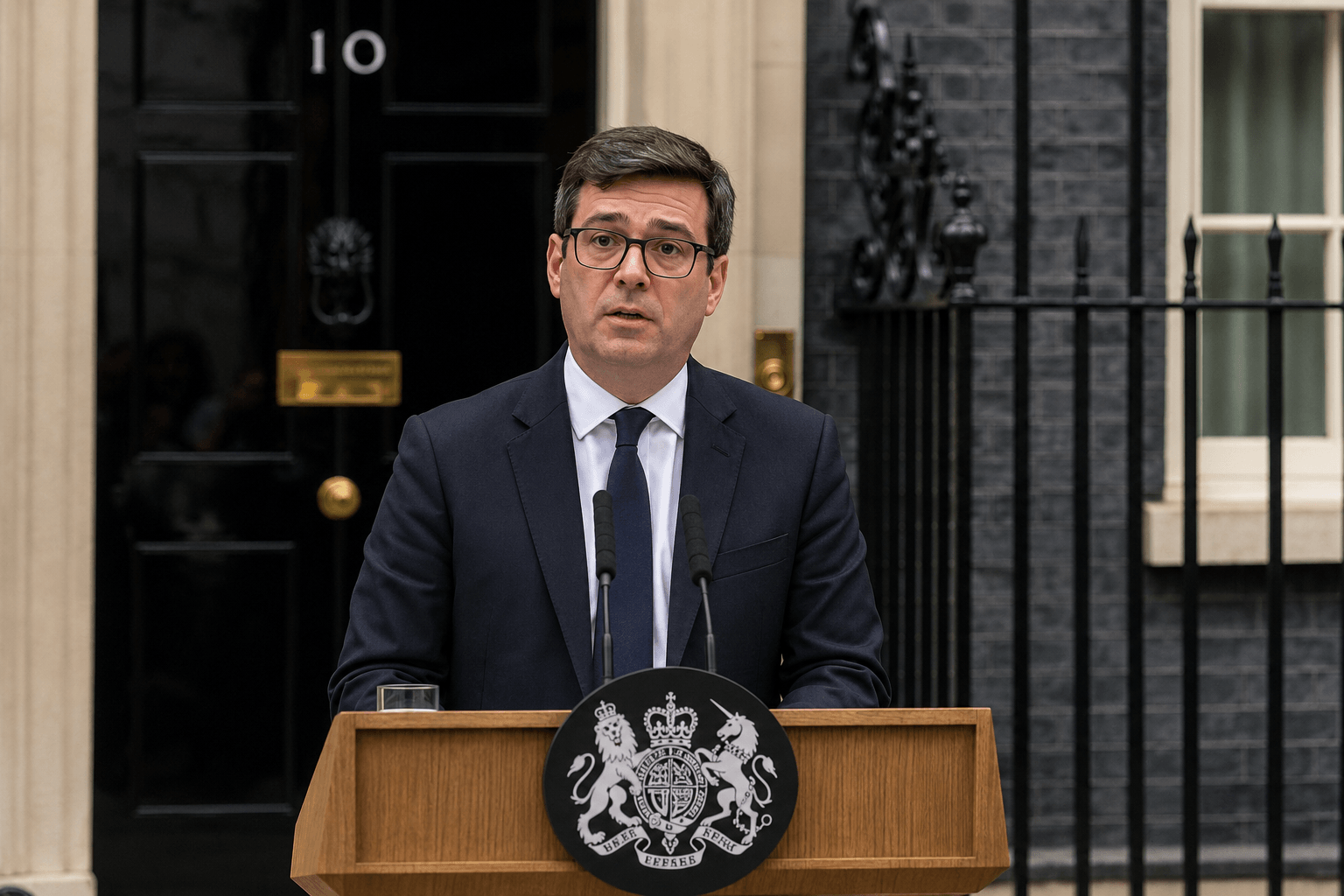
Andy Burnham became the United Kingdom’s prime minister in July 2026 after Keir Starmer resigned as Labour leader and head of government, following months of falling popularity and pressure from his own party. Starmer announced his resignation on June 22, 2026, and Burnham, the former mayor of Greater Manchester, was confirmed as the new Labour leader on July 17, 2026, becoming the UKu2019s seventh prime minister in a decade.
Quick Answer
- What happened: Keir Starmer resigned as UK prime minister on June 22, 2026.
- Who replaced him: Andy Burnham, former Mayor of Greater Manchester, became Labour leader and prime minister on July 17, 2026.
- Why: Starmer lost the support of Labour MPs after poor local election results and mounting internal pressure.
- Whatu2019s next: Burnham is expected to lead Labour into the next general election, due by 2029.
What Happened on June 22, 2026?
Keir Starmer announced outside 10 Downing Street that he would resign as Labour leader and prime minister, telling reporters he accepted “with good grace” that Labour MPs no longer wanted him to lead them into the next general election. Starmer had returned Labour to power in July 2024 with a landslide victory after 14 years in opposition, but his premiership was marked by domestic policy reversals, ministerial resignations, and a steep decline in public support. Labouru2019s heavy losses in local and regional elections in May 2026 intensified calls from within the party for him to step aside.
Why Is Andy Burnham Trending in UK News?
Burnhamu2019s rise to the premiership followed a striking political move: he won a parliamentary by-election in the Makerfield constituency in June 2026, which allowed him to return to the House of Commons after leaving Parliament in 2017 to become Mayor of Greater Manchester. That victory is widely seen as the trigger for Starmeru2019s resignation. Former Health Secretary Wes Streeting, considered Burnhamu2019s main rival for the leadership, publicly backed Burnham instead of contesting the role, clearing the path for Burnham to become Labour leader without a full leadership contest.
Who Is Andy Burnham?
Andy Burnham was born on January 7, 1970, in Liverpool. He served as a Labour minister under Tony Blair and Gordon Brown before becoming Mayor of Greater Manchester in 2017, a role he held for nearly a decade. He had previously run for the Labour leadership twice before and lost both times. His election as leader in July 2026 came with the backing of around 80 percent of Labour MPs.
Timeline of the Transition
- June 18, 2026: Andy Burnham wins the Makerfield by-election, returning to Parliament.
- June 22, 2026: Keir Starmer announces his resignation as Labour leader and prime minister, agreeing to stay on as caretaker PM until a successor is chosen.
- July 9-16, 2026: Labouru2019s leadership nomination window opens and closes, with Burnham the clear frontrunner after Wes Streetingu2019s endorsement.
- July 17, 2026: Andy Burnham is confirmed as Labour leader and prime minister.
Starmeru2019s Two Years in Office
Keir Starmeru2019s time as prime minister began with historic promise. His July 2024 general election victory ended 14 years of Conservative government and gave Labour one of its largest parliamentary majorities in decades. Starmer was well regarded internationally for his support of Ukraine, his work within NATO, his opposition to US policy on Iran, and his efforts to rebuild ties with the European Union after Brexit. Domestically, however, his government struggled. A series of policy reversals on issues like winter fuel payments and welfare reform eroded public trust, and a controversy over the appointment of a UK ambassador to Washington who had ties to the late Jeffrey Epstein added to the pressure. By the time of the May 2026 local elections, Labouru2019s support had fallen sharply, and Reform UK, led by Nigel Farage, had moved ahead in national polling.
How the Handover Worked
Under Labour Party rules, only sitting Members of Parliament can stand for the party leadership, which is one reason Burnhamu2019s by-election win in Makerfield was so significant. Without a seat in the Commons, he could not have been nominated. Once he returned to Parliament, Wes Streetingu2019s decision to back him rather than run himself effectively ended any prospect of a contested leadership race. Starmer remained in post as a caretaker prime minister throughout the process, overseeing government business until Burnham was formally confirmed and appointed by King Charles III.
Reaction to the Change
Burnhamu2019s confirmation was met with applause from Labour MPs, many of whom see him as a more relatable, working-class voice for the party after Starmeru2019s more technocratic image struggled to connect with voters. Political commentators have noted that Burnhamu2019s long record as a regional mayor, rather than a Westminster insider, may help Labour compete more directly with Reform UK in the industrial and northern seats where support has eroded fastest. Others caution that a mid-term leadership change carries its own risks, since it gives Burnham a comparatively short runway before the next general election, expected in 2029, to demonstrate results.
What Does This Mean for the UK?
Burnham takes over a Labour Party trying to halt the rise of Nigel Farageu2019s Reform UK, which had been leading national opinion polls. His leadership is widely seen as an attempt to reset Labouru2019s domestic message after a rocky first two years in government. Burnham has pledged to reunite the party and restore public confidence ahead of the next general election, expected in 2029.
What Happens Next?
Watch for Burnhamu2019s first major policy announcements as prime minister and any reshuffling of the cabinet. His handling of the economy, immigration policy, and Labouru2019s response to Reform UKu2019s continued rise in the polls will shape how the transition is judged in the months ahead.
Frequently Asked Questions
When did Andy Burnham become UK prime minister?
Andy Burnham was confirmed as Labour leader and prime minister on July 17, 2026, after Keir Starmeru2019s resignation.
Why did Keir Starmer resign?
Starmer resigned after losing the support of Labour MPs, following poor local election results in May 2026 and mounting internal pressure over his leadership.
What was Andy Burnhamu2019s role before becoming prime minister?
Andy Burnham was Mayor of Greater Manchester from 2017 until his return to Parliament in 2026, and previously served as a Labour minister under Tony Blair and Gordon Brown.
How many prime ministers has the UK had in the last decade?
Andy Burnham is the UKu2019s seventh prime minister in roughly ten years.
Will there be a general election soon?
No new general election was called as part of this transition; the next UK general election is expected by 2029.