
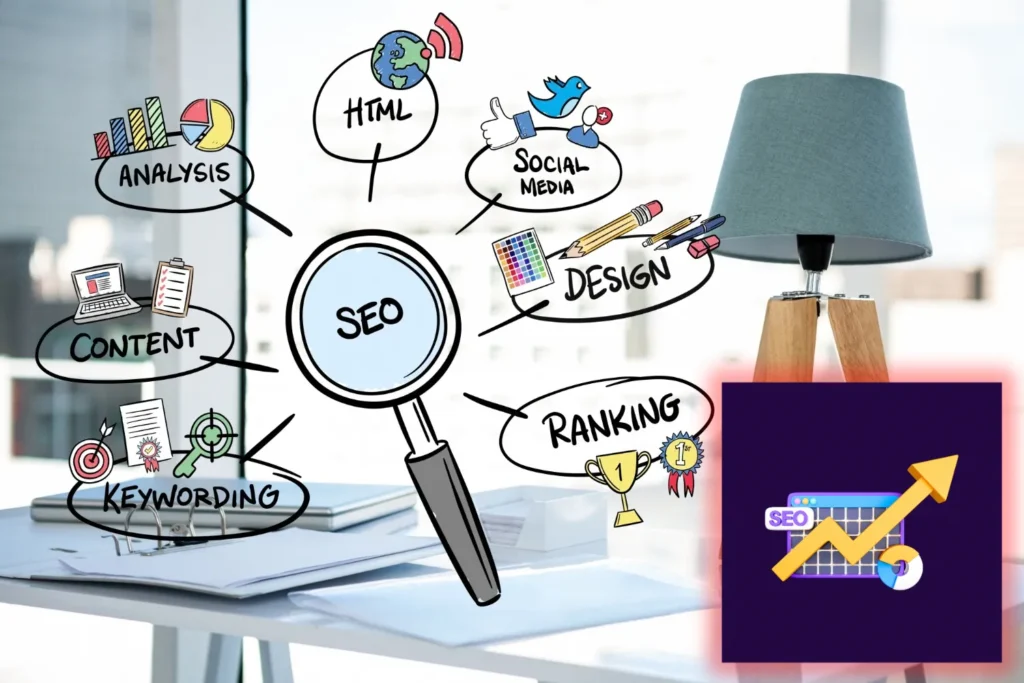
Search engine optimization (SEO) is the process of improving a website so it ranks higher in unpaid search results and gets found by the right people. Done well, it brings a steady stream of visitors without paying for every single click.
This guide covers everything in plain language: what SEO is, how it actually works in 2026, the three core types of SEO, and a practical checklist you can follow today. We also cover how SEO connects to AI search, since more people now get answers from AI Overviews, ChatGPT and Perplexity instead of scrolling a results page.
What Is SEO?
SEO is the set of practices that help a web page show up when someone searches for something related to it. It has three main parts.
- On-page SEO — the content, titles, headings and internal links on the page itself.
- Technical SEO — site speed, mobile-friendliness, crawlability and site structure.
- Off-page SEO — backlinks and brand mentions that build trust and authority.
Good SEO in 2026 also means writing content that AI search tools can easily read, summarise and cite. We cover that under Generative Engine Optimization later in this guide.
What Is Search Engine Optimization?
Search engine optimization is the practice of making a website easier for search engines like Google, Bing and now AI-powered engines to find, understand, and recommend. The goal is to appear in the organic, unpaid section of search results, as opposed to paid ads, which fall under search engine marketing (SEM).
The term covers a wide range of work: writing content that answers real questions, structuring pages so crawlers can read them, making a site fast and mobile-friendly, and earning links and mentions from other trustworthy sites.
SEO is not a single setting you switch on. It is an ongoing practice, closer to maintaining a garden than flipping a switch. Search engines constantly update how they evaluate pages, so SEO work never really finishes.
How Search Engines Actually Work
To understand SEO, it helps to understand what a search engine does behind the scenes. The process has three steps.
1. Crawling. Search engines use automated programs called crawlers, or bots, to discover pages across the web by following links. Google’s crawler is called Googlebot. You can read how it works on Google’s official crawling and indexing page.
2. Indexing. Once a page is crawled, the search engine analyses its content and stores it in a massive database called an index. A page that is not indexed cannot appear in search results, no matter how good it is.
3. Ranking. When someone searches, the engine scans its index and ranks the most relevant, high-quality pages first, using hundreds of signals. Google publishes a general overview of this process in its How Search Works guide.
Every part of SEO exists to influence one of these three steps: helping a page get crawled, get indexed correctly, and rank as high as possible for relevant searches.
Why SEO Matters in 2026
Search is still one of the biggest sources of website traffic, even with the rise of social media and AI chat tools. A few reasons SEO remains worth the effort:
It targets intent, not interruption. Someone searching “best running shoes for flat feet” already wants an answer. SEO meets that demand instead of interrupting someone scrolling a feed.
It compounds over time. A well-optimized article can keep bringing visitors for years with only occasional updates, unlike a paid ad that stops the moment you stop paying.
It builds trust. People tend to trust organic results more than ads. Ranking well is a quiet signal of credibility.
It now feeds AI search too. Tools like Google AI Overviews, Microsoft Copilot and Perplexity pull their answers from indexed web content. Being well-optimized for traditional search increases the odds of being cited in an AI-generated answer as well.
According to Backlinko’s SEO statistics roundup, organic search continues to be one of the largest traffic sources for most websites. You can also see Google’s own figures on how often it changes its ranking systems in the Google Search Central blog.
The Three Types of SEO Explained
Every SEO tactic falls into one of three buckets.
1. On-Page SEO
On-page SEO covers everything you control directly on a page: the content itself, titles, headings, URL, internal links and images. This is where keyword research, writing quality and page structure live.
2. Technical SEO
Technical SEO covers the behind-the-scenes setup that lets search engines crawl and render your site properly. This includes site speed, mobile usability, secure HTTPS connections, XML sitemaps, and clean code.
3. Off-Page SEO
Off-page SEO covers signals that happen away from your own site, mainly backlinks from other websites, but also brand mentions, reviews and social signals. It tells search engines that other sources trust and reference your content.
A strong SEO strategy needs all three. A beautifully written article on a slow, uncrawlable site will struggle. A technically perfect site with thin content will not rank either.
On-Page SEO: The Complete Checklist
On-page SEO is usually the best place to start because you control every variable.
Keyword in the right places
Include your target keyword naturally in:
- The page title (ideally near the beginning)
- The URL slug
- The first 100 words
- At least one H2 heading
- The meta description
- Image alt text where relevant
Avoid keyword stuffing. Google’s own spam policies for Search explicitly flag repetitive, unnatural keyword use as a violation.
Title tags and meta descriptions
The title tag is what shows as the clickable blue link in search results. Keep it under about 60 characters so it does not get cut off. The meta description does not directly affect rankings but strongly affects click-through rate, so write it like an advert for the page.
Header structure (H1, H2, H3)
Use one H1 per page, matching the main topic. Break the body into logical H2 and H3 sections. This helps both human skimmers and AI systems parse the structure of your content, which is central to Answer Engine Optimization, covered later in this guide.
Content quality and depth
Google’s Helpful Content guidance asks a simple question: would a reader find this content satisfying after reading it? You can review the official criteria in Google’s creating helpful, reliable, people-first content documentation. Thin, generic content that just repeats what competitors already say rarely ranks well in 2026.
Internal linking
Link to other relevant pages on your own site using descriptive anchor text. This helps search engines understand your site structure and helps visitors find related content, which supports both SEO and SXO.
Image optimization
Compress images, use descriptive file names, and always fill in alt text. This improves page speed and accessibility, and it can earn extra visibility in Google Images.
URL structure
Keep URLs short, readable and keyword-relevant. /search-engine-optimization/ is far better than /post?id=4471.
Technical SEO: The Complete Checklist
Technical SEO ensures search engines can actually access and understand your content.
Site speed and Core Web Vitals
Google uses a set of metrics called Core Web Vitals to measure real-world loading speed, interactivity and visual stability. You can test any page with Google’s own PageSpeed Insights tool. Slow sites tend to rank worse and convert fewer visitors.
Mobile-friendliness
Google primarily uses the mobile version of a page for indexing and ranking, a system called mobile-first indexing. Test your pages with Google’s Mobile-Friendly Test.
HTTPS and security
A valid SSL certificate (the padlock icon in the browser) is a baseline requirement in 2026. If your site still runs on HTTP, that is one of the fastest wins available.
XML sitemaps and robots.txt
An XML sitemap lists your important pages so search engines can find them efficiently. Submit it through Google Search Console, Google’s free tool for monitoring indexing, performance and errors. Your robots.txt file tells crawlers which parts of the site to skip.
Structured data (schema markup)
Structured data, often written in JSON-LD format, helps search engines understand exactly what a page is about, whether it is a recipe, an FAQ, a product or an article. You can validate schema with Google’s Rich Results Test and browse the full vocabulary at Schema.org.
Crawl errors and broken links
Regularly check Search Console for crawl errors, and fix or redirect broken links (404s). A messy site with lots of dead ends wastes crawl budget and frustrates visitors.
Duplicate content and canonical tags
If similar content exists on multiple URLs, use a canonical tag to tell search engines which version is the primary one. Learn more in Google’s guide to canonicalization.
Off-Page SEO and Link Building
Off-page SEO is mostly about backlinks: other websites linking to yours. Search engines treat a link as a vote of confidence, especially from relevant, trustworthy sites.
What makes a good backlink
- Relevance: A link from a site in a related topic carries more weight than a random, unrelated one.
- Authority: Links from well-established, trusted domains tend to help more.
- Natural anchor text: Varied, natural phrasing beats the exact same keyword-stuffed anchor text repeated everywhere.
- Editorial placement: A link naturally placed within an article is stronger than one stuffed into a footer or sidebar.
Common, legitimate link-building methods
- Create genuinely link-worthy content, such as original research, free tools or in-depth guides.
- Digital PR, where you pitch journalists and bloggers a newsworthy angle.
- Guest posting on relevant, reputable sites in your niche.
- Broken link building, offering your content as a replacement for a dead link.
- Business directories and partnerships, listing your site on relevant, legitimate directories such as your local Chamber of Commerce or industry associations.
Avoid buying links in bulk or using link farms. Google’s link spam policy explicitly targets manipulative link schemes, and getting caught can tank rankings site-wide.
E-E-A-T and off-page trust
Google’s quality guidelines use a framework called E-E-A-T: Experience, Expertise, Authoritativeness and Trustworthiness. You can read the full explanation in the Search Quality Rater Guidelines. Off-page signals such as being mentioned by reputable sites, having consistent business information, and showing clear authorship all feed into this trust layer.
Local SEO Basics
If a business serves a specific area, local SEO is its own important branch.
- Claim and fully complete a Google Business Profile.
- Keep your business Name, Address and Phone number (NAP) consistent everywhere online.
- Collect genuine customer reviews and respond to them.
- Get listed in reputable local directories and industry-specific listings.
- Create location-specific pages if you serve multiple cities or regions.
Local SEO overlaps with technical and on-page SEO but focuses on ranking in the “map pack” and local search results.
Keyword Research, Step by Step
Keyword research is how you find out what people are actually searching for.
Step 1: Start with a seed topic. Write down the broad subject your page covers.
Step 2: Expand with a keyword tool. Tools like Google Keyword Planner, Google Trends, Ahrefs and Semrush show search volume, trends and related terms.
Step 3: Check search intent. Search the keyword yourself. If the results are mostly product pages but you planned a blog post, your intent does not match, and ranking will be hard no matter how good the writing is.
Step 4: Weigh volume against difficulty. A keyword with huge volume but very high competition may be harder to rank for than several lower-volume, low-competition keywords combined.
Step 5: Group related keywords. Many searches share the same intent. One well-structured page can often target a cluster of related phrases instead of needing a separate page for each one.
Step 6: Map keywords to funnel stage. Informational keywords (“what is SEO”) suit blog content. Transactional keywords (“SEO agency pricing”) suit service or product pages.
AEO, GEO and AIO: Optimizing for AI Search
Search has expanded beyond the traditional blue-link results page. People now get direct answers from Google AI Overviews, voice assistants, and chatbots like ChatGPT, Gemini, Copilot and Perplexity. This has created three closely related practices that sit alongside traditional SEO.
AEO: Answer Engine Optimization
AEO focuses on structuring content so it can be lifted directly as a short, clear answer, whether that is a Google featured snippet, a voice assistant response, or an AI Overview box.
How to apply it:
- Answer the core question in the first one to two sentences of a section, then expand with detail.
- Use clear question-style H2 or H3 headings that match how people actually search.
- Add an FAQ section with direct, self-contained answers, like the one at the end of this guide.
- Use bullet points and numbered lists for processes and comparisons, since they are easy for both people and AI systems to extract.
GEO: Generative Engine Optimization
GEO is about increasing the chance that AI chat tools cite or reference your content when generating an answer, rather than ranking in a traditional results list.
How to apply it:
- Back up claims with sources, data and specific numbers rather than vague statements.
- Keep information accurate and current; AI systems favour content that looks well-maintained.
- Use clear, descriptive headings so each section can stand alone if quoted out of context.
- Include original insight or data where possible. AI tools tend to pull from pages that add something beyond a rehash of existing content.
AIO: AI Optimization
AIO is the broader practice of making a whole site easy for AI crawlers and tools to access, read and understand, not just a single article.
How to apply it:
- Make sure your
robots.txtdoes not accidentally block AI crawlers you want visiting your site. - Use clean, semantic HTML and structured data (schema) throughout the site, not just on one page.
- Keep a consistent, accurate “About” page and author information, since AI tools weigh credibility signals too.
- Avoid content hidden entirely behind heavy JavaScript rendering, which can be harder for some AI crawlers to process.
These three practices do not replace traditional SEO. They build on it. A page that already follows solid on-page and technical SEO is most of the way to being AEO, GEO and AIO-ready.
SXO: Search Experience Optimization
SXO combines SEO with user experience and conversion rate optimization. The idea is simple: ranking first does not matter much if visitors bounce immediately or never take action.
Core SXO practices:
- Match content to intent precisely, so visitors find exactly what they expected to click on.
- Make pages fast and easy to navigate, since friction drives people away before they convert.
- Use clear calls to action, so once someone finds what they need, the next step is obvious.
- Design for readability, with short paragraphs, white space, and clear visual hierarchy.
- Track real user behavior with tools like Google Analytics and heatmap tools to see where visitors actually struggle.
Google has increasingly tied user satisfaction signals into its ranking systems, which means good SXO and good SEO now reinforce each other rather than competing.
Google’s 2026 Ranking Factors
Google has never published the exact, complete list of ranking factors, and it uses hundreds of signals. But based on Google’s own documentation and industry analysis, a few factors clearly carry the most weight in 2026.
- Content quality and E-E-A-T. Original, accurate, well-sourced content from a credible author consistently outperforms generic, templated writing.
- Search intent match. Content has to match what the searcher actually wants, not just contain the right keyword.
- Core Web Vitals and page experience. Speed, stability and mobile usability remain confirmed ranking signals.
- Backlinks and authority. Quality, relevant backlinks are still one of the strongest trust signals Google uses.
- Technical crawlability. A page that cannot be crawled or indexed properly cannot rank, regardless of content quality.
- AI search readiness. Clear structure, direct answers and well-sourced claims increase visibility in AI Overviews alongside traditional rankings.
You can follow Google’s own confirmed updates directly through the Google Search Central blog and the Google Search Status Dashboard.
Common SEO Mistakes to Avoid
Even experienced site owners fall into these traps.
Chasing keywords instead of intent. Ranking for a keyword with the wrong content type rarely converts, even if traffic goes up.
Ignoring technical SEO. Beautiful content on a slow, broken site will underperform no matter how well it is written.
Buying low-quality backlinks. Spammy link schemes risk manual penalties and can hurt an entire domain’s rankings.
Publishing thin, duplicate, or AI-churned content with no real value. Volume without depth rarely survives Google’s Helpful Content systems.
Neglecting mobile users. With mobile-first indexing, a poor mobile experience directly hurts rankings, not just conversions.
Expecting instant results. SEO is a compounding strategy, not a quick-fix channel. Treating it like a one-off task instead of an ongoing practice is one of the most common reasons results stall.
Forgetting to measure. Without tracking rankings, traffic and conversions, it is impossible to know what is actually working.
SEO Tools Worth Using
A short list of reliable, widely used tools across each area of SEO:
- Google Search Console — free indexing, performance and error monitoring directly from Google.
- Google Analytics — free traffic and behavior tracking.
- Google Keyword Planner — free keyword research tied to real Google Ads data.
- Ahrefs — backlink analysis, keyword research and site audits.
- Semrush — competitor research, keyword tracking and technical audits.
- Yoast SEO — on-page optimization and technical checks for WordPress.
- Screaming Frog — technical site crawling and auditing.
- PageSpeed Insights — free Core Web Vitals and speed testing.
Using one tool from each category (one for keyword research, one for technical audits, one for rank tracking) is usually enough for most sites.
How Long Does SEO Take to Work?
This is one of the most common questions, and the honest answer is: it depends on competition, site age and consistency, but results are rarely instant.
- New sites: Often take 6 to 12 months to see meaningful organic traffic, since trust and authority need time to build.
- Established sites publishing consistently: Can see movement in 3 to 6 months, especially for lower-competition keywords.
- Highly competitive keywords: Can take a year or longer, even with strong content and backlinks.
SEO is closer to compound interest than a light switch. Small, consistent improvements over months add up to significant results, while sporadic effort rarely moves the needle.
Frequently Asked Questions
What is search engine optimization in simple words?
Search engine optimization, or SEO, is the practice of improving a website so it appears higher in unpaid search results. It involves creating helpful content, fixing technical issues, and earning links so search engines can find, understand and trust a page.
What are the 3 main types of SEO?
The three main types are on-page SEO (content and HTML elements on the page itself), technical SEO (site speed, crawlability and structure), and off-page SEO (backlinks and brand signals from other sites).
How long does SEO take to work?
Most new or small sites start seeing meaningful movement in 4 to 6 months, with stronger results after 9 to 12 months of consistent work. Competitive keywords and established competitors can take longer.
Is SEO still worth it in 2026 with AI search?
Yes. AI Overviews and chatbots still pull their answers from well-optimized, trustworthy web pages. Strong SEO fundamentals, clear structure and credible sources make content more likely to be cited by both traditional search and AI search engines.
What is the difference between SEO and SEM?
SEO focuses on unpaid, organic rankings. SEM (search engine marketing) includes paid advertising, such as Google Ads, that appears alongside organic results. Many strategies use both together.
Can I do SEO myself, or do I need an agency?
Many of the basics, like keyword research, on-page optimization and fixing technical errors, are learnable with free tools like Google Search Console. Larger or highly competitive sites often bring in specialists for technical audits and link building.
Does Google penalize AI-written content?
Google does not penalize content simply because it was created with AI assistance. It penalizes content that is low-quality, inaccurate, or created mainly to manipulate rankings rather than help readers, regardless of how it was produced.
What is E-E-A-T in SEO?
E-E-A-T stands for Experience, Expertise, Authoritativeness and Trustworthiness. It is the framework Google’s quality raters use to judge whether content and its author can be trusted, and it has become central to ranking in 2026.
How often should I update old content for SEO?
Reviewing cornerstone articles every 3 to 6 months to refresh stats, links and examples is a good habit, especially for fast-changing topics. Outdated content can quietly lose rankings over time.
Why SEO Still Matters
Search engine optimization has changed shape over the years, but its core purpose has not: help search engines, and increasingly AI tools, understand that your content genuinely answers people’s questions better than the alternatives.
Strong SEO in 2026 means combining solid on-page writing, a technically healthy site, real backlinks, and structure that works for both traditional search and AI Overviews. None of these replace the others. Skipping any one of them caps how far the rest can take you.
Start with the checklist in this guide: fix the technical basics, write genuinely useful content around real search intent, and earn links the honest way. Then revisit and refresh the work regularly, since SEO rewards consistency far more than any single trick.
Explore more free guides and tools on Every Tools to keep building out your site’s SEO foundation.



