
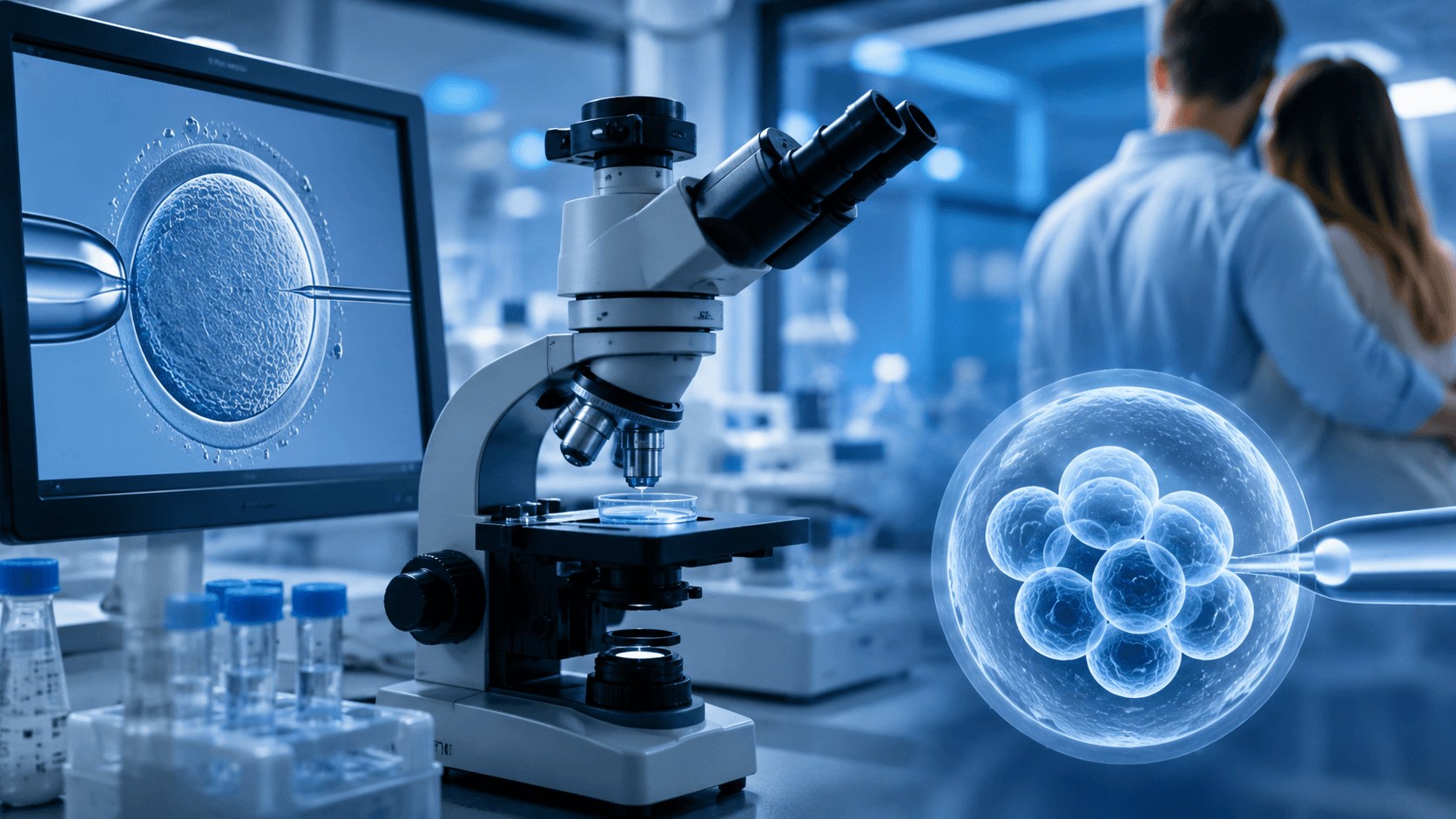
IVF (in vitro fertilisation) is a fertility treatment in which eggs are collected after hormone stimulation, fertilised with sperm in a laboratory, grown into embryos, and then transferred to the uterus. A cycle usually takes several weeks, and success depends strongly on age, the cause of infertility, and embryo quality, so it is never guaranteed.
Key takeaways
- An IVF cycle includes stimulation, egg collection, fertilisation, embryo culture, embryo transfer, and a pregnancy test about two weeks later.
- Age is the strongest factor in success, and official national data is more reliable than clinic marketing.
- Risks include OHSS, multiple pregnancy, procedure complications, and emotional strain.
- Ask for evidence and costs for any add-on, such as embryo testing or time-lapse imaging.
In this guide
- What Is IVF?
- When Should You See a Doctor About Fertility?
- How an IVF Cycle Works Step by Step
- What Affects IVF Success?
- Risks and Side Effects
- Embryo Testing and Lab Add-Ons: What the Evidence Says
- Cost, Funding, and Guidelines
- Preparing Your Body and Mind
- Emotional Support
- Questions to Ask a Fertility Clinic
- Finding a Clinic
- Frequently Asked Questions
Last updated: October 2026
In vitro fertilisation, or IVF, is the best-known form of assisted reproduction. It can help people who cannot conceive naturally, but it is also demanding, expensive in many places, and not guaranteed to work. This guide explains in plain language what IVF is, how a cycle works step by step, what affects success, the risks, the add-ons you may be offered, and questions to ask a clinic. It is general education and not a substitute for advice from a fertility specialist.
What Is IVF?
IVF means fertilising an egg with sperm outside the body, in a laboratory, and then placing the resulting embryo in the uterus. It is used for problems such as blocked or damaged fallopian tubes, endometriosis, low sperm count or quality, ovulation problems, and unexplained infertility. In a related technique called ICSI (intracytoplasmic sperm injection), a single sperm is injected directly into an egg, which is often used when there are male-factor problems.
When Should You See a Doctor About Fertility?
Many specialists suggest seeing a doctor if you have not conceived after about 12 months of regular, unprotected sex when you are under 35, or after about 6 months if you are 35 or older. See a doctor sooner if you have irregular or absent periods, known conditions such as endometriosis or PCOS, a history of pelvic infection or surgery, or if your partner has known sperm problems. Early tests may include blood tests for hormones, an ultrasound scan, a check of the fallopian tubes, and a semen analysis. The NHS infertility guidance explains the usual first steps.
How an IVF Cycle Works Step by Step
- Assessment and planning. Your clinic reviews your history and test results and recommends a protocol.
- Ovarian stimulation. Daily hormone injections for around 8 to 14 days encourage several eggs to mature. You have blood tests and ultrasound scans to monitor your response.
- Trigger injection. A final injection prepares the eggs for collection at a precisely timed moment.
- Egg collection. A short procedure, usually under sedation, in which a fine needle guided by ultrasound collects eggs from the ovaries.
- Fertilisation. Eggs are combined with sperm, by standard IVF or ICSI, and checked the next day.
- Embryo development. Embryos grow in the laboratory for several days, often up to day 5 or 6 when they are called blastocysts. Embryologists grade them on appearance.
- Embryo transfer. One embryo, or sometimes two, is placed in the uterus with a thin catheter. This can be a fresh transfer, soon after egg collection, or a frozen transfer in a later cycle.
- The two-week wait. A pregnancy test is usually taken around two weeks after transfer.
For another view of the same process, see our step-by-step article on modern reproductive interventions.
What Affects IVF Success?
| Factor | Why it matters |
|---|---|
| Age of the woman at egg collection | The strongest single factor, because egg quality and numbers decline with age |
| Cause of infertility | Some causes respond better to treatment than others |
| Number and quality of embryos | More good-quality embryos give more chances |
| Previous pregnancies or births | Can be a favourable sign |
| Lifestyle factors | Smoking, heavy alcohol, and very high or low body weight can reduce chances |
| Clinic and laboratory quality | Experience, standards, and protocols matter |
Success rates are reported as live birth rates per cycle or per embryo transfer, and they vary widely between age groups. Look at official data rather than clinic marketing. The UK regulator, the Human Fertilisation and Embryology Authority (HFEA), publishes clinic and national figures, and in the United States the CDC publishes assisted reproductive technology data.
Risks and Side Effects
- Medication effects: bloating, headaches, mood changes, and injection-site bruising are common.
- Ovarian hyperstimulation syndrome (OHSS): an overreaction to stimulation that causes abdominal swelling and pain. It is usually mild, but severe cases need urgent care.
- Procedure risks: bleeding, infection, or reactions to sedation after egg collection are uncommon.
- Multiple pregnancy: transferring more than one embryo raises the chance of twins or more, which carries higher risks. Many clinics now recommend single embryo transfer where suitable.
- Ectopic pregnancy and miscarriage: these can occur, as in natural pregnancies.
- Emotional strain: uncertainty, cost, and repeated cycles can be very stressful.
Contact your clinic urgently if you develop severe abdominal pain, rapid weight gain, difficulty breathing, or heavy bleeding during treatment.
Embryo Testing and Lab Add-Ons: What the Evidence Says
Clinics may offer extras such as time-lapse imaging, preimplantation genetic testing for aneuploidy (PGT-A), and other add-ons. Some of these are useful for specific medical reasons, for example testing embryos for a known inherited condition. For many other add-ons, the evidence that they improve live birth rates is limited or mixed, and they can add significant cost. The HFEA publishes a traffic-light rating of treatment add-ons based on the evidence. Ask your clinic what evidence supports any add-on and what it will cost.
Cost, Funding, and Guidelines
Costs and funding vary widely by country and region. In England, the National Institute for Health and Care Excellence (NICE) recommends that eligible women under 40 may be offered up to three full IVF cycles, but local NHS funding rules differ and many people pay privately. The NICE fertility guideline explains the recommendations. Ask for a full written cost breakdown, including medication, scans, freezing, storage, and extra cycles, and plan your finances. Our guides to financial planning and personal finance can help you set a budget.
Preparing Your Body and Mind
- Folic acid: a daily supplement is generally recommended for anyone trying to conceive. Ask your doctor about the right dose.
- Stop smoking and limit alcohol. Both can reduce fertility and affect pregnancy outcomes.
- Aim for a healthy weight and balanced diet. For ideas on whole grains, see our guide to ancient grains.
- Sleep and stress: good rest and support help you cope with treatment. See our tips on better sleep and bedding.
- Be careful with supplements and “fertility diets”. Claims often go beyond the evidence, so check with your doctor.
Emotional Support
IVF can be emotionally exhausting for both partners. Counselling, peer support, and talking openly about expectations can help. Charities such as Fertility Network UK and RESOLVE in the US offer information and support groups.
Questions to Ask a Fertility Clinic
- What are your live birth rates for people of my age and diagnosis, and where is this published?
- Which protocol do you recommend for me, and why?
- How many embryos will you transfer, and what is your policy on single embryo transfer?
- Which add-ons do you suggest, what is the evidence, and what do they cost?
- What is the total cost, including medication, monitoring, freezing, and storage?
- What happens if the cycle is cancelled or I have OHSS?
- Is the clinic licensed by the regulator in my country?
- What counselling and support do you provide?
Finding a Clinic
Check that a clinic is licensed and inspected by your national regulator, and read independent information before choosing. Some clinics and doctors appear below as examples. Links in this section are sponsored, and their listing is not an endorsement. Always verify credentials, success data, and reviews yourself: IVF specialist, Mumbai and IVF centre, Dr Zeenat.
Frequently Asked Questions
Hormone injections help several eggs mature, the eggs are collected, fertilised in a laboratory, grown into embryos, and one or two embryos are transferred to the uterus.
A typical cycle takes several weeks from the start of stimulation to the pregnancy test, with frozen transfers adding more time.
It depends mainly on age and the cause of infertility. Check official sources such as the HFEA or CDC for age-specific live birth rates.
Medication side effects, ovarian hyperstimulation syndrome, procedure complications, multiple pregnancy, and emotional strain are the main risks.
ICSI is a technique in which a single sperm is injected directly into an egg, often used when there are male-factor problems.
For many add-ons, evidence is limited or mixed. The HFEA rates add-ons by evidence, and you should ask your clinic for proof and cost.
This article is general information, not medical advice. IVF suitability, protocols, and success rates are individual, so speak to a qualified fertility specialist. Sponsored links are not endorsements.