
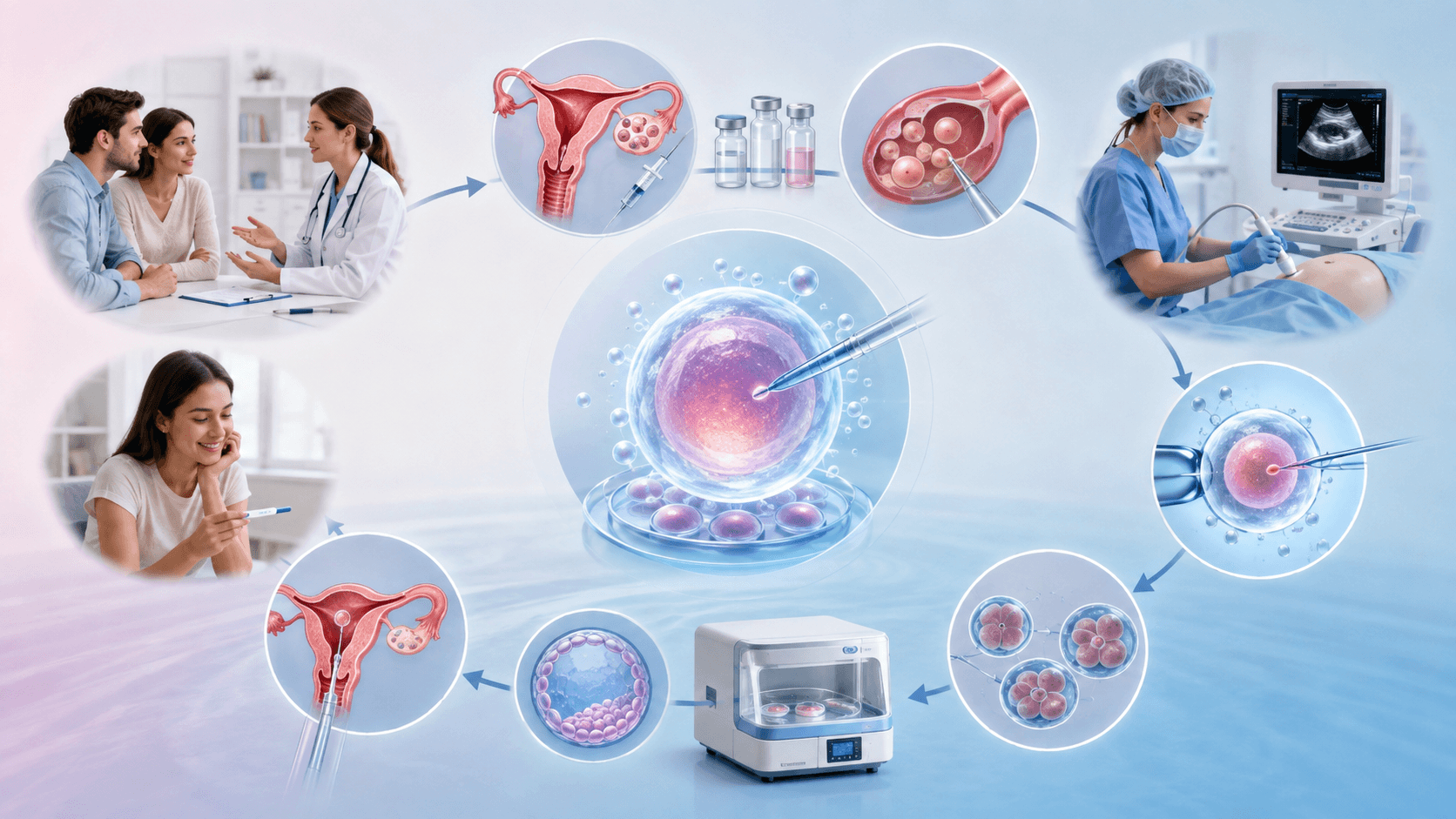
IUI places washed sperm directly into the uterus around ovulation, while IVF fertilises eggs in a laboratory and transfers the embryo. IUI is simpler and cheaper per cycle but generally has lower success, and is not suitable for blocked fallopian tubes or severe sperm problems. Doctors choose between ovulation induction, IUI, and IVF based on the cause, age, and previous treatment.
Key takeaways
- Treatment choice depends on the cause of infertility, age, and how long you have been trying.
- Ovulation induction treats ovulation problems such as PCOS, and IUI suits some mild male-factor and other selected cases.
- IVF is recommended for blocked tubes, severe male factor, older age, or when simpler treatments fail.
- Multiple pregnancy is the main risk of stimulated IUI, so ask how it will be monitored.
In this guide
- First Steps: Finding the Cause
- Fertility Treatments Compared
- Ovulation Induction
- What Is IUI and How Does It Work?
- IUI vs IVF: Key Differences
- Male-Factor Infertility
- Tubal and Uterine Problems
- When Do Doctors Suggest Moving to IVF?
- Risks and Side Effects of Treatments
- How to Improve Your Chances
- Costs and Planning
- Questions to Ask Your Fertility Specialist
- Finding a Specialist
- Frequently Asked Questions
Last updated: October 2026
When people struggle to conceive, IVF is often the first treatment they hear about, but it is not the only option, and it is not always the first one doctors recommend. Depending on the cause, simpler steps such as treating ovulation problems, timed intercourse, or intrauterine insemination (IUI) may be tried first. This guide compares the main fertility treatments, explains what each involves, what affects success, and how doctors decide when to move on to IVF. For a full explanation of IVF itself, see our guide to how IVF works. This article is general information, not medical advice.
First Steps: Finding the Cause
Fertility problems can involve the woman, the man, both, or have no clear cause. A fertility assessment commonly includes:
- Semen analysis to check sperm count, movement, and shape.
- Blood tests for hormones that show whether and when ovulation is happening, and for ovarian reserve.
- Ultrasound scans of the uterus and ovaries.
- Tests of the fallopian tubes, such as a hysterosalpingogram (an X-ray with dye) or an ultrasound with fluid.
Many specialists suggest assessment after about 12 months of trying if the woman is under 35, and after about 6 months if she is 35 or older, or sooner if there are known risk factors. The NHS and the American Society for Reproductive Medicine’s patient site explain the usual process.
Fertility Treatments Compared
| Treatment | What it is | Often used for |
|---|---|---|
| Lifestyle changes and timed intercourse | Tracking ovulation and optimising health | Mild problems, or the first step while testing is done |
| Ovulation induction | Medicines that trigger ovulation, such as letrozole or clomiphene | Ovulation disorders, including PCOS |
| IUI (intrauterine insemination) | Washed, concentrated sperm is placed into the uterus around ovulation | Mild male-factor problems, cervical factors, same-sex couples or single women using donor sperm, and sometimes unexplained infertility |
| IVF | Eggs are collected, fertilised in a laboratory, and embryos are transferred | Blocked tubes, severe male factor, endometriosis, older age, or when other treatments have not worked |
| ICSI | A single sperm is injected into each egg during IVF | Significant male-factor infertility |
| Surgery | Procedures to treat blocked tubes, fibroids, polyps, endometriosis, or varicocele in men | Specific structural problems |
| Donor eggs, sperm, or embryos | Using donated cells with IVF or IUI | When own eggs or sperm cannot be used |
Ovulation Induction
Women who do not ovulate regularly, often because of polycystic ovary syndrome (PCOS), may be offered medicines that stimulate ovulation. Current international guidance for PCOS supports letrozole as a first-line medicine, and clomiphene and metformin may also be used in some cases. Doctors monitor treatment with ultrasound scans to reduce the risk of releasing too many eggs, which can lead to twins or more. Weight management and exercise can also help restore ovulation in some women.
What Is IUI and How Does It Work?
- Cycle monitoring. Ovulation is tracked using scans, hormone tests, or ovulation kits, with or without ovulation medicines.
- Sperm preparation. A semen sample is washed in a laboratory to concentrate healthy, moving sperm.
- Insemination. A thin catheter places the prepared sperm in the uterus. The procedure takes minutes and is usually similar to a smear test, without anaesthesia.
- Waiting. A pregnancy test is taken about two weeks later.
IUI vs IVF: Key Differences
| Factor | IUI | IVF |
|---|---|---|
| Where fertilisation happens | Inside the body | In the laboratory |
| Medication | None or mild, depending on the protocol | Strong hormone injections for stimulation |
| Procedures | Simple insemination | Egg collection under sedation and embryo transfer |
| Success per cycle | Generally lower, and it depends strongly on age and the cause | Generally higher, and it also depends strongly on age |
| Cost | Usually lower per cycle | Higher per cycle |
| Risk of multiple pregnancy | Higher when combined with ovulation-stimulating medicines | Lower when a single embryo is transferred |
| Not suitable if | Fallopian tubes are blocked, or sperm quality is severely reduced | Few situations rule out IVF, but health and age matter |
Guidance differs between countries. In England, the NICE fertility guideline has not routinely recommended IUI for unexplained infertility, mild endometriosis, or mild male-factor problems, and instead advises considering IVF if pregnancy has not occurred after a period of trying. Some other professional bodies are more supportive of IUI in selected couples. Check the latest advice for your country and discuss what is right for you.
Male-Factor Infertility
Male factors contribute to a large share of infertility cases. Possible causes include low sperm count or poor movement, blockages, hormonal problems, varicocele (enlarged veins in the scrotum), infections, genetic conditions, and lifestyle influences such as smoking, heavy alcohol use, and overheating. Treatments include lifestyle changes, treating infections, surgery for varicocele or blockages, hormone treatment in selected cases, sperm retrieval, and ICSI with IVF. A urologist or andrologist can advise.
Tubal and Uterine Problems
- Blocked or damaged fallopian tubes: may need surgery in some cases, or IVF, which bypasses the tubes.
- Fibroids and polyps: can sometimes be removed if they distort the uterine cavity.
- Endometriosis: treatment depends on severity and may include surgery, IUI, or IVF.
- Thin lining or scarring: may need specialist assessment.
When Do Doctors Suggest Moving to IVF?
- Blocked fallopian tubes, or severe male-factor infertility
- Older age, when time is limited
- Several unsuccessful cycles of simpler treatment
- Endometriosis or other conditions that reduce natural conception
- Need for genetic testing of embryos for a known inherited condition
Risks and Side Effects of Treatments
- Multiple pregnancy: the main risk of ovulation induction and IUI with stimulation. Twins and triplets carry higher risks for the mother and babies.
- Ovarian hyperstimulation syndrome: more common with stronger medicines and IVF, although it can occasionally occur with other treatments.
- Medicine side effects: hot flushes, mood changes, headaches, and bloating.
- Infection or cramping after procedures, which is uncommon.
- Emotional stress: support from a counsellor or a charity such as Fertility Network UK can help.
How to Improve Your Chances
- Stop smoking and limit alcohol.
- Aim for a healthy weight with a balanced diet. See our guide to ancient grains.
- Take folic acid before conception, as advised by your doctor.
- Manage stress and sleep well. Our guide to better sleep may help.
- Have both partners assessed, since male factors are common.
- Be realistic about timing, and ask about your own odds, based on age and test results.
Costs and Planning
Costs vary widely by country and clinic, and public funding may be limited. Ask for a full written breakdown covering scans, medicines, procedures, and any add-ons. Plan a budget with our guides to financial planning and personal finance. The UK regulator, the HFEA, and the European society ESHRE publish information on clinics and treatments.
Questions to Ask Your Fertility Specialist
- What is the likely cause of our fertility problem?
- Which treatment do you recommend first, and why?
- What are our chances per cycle, given our ages and test results?
- How many cycles of this treatment do you advise before changing the plan?
- What are the risks, especially multiple pregnancy?
- What will it cost, and what is included?
Finding a Specialist
Choose clinics that are licensed and inspected by the regulator in your country. Links in this section are sponsored and are not endorsements. Always verify credentials, outcome data, and reviews yourself: IVF Center and IVF Doctor.
Frequently Asked Questions
In IUI, prepared sperm is placed in the uterus and fertilisation happens inside the body. In IVF, eggs are collected and fertilised in a laboratory, and an embryo is transferred to the uterus.
IVF generally has a higher success rate per cycle, but results depend strongly on age and the cause of infertility.
It may suit people with mild male-factor problems, some cervical factors, those using donor sperm, and selected cases of unexplained infertility, as long as the fallopian tubes are open.
It is treatment with medicines such as letrozole or clomiphene that stimulate ovulation, often used for PCOS.
It varies between specialists and countries, so ask your doctor to explain the plan, taking age and diagnosis into account.
Most people feel mild cramping at most, and the procedure is quick and usually done without anaesthesia.
This article is general information, not medical advice. Fertility treatment suitability and guidelines vary, so see a qualified fertility specialist. Sponsored links are not endorsements.