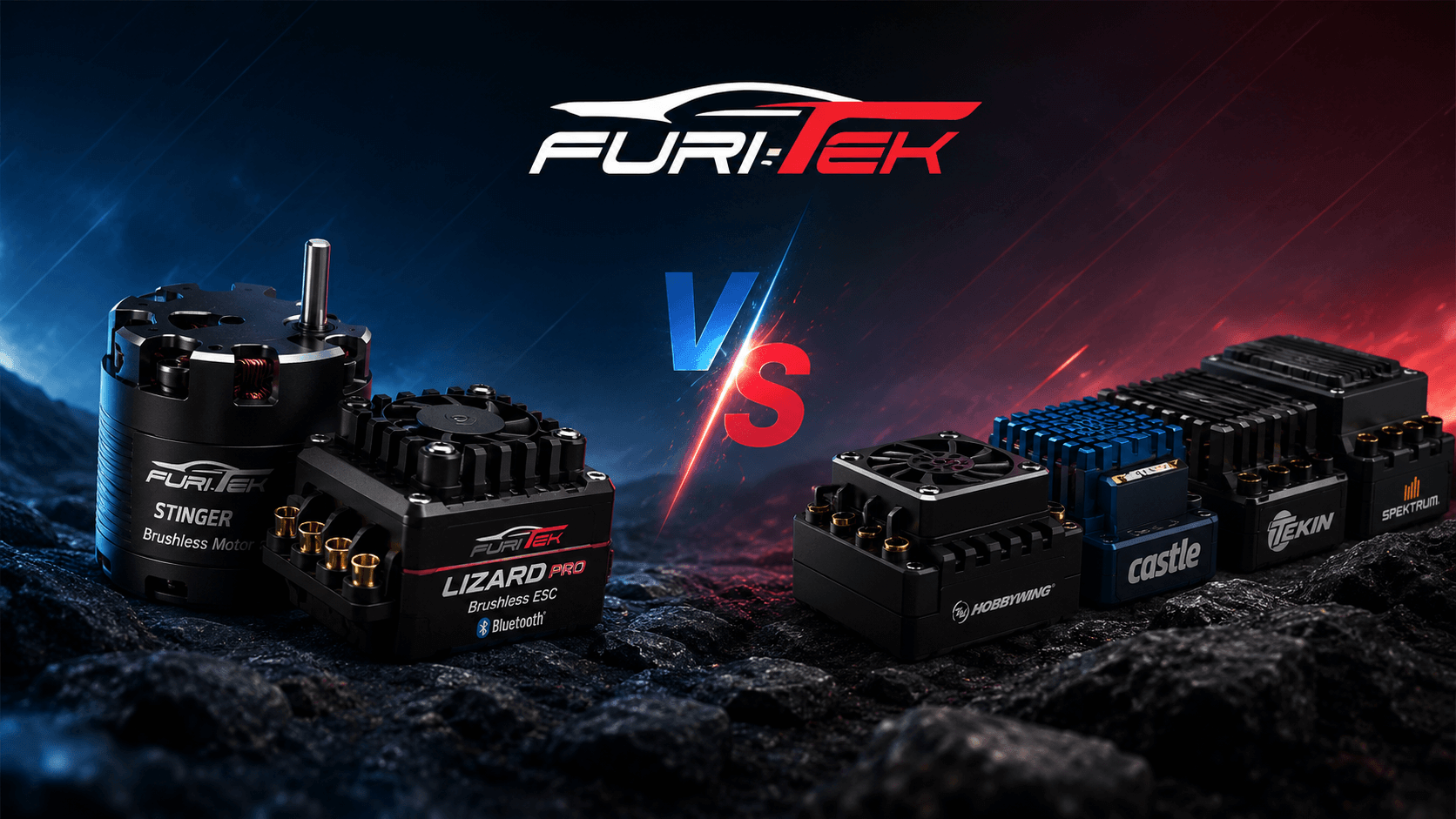
To choose an RC brushless motor, match the motor size and KV rating to your model and battery voltage, pick a sensored or sensorless type that suits how you drive, and choose a brushless ESC with a safe amp and voltage margin. Check gearing, temperature, and LiPo battery safety, because overheating and wrong voltage are the most common causes of failure.
Key takeaways
- KV is RPM per volt with no load: higher KV means higher speed and lower torque.
- Match motor size, ESC amp rating, and battery cell count (2S is 7.4 V, 3S is 11.1 V).
- Sensored motors give smooth low-speed control, while sensorless are simpler and cheaper.
- Watch gearing and motor temperature, and follow LiPo charging and storage safety.
In this guide
- Brushed vs Brushless RC Motors
- The Key Specifications Explained
- How to Choose the Right Motor for Your Model
- Choosing an ESC
- Gearing and Heat
- LiPo Battery Safety
- Popular RC Brands and Communities
- Upgrade Checklist
- Common Mistakes
- Frequently Asked Questions
Last updated: October 2026
Upgrading to a brushless system is one of the biggest performance jumps you can make in a radio-controlled car, truck, or crawler. It also confuses many beginners, because motor sizes, KV ratings, ESC amp ratings, and battery cells all have to work together. This guide explains how brushless motors work, how to read the specifications, a worked example, and how to choose the right motor and ESC for your model.
Brushed vs Brushless RC Motors
| Feature | Brushed motor | Brushless motor |
|---|---|---|
| How it works | Carbon brushes touch a commutator to switch current | Electronics switch current, with no brushes to wear out |
| Efficiency | Lower | Higher, so longer run times |
| Power and speed | Modest | Much higher |
| Maintenance | Brushes wear and need replacing | Very little |
| Cost | Cheaper | More expensive |
| Needs | A brushed ESC | A brushless ESC |
A brushless motor needs a matching brushless ESC (electronic speed controller). You cannot use a brushless motor with a brushed ESC.
The Key Specifications Explained
KV Rating
KV does not mean kilovolts. It tells you how many revolutions per minute (RPM) the motor turns for each volt applied, with no load. A higher KV motor spins faster but produces less torque for the same size. A lower KV motor spins slower with more torque.
Example: a 3,500KV motor on a 2S LiPo battery (7.4 volts) has a theoretical no-load speed of 3,500 × 7.4 = 25,900 RPM. On a 3S battery (11.1 volts) it would be 3,500 × 11.1 = 38,850 RPM. Real speeds are lower under load, and higher voltage also means more heat and stress.
Motor Size
Many RC motors use a four-digit size code. For example, a “3652” motor is about 36 mm in diameter and 52 mm long. Larger motors can produce more power and torque, but must fit your model.
Sensored vs Sensorless
- Sensored: includes a sensor cable that tells the ESC the rotor position, giving smoother low-speed control and better starts. It is popular for crawlers and racing.
- Sensorless: simpler and cheaper, and common in bashing and speed runs, but can be less smooth at very low speeds.
ESC Amp Rating
The ESC must handle the current the motor draws. Check the continuous and burst amp ratings, and choose an ESC with a comfortable margin above what the motor and battery will demand. An ESC that is too small can overheat or fail.
Battery Voltage and Cell Count
Each lithium-polymer (LiPo) cell has a nominal voltage of 3.7 volts. A 2S pack has two cells (7.4 V), and a 3S pack has three (11.1 V). Always match the battery to the maximum voltage that your motor and ESC are rated for.
How to Choose the Right Motor for Your Model
| Type of RC | What matters most | General direction |
|---|---|---|
| Crawlers and scale trucks | Slow-speed control and torque | Sensored, lower speed, high-torque setups |
| Short course and trucks for bashing | Power and durability | Medium to high KV, strong ESC, good cooling |
| On-road and touring cars | Smooth power delivery and speed | Sensored motors suited to the class rules |
| Speed runs | Top speed | High KV, higher voltage, and careful gearing |
Always check the manufacturer’s recommended motor range for your chassis, since the drivetrain, gearing, and weight limit what is safe.
Choosing an ESC
- Match the voltage. It should support the battery cell count you plan to use.
- Check the amp rating with a comfortable margin.
- Pick sensored or sensorless support to match your motor.
- Look for protections: low-voltage cutoff, thermal protection, and a built-in BEC to power the receiver and servo.
- Check programmability. A programmable ESC lets you adjust throttle, braking, and punch.
Gearing and Heat
Gearing decides how much load the motor carries. A bigger pinion gear or smaller spur gear increases top speed but adds load and heat. Check motor temperature after a run. Many motors are best kept below roughly 70 to 80 degrees Celsius (160 to 175 degrees Fahrenheit), though the manufacturer’s limits matter most. If it is too hot to hold, gear down, improve airflow, or reduce load.
LiPo Battery Safety
LiPo batteries are powerful and need respect. Follow these basics:
- Use a balance charger designed for LiPo, and never leave a charging battery unattended.
- Charge on a non-flammable surface, ideally in a LiPo-safe bag or container.
- Do not use or charge a puffed, damaged, or punctured battery.
- Do not over-discharge. Use your ESC low-voltage cutoff.
- Store at the recommended storage charge, not fully charged.
The Academy of Model Aeronautics and Battery University publish battery safety guides, and many hobby manufacturers publish their own instructions. For a similar topic about batteries in larger vehicles, see our guide to electric cargo bikes.
Popular RC Brands and Communities
Well-known motor and ESC makers include Castle Creations, Hobbywing, and Traxxas, while brands such as Furitek serve the smaller-scale and crawler market. Forums such as RCGroups are useful for reading real-world experiences, and in the UK the British Radio Car Association supports racing. Always compare specifications and read reviews rather than relying on brand reputation alone.
Upgrade Checklist
| Step | Check |
|---|---|
| 1 | Chassis and drivetrain can handle more power |
| 2 | Motor size fits and matches the class or use |
| 3 | KV suits your voltage and gearing |
| 4 | ESC amp and voltage ratings have a margin |
| 5 | Battery type, cell count, and plug are compatible |
| 6 | Cooling and temperature checks planned |
| 7 | Spare parts, such as gears and diffs, are ready |
Common Mistakes
- Choosing the highest KV. More speed means more heat and less control.
- Using an undersized ESC. It will overheat.
- Ignoring gearing. Poor gearing is a common cause of burnt motors.
- Using the wrong battery voltage. It can destroy electronics.
- Skipping upgrades to the drivetrain. Stronger power can break weak parts.
Frequently Asked Questions
KV is the number of RPM per volt with no load. A 3,500KV motor on 7.4 volts has a theoretical no-load speed of about 25,900 RPM.
Not always. Higher KV gives more speed but less torque and more heat. Choose KV to suit your model, gearing, and battery.
Sensored motors use a cable to report rotor position and run smoother at low speed. Sensorless motors are simpler and common for bashing.
No. A brushless motor needs a brushless ESC.
Check the motor current draw and choose an ESC with continuous and burst amp ratings comfortably above it, and matching the battery voltage.
Many motors should stay below roughly 70 to 80 degrees Celsius. Follow the manufacturer limits, and gear down or add cooling if it gets too hot.
This article is general information. Always follow the manufacturer instructions for your motor, ESC, and batteries, especially for LiPo safety.