
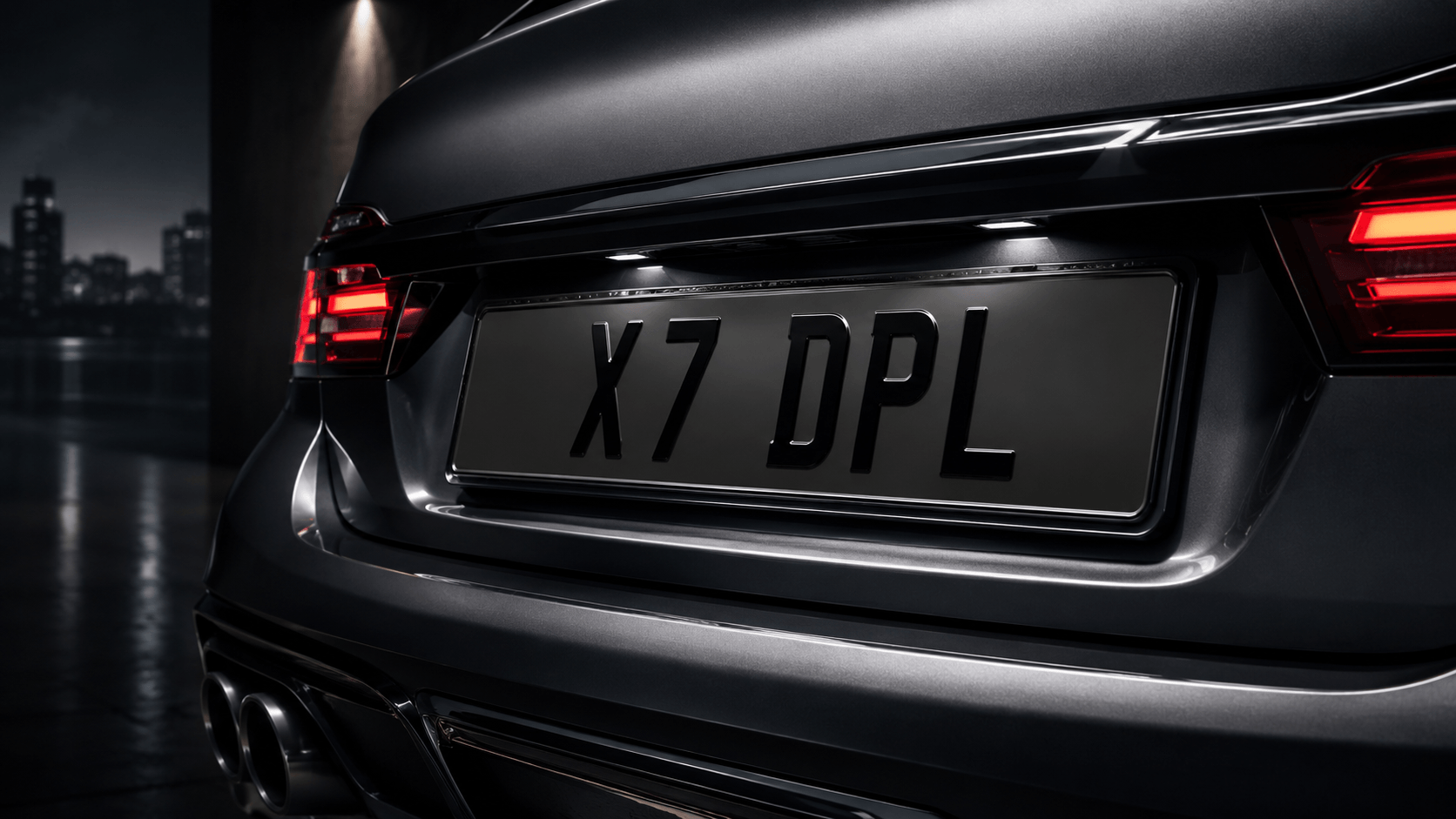
In the UK, number plate rules require black characters in the Charles Wright 2001 font on a white reflective background at the front and yellow at the rear, with set character sizes and spacing, to the BS AU 145e standard. Plates must be bought from a registered supplier, and illegal designs can lead to fines of up to £1,000 and a failed MOT.
Key takeaways
- Use the prescribed font, sizes, spacing, and colours: white at the front, yellow at the rear.
- Only registered suppliers can make road-legal plates, and they must check your documents.
- Stylised characters, altered spacing, tinted covers, and stickers are not allowed.
- Illegal plates can lead to fines up to £1,000 and MOT failure.
In this guide
- The Basic UK Number Plate Requirements
- Character Size and Spacing
- What Is Legal Styling and What Is Not
- How to Get a Legal Number Plate
- Penalties for Illegal Plates
- How to Personalise Your Car Legally
- Number Plates Used Only for Shows
- Common Mistakes
- Frequently Asked Questions
Last updated: October 2026
A number plate is a legal document on your car, not just a decoration. In the UK, the design is tightly controlled, and getting it wrong can mean a fine and a failed MOT. This guide explains what the rules require, which styling choices are allowed, and how to get a legal plate that still looks sharp.
The Basic UK Number Plate Requirements
- Colours: black characters on a white reflective background at the front, and black characters on a yellow reflective background at the rear.
- Font: the prescribed typeface known as Charles Wright 2001. Other fonts are not allowed.
- Standard: new plates must meet the British Standard BS AU 145e and show the standard mark, supplier details, and the plate must be reflective.
- Visibility: plates must be clean, undamaged, and clearly readable at all times.
- Both ends: most vehicles must display a plate at the front and the rear.
Character Size and Spacing
The DVLA sets exact dimensions for standard plates. As a guide, characters are 79 mm high, 50 mm wide (apart from the number 1 and letter I), with a 14 mm stroke. There are fixed gaps between characters and between the two groups on a standard format plate, and fixed margins around the edge. Check the current official guidance before ordering, because rules and special formats can differ, for example for older vehicles and motorcycles.
| Item | Typical requirement for a standard plate |
|---|---|
| Character height | 79 mm |
| Character width | 50 mm (except 1 and I) |
| Stroke thickness | 14 mm |
| Space between characters | 11 mm |
| Space between the two groups | 33 mm |
What Is Legal Styling and What Is Not
| Allowed | Not allowed |
|---|---|
| The correct font and spacing, with the required sizes | Different fonts, stylised or italic characters |
| A national identifier such as a flag with GB or UK on the left, if it meets the rules | Other logos, pictures, or slogans in the registration area |
| A green flash on plates for zero-emission vehicles, where eligible | Altering letters or numbers to spell words, such as using screws or gaps to change how they read |
| A plain border or surround that does not cover any of the plate | Frames, tinted covers, or stickers that hide or distort the characters |
| Raised or 3D-style characters only where the plate fully meets the standard | Any design that changes the shape, size, or spacing of the characters |
How to Get a Legal Number Plate
- Use a registered supplier. Only suppliers on the official register can make plates for road use.
- Prepare your documents. The supplier must check your identity and your right to use the registration, for example with your vehicle registration document (V5C) and photo ID.
- Choose the plate type. Standard, motorcycle, or other format, with or without a national identifier.
- Check the finished plate. Look at the font, spacing, and markings before fitting.
- Fit it correctly. Make sure it sits flat and is not blocked by a tow bar or bike rack.
For official rules and the list of suppliers, see the GOV.UK guide to number plates.
Penalties for Illegal Plates
- A fine of up to £1,000 for driving a vehicle with an illegal plate.
- A possible MOT failure if the plate is damaged, hard to read, or does not meet the rules.
- Problems with insurance claims and police stops.
How to Personalise Your Car Legally
You cannot change the design of the plate, but you can choose a different registration number. Private or “cherished” registrations can be bought and assigned to your vehicle through official channels. Once you have a legal plate, you can make your car stand out in other ways, such as wheels, paint, or a neat dealer or club badge away from the plate area. Avoid anything that covers or changes the plate.
Number Plates Used Only for Shows
Novelty or “show” plates are only for private property or displays, not for use on public roads. If your plate does not follow the road legal rules, do not drive on public roads with it.
Common Mistakes
- Buying from unregistered sellers. The plate may not comply or be traceable.
- Using stylised fonts. Even small design changes can make a plate illegal.
- Bad spacing. Plates with altered gaps can fail checks.
- Dirty or faded plates. Keep them clean and replace damaged ones.
- Using tinted or reflective covers. They can hide or distort characters from cameras.
Frequently Asked Questions
The Charles Wright 2001 typeface, with fixed character sizes and spacing.
Black characters on a white reflective background at the front, and black on a yellow reflective background at the rear.
Only if they fully meet the legal standard for font, size, spacing, and markings. Many novelty designs do not.
Yes, from a registered supplier, who must check your ID and your right to use the registration.
Up to £1,000, and the vehicle may also fail its MOT.
You can use a national identifier such as a flag with GB or UK on the left, if it meets the official rules.
This article is general information. Rules change, so check current guidance from GOV.UK and the DVLA before ordering plates.



