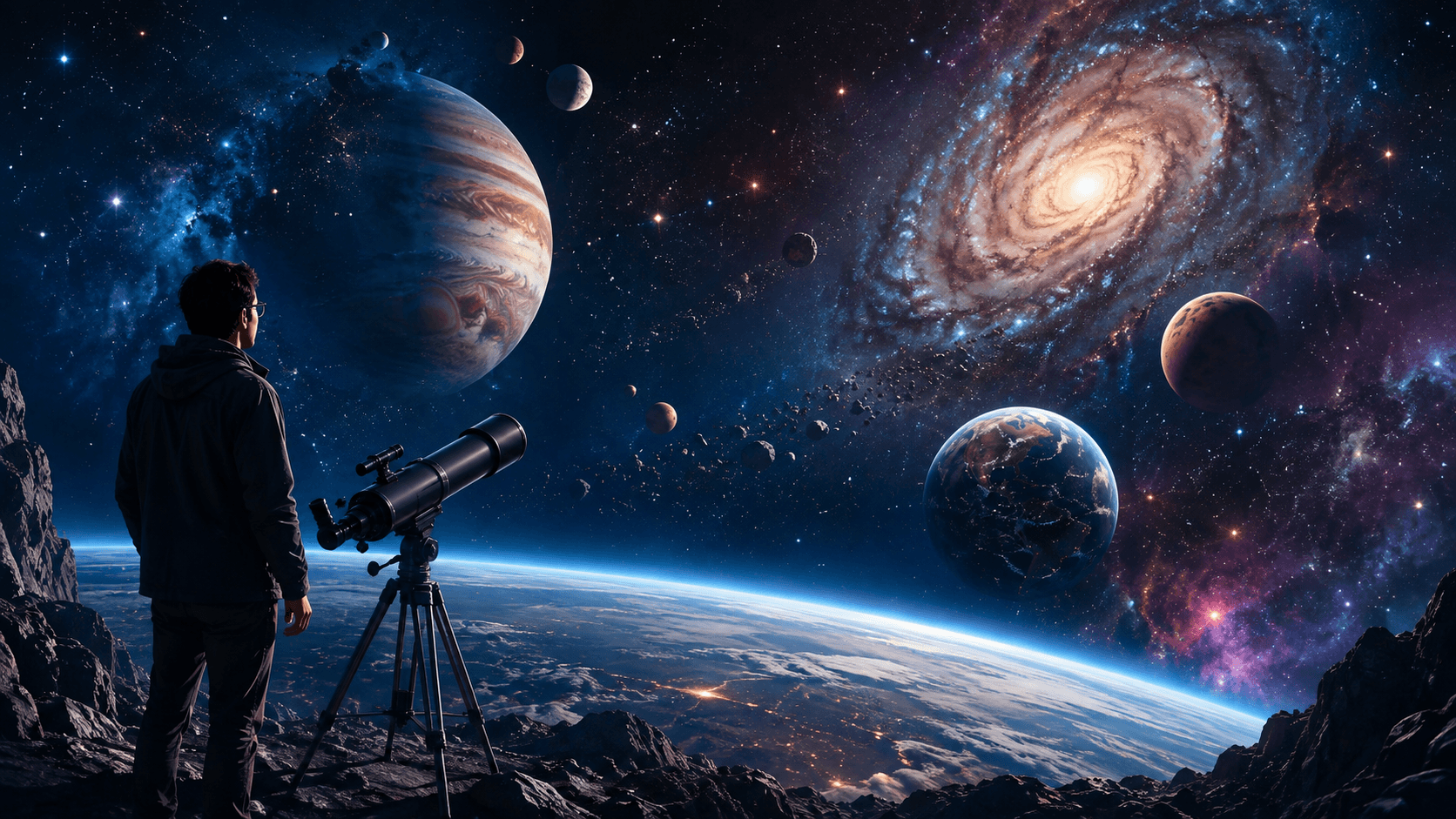
Space exploration is the use of rockets, satellites, probes, telescopes, and crewed spacecraft to study space and travel beyond Earth. Key milestones include Sputnik in 1957, Yuri Gagarin in 1961, the Apollo 11 Moon landing in 1969, the Voyager probes, the Hubble and James Webb telescopes, the International Space Station, and Mars rovers.
Key takeaways
- Space exploration began with Sputnik in 1957 and reached the Moon in 1969.
- Agencies such as NASA, ESA, ISRO, and JAXA work alongside private companies like SpaceX.
- Satellites support communication, navigation, and weather forecasting on Earth.
- Challenges include cost, radiation, microgravity, communication delays, and space debris.
In this guide
- What Is Space Exploration?
- A Short Timeline of Space Exploration
- Key Types of Space Missions
- Who Explores Space?
- How Rockets Work in Simple Terms
- Why Space Exploration Matters on Earth
- Current Goals in Space Exploration
- Challenges of Space Exploration
- How to Learn More and Get Involved
- Common Misconceptions About Space
- Frequently Asked Questions
Last updated: October 2026
Space exploration has taken humans from watching the stars to walking on the Moon, landing robots on Mars, and sending probes beyond the edge of the solar system. It can seem like a subject for experts, but the basic story is easy to follow. This guide explains how space exploration began, the key missions and milestones, the organisations involved, how it benefits life on Earth, and what challenges and goals lie ahead.
What Is Space Exploration?
Space exploration is the use of rockets, satellites, probes, telescopes, and crewed spacecraft to study space and travel beyond Earth’s atmosphere. It includes missions to orbit Earth, visit the Moon and planets, observe distant galaxies, and carry astronauts to space stations.
A Short Timeline of Space Exploration
| Year | Milestone |
|---|---|
| 1957 | The Soviet Union launches Sputnik 1, the first artificial satellite |
| 1961 | Yuri Gagarin becomes the first human in space |
| 1969 | Apollo 11 lands the first humans on the Moon, with Neil Armstrong and Buzz Aldrin walking on the surface |
| 1977 | Voyager 1 and Voyager 2 launch to study the outer planets |
| 1990 | The Hubble Space Telescope is launched |
| 1998 to 2000 | Construction of the International Space Station begins, and it becomes continuously inhabited from late 2000 |
| 2004 to 2012 | Mars rovers Spirit, Opportunity, and Curiosity explore the Red Planet |
| 2012 | Voyager 1 enters interstellar space |
| 2015 | SpaceX lands an orbital-class rocket booster for the first time |
| 2021 | Perseverance lands on Mars with the Ingenuity helicopter, and the James Webb Space Telescope launches in December |
| 2023 | India’s Chandrayaan-3 lands near the Moon’s south polar region |
You can read more about the first Moon landing in the Apollo 11 overview.
Key Types of Space Missions
- Satellites: orbit Earth for communication, navigation, weather, and observation.
- Space telescopes: observe the universe without interference from the atmosphere. See NASA’s pages on the James Webb Space Telescope.
- Space stations: orbiting laboratories where astronauts live and work, such as the International Space Station.
- Planetary probes and rovers: robotic explorers that study other worlds.
- Crewed missions: flights that carry people to orbit and, in the past, to the Moon.
- Deep-space probes: missions such as Voyager, which keep travelling beyond the planets.
Who Explores Space?
| Organisation | Role |
|---|---|
| NASA (United States) | Crewed and robotic missions, telescopes, and science |
| ESA (Europe) | Joint European missions in science, Earth observation, and exploration |
| ISRO (India) | Lunar, planetary, and satellite missions |
| JAXA (Japan) | Space science, satellites, and asteroid sample missions |
| Other national agencies | Including China, Russia, and many more countries |
| Private companies | Firms such as SpaceX that build reusable rockets and spacecraft |
International cooperation is guided by agreements, and the United Nations Office for Outer Space Affairs works on space law and cooperation.
How Rockets Work in Simple Terms
A rocket works by pushing hot gas out of its engines at high speed, which pushes the rocket in the opposite direction, following Newton’s third law of motion. To reach orbit, a rocket must reach very high speed, about 28,000 kilometres per hour near Earth. Many rockets use several stages, dropping empty fuel tanks as they climb to become lighter. Reusable rockets can land and fly again, which is helping to reduce the cost of launches.
Why Space Exploration Matters on Earth
- Communication and navigation: satellites support phones, television, and GPS.
- Weather and climate: satellites help forecast storms and monitor changes in oceans, ice, and forests.
- Science and discovery: missions teach us about the origin of the universe, planets, and the possibility of life elsewhere.
- Technology and spin-offs: research for space has led to improvements in materials, medicine, and electronics.
- Inspiration and education: space inspires young people to study science, technology, and engineering. See our article on raising resilient kids for ideas on encouraging curiosity and perseverance.
Current Goals in Space Exploration
- Returning humans to the Moon: NASA’s Artemis programme aims to establish a sustained presence. Schedules change, so check the latest on NASA’s website.
- Exploring Mars: rovers search for signs of past life and collect samples.
- Studying the early universe: telescopes such as Webb look at the first galaxies.
- Commercial space activity: private firms are launching satellites, running cargo and crew flights, and planning new stations.
- Tracking asteroids and space weather: to protect Earth and satellites.
Challenges of Space Exploration
| Challenge | Why it matters |
|---|---|
| Cost | Missions are expensive and take many years |
| Radiation | Space radiation is a health risk for long missions |
| Microgravity | Long stays can weaken bones and muscles |
| Distance and communication delays | Signals take time to travel, especially to Mars and beyond |
| Space debris | Old satellites and fragments threaten active spacecraft |
| Life support | Air, water, and food must be supplied or recycled |
How to Learn More and Get Involved
- Follow live updates and educational resources from NASA, ESA, and other agencies.
- Visit planetariums, science centres, and observatories.
- Try stargazing. You can see planets, the Moon, and the International Space Station with the naked eye.
- Join local astronomy clubs and citizen science projects.
- Read biographies of explorers and scientists. Our article on famous people who changed the world includes several science pioneers.
Common Misconceptions About Space
- “Astronauts float because there is no gravity.” Gravity is still present in orbit. Astronauts are in continuous free fall around Earth.
- “Space is completely empty.” It contains very little matter, but it is not completely empty.
- “We can see the Great Wall of China from space.” This is a common myth, as the wall is very narrow.
- “Space exploration is just a waste of money.” It produces knowledge, technology, and services we use every day, although the right level of spending is a matter of public debate.
Frequently Asked Questions
Sputnik 1, launched by the Soviet Union on 4 October 1957.
Yuri Gagarin, on 12 April 1961.
On 20 July 1969, during the Apollo 11 mission, when Neil Armstrong and Buzz Aldrin walked on the surface.
They expel hot gas at high speed from their engines, which pushes the rocket in the opposite direction, following Newton third law of motion.
It supports satellites for communication, navigation, and weather, advances science and technology, and inspires education.
It is an orbiting laboratory where astronauts from several countries live and work, and it has been continuously occupied since 2000.
This article is a general overview. Mission schedules and details change, so check official space agency websites for the latest information.