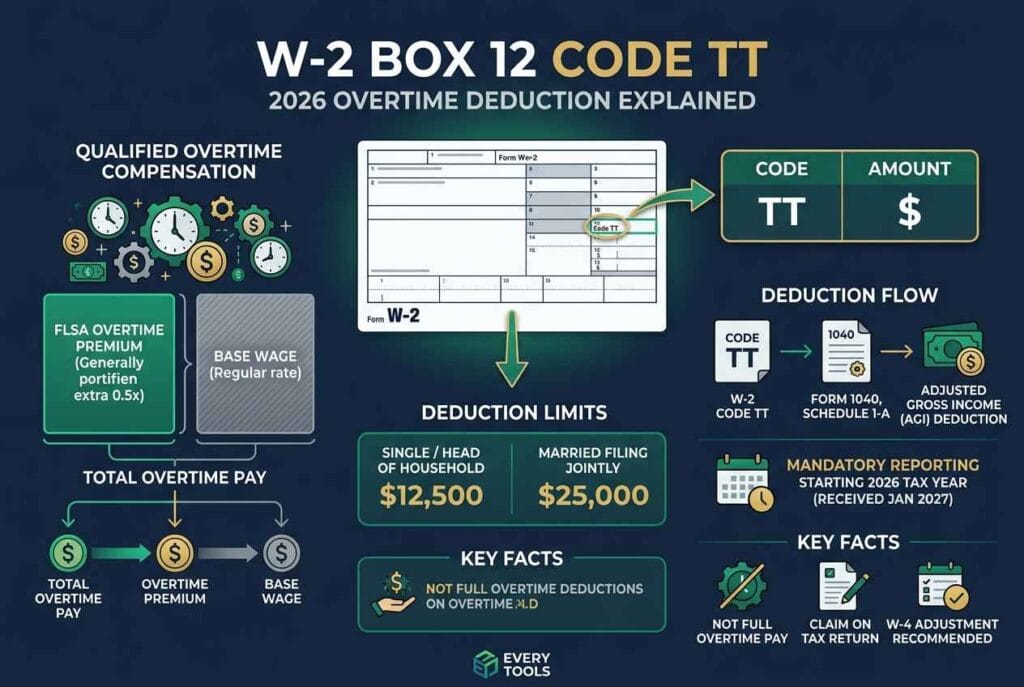
W-2 Box 12 Code TT is a new code that first appears on 2026 Forms W-2, which employees will receive in January 2027. It reports your total qualified overtime compensation, the amount employers use to substantiate the federal No Tax on Overtime deduction created by the One Big Beautiful Bill Act (OBBBA). If you see Code TT with a dollar amount in Box 12 of your W-2, that figure is the portion of your overtime pay that may qualify for a federal tax deduction.
This guide explains exactly what Code TT means, how the amount is calculated, why it is not the same as your total overtime pay, how it flows through to your tax return, and what changed between the 2025 and 2026 tax years. Real examples are included throughout, based on official IRS guidance.
Quick answer: what is W-2 Box 12 Code TT?
- Code TT reports your qualified overtime compensation (QOC) for tax year 2026 onward, first appearing on the W-2 you receive in January 2027.
- It is not your full overtime pay. It is only the FLSA overtime premium, generally the extra half of a time-and-a-half payment.
- Example: at a $20 regular rate with a $30 overtime rate, only the extra $10 an hour is qualified overtime compensation, not the full $30.
- It substantiates a deduction of up to $12,500 (single) or $25,000 (joint) on Schedule 1-A of your Form 1040, for tax years 2025 through 2028.
- Withholding is unaffected. Your employer still withholds tax on your full overtime pay as normal; the deduction is claimed when you file your return.
Want to estimate the deduction yourself? Use our free overtime pay calculator.
In this guide
- What is W-2 Box 12 Code TT?
- What counts as qualified overtime compensation?
- Worked example: calculating qualified overtime compensation
- How the No Tax on Overtime deduction works
- How to claim the deduction on your tax return
- What changed since the 2025 tax year
- Does Code TT change your paycheck withholding?
- What if Box 12 Code TT looks wrong?
- Employer requirements and penalties
- Common mistakes about Code TT
- How we calculated these figures
- Frequently asked questions
- Summary
- Sources
What is W-2 Box 12 Code TT?
Box 12 on Form W-2 is used for a range of specific, coded items beyond your basic wages, each identified by a one- or two-letter code. Code TT is a brand new addition, introduced specifically for the 2026 tax year to report qualified overtime compensation, following the passage of the One Big Beautiful Bill Act. According to the IRS guidance on the No Tax on Overtime deduction, employers must separately report this figure starting with tax year 2026 W-2 forms, which employees receive in January 2027.
What counts as qualified overtime compensation?
This is the detail most workers get wrong: Box 12 Code TT does not report your total overtime pay. It reports only the premium portion of overtime required under Section 7 of the Fair Labor Standards Act (FLSA), which is generally the extra half of a standard time-and-a-half payment. The base portion of your overtime pay, the part that matches your regular hourly rate, is not qualified overtime compensation, because that portion was already going to be paid to you regardless of the overtime premium rules, and it is taxed the same as any other regular wages.
For example, if your regular hourly rate is $20 and your FLSA-required overtime rate is $30 an hour (time and a half), only the additional $10 an hour is qualified overtime compensation. The base $20 an hour is treated as ordinary wages, not as part of Code TT. Qualified overtime compensation is generally calculated weekly, as the number of hours over 40 in a workweek multiplied by half of your regular rate of pay.
Worked example: calculating qualified overtime compensation
Consider a worker earning $22 an hour, who works 48 hours in a particular week, meaning 8 hours of overtime at time and a half ($33 an hour).
| Item | Calculation | Amount |
|---|---|---|
| Regular hourly rate | $22.00 | |
| Overtime rate (1.5×) | $22 × 1.5 | $33.00 |
| Total overtime pay this week | $33 × 8 hours | $264.00 |
| Base portion (ordinary wages, not Code TT) | $22 × 8 hours | $176.00 |
| Qualified overtime compensation (Code TT) | ($33 − $22) × 8 hours | $88.00 |
Only the $88 premium portion counts as qualified overtime compensation for that week, not the full $264 in overtime pay. Over a full year of similar weeks, this premium amount accumulates and is what your employer reports in Box 12, Code TT on your W-2.
| Item | Amount |
|---|---|
| Weekly qualified overtime compensation | $88.00 |
| Yearly qualified overtime compensation (Box 12, Code TT) | $4,576.00 |
| Deduction cap (single filer) | $12,500.00 |
| Amount actually deductible (lower of the two) | $4,576.00 |
How the No Tax on Overtime deduction works
The amount in Box 12, Code TT substantiates a federal income tax deduction available for tax years 2025 through 2028, under a new section of the tax code, IRC §225. Eligible workers can deduct qualified overtime compensation from their federal taxable income, up to the following limits:
| Filing status | Maximum deduction | Phaseout begins (MAGI) |
|---|---|---|
| Single / Head of household | $12,500 | $150,000 |
| Married filing jointly | $25,000 | $300,000 |
The deduction begins to phase out once your modified adjusted gross income (MAGI) exceeds $150,000 for a single filer, or $300,000 for a married couple filing jointly, reducing the amount you can deduct as income rises further above those thresholds. Importantly, your employer must report your full qualified overtime compensation in Box 12, Code TT, even if the amount exceeds what you can actually deduct because of the cap or the phaseout. The IRS’s own example illustrates this: an employer that paid $30,000 in qualified overtime compensation during the year reports the full $30,000 in Code TT, even though the deduction itself is capped at $12,500 for a single filer.
How to claim the deduction on your tax return
To claim the No Tax on Overtime deduction, you report the amount using Schedule 1-A of Form 1040, which flows into the above-the-line deductions total on your return. This means you can claim it whether or not you itemize your other deductions, since above-the-line deductions reduce your income before the choice between the standard deduction and itemizing is even made. For tax year 2026, you may only include the qualified overtime compensation figure that your employer actually reported in Box 12, Code TT of your W-2; you cannot self-calculate a higher figure based on your own estimate of your overtime hours, even if you believe your employer under-reported the amount.
What changed since the 2025 tax year
Because the One Big Beautiful Bill Act became law after the 2025 tax year’s forms and payroll systems were already finalized, the IRS granted transition relief for 2025 through Notice 2025-62 and Notice 2025-69. For 2025 tax returns, filed in early 2026, employers were not required to separately report qualified overtime compensation on the W-2 at all; some employers voluntarily reported an estimate in Box 14 instead, and employees without a Box 14 figure could rely on their own pay records or a reasonable estimate.
| Tax year | W-2 reporting requirement |
|---|---|
| 2025 (filed 2026) | Not required; some employers voluntarily used Box 14; employees could use pay records or a reasonable estimate under transition relief |
| 2026 (filed 2027) onward | Mandatory reporting in Box 12, Code TT; employees must use this exact figure, not a self-estimate |
Starting with tax year 2026, that transition relief ends completely. Employers must use the standardized Box 12, Code TT, and employees generally cannot use a self-calculated estimate; the figure must come directly from the W-2, or from a corrected W-2c if the original figure was wrong.
Does Code TT change your paycheck withholding?
No. Employers must continue withholding federal income tax, Social Security tax and Medicare tax from your full overtime pay exactly as before; qualified overtime compensation remains fully subject to withholding throughout the year. Employers are not permitted to reduce withholding simply because an employee expects to claim the deduction later. If you want your paycheck withholding adjusted to reflect the expected deduction, you must submit an updated Form W-4 to your employer, since the 2026 Form W-4 includes a specific place for this adjustment in Step 4(b). Without an updated W-4, the tax benefit of qualified overtime compensation only arrives when you file your tax return and claim the deduction on Schedule 1-A, typically as part of a larger refund or a smaller balance due.
What if Box 12 Code TT looks wrong?
If you believe the amount reported in Box 12, Code TT is too low, too high, or missing entirely, contact your employer’s payroll department first, since they are responsible for the accuracy of this figure. If an error is confirmed, your employer must file Form W-2c with the Social Security Administration and provide you with a corrected copy as soon as possible. You generally cannot claim a higher qualified overtime compensation figure on your tax return than what appears on your official W-2 or W-2c; the IRS has specifically noted that Form 4852, the substitute form normally used when a W-2 is missing, cannot be used to claim additional qualified overtime compensation beyond what was actually reported.
Employer requirements and penalties
Employers, including private businesses and government bodies, must separately identify and report each eligible employee’s qualified overtime compensation in Box 12, Code TT for tax year 2026 and beyond. Qualified overtime compensation is generally calculated weekly, as hours over 40 in a workweek multiplied by half the employee’s regular rate of pay, for FLSA-covered non-exempt employees. In rare cases where a worker is an employee under FLSA rules but classified as an independent contractor for federal tax purposes, the amount may instead be reported on Form 1099-MISC, Box 14, or Form 1099-NEC, Box 1d, though this situation is uncommon.
Standard incorrect information return penalties apply if an employer fails to comply with the Code TT reporting requirement, generally around $680 per incorrect return filed, subject to annual caps on total penalties. If the IRS finds evidence of intentional or knowing non-compliance, higher penalties can apply without the usual caps. These reporting obligations apply regardless of an employer’s size or sector.
Common mistakes about Code TT
- Assuming Code TT shows your total overtime pay. It only shows the premium portion, generally half of your time-and-a-half rate, not the full overtime wage.
- Assuming the Code TT amount is exactly what you can deduct. Your actual deduction is capped at $12,500 (single) or $25,000 (joint) and phases out at higher incomes, even if a larger amount is reported.
- Expecting a bigger paycheck immediately. The tax benefit arrives when you file your return, not through reduced withholding, unless you specifically update your Form W-4.
- Looking for Code TT on a 2025 W-2. The code did not exist yet for the 2025 tax year; transition relief applied instead.
- Trying to self-report a higher qualified overtime figure than what your employer actually reported on your W-2, without first requesting a corrected W-2c.
- Confusing Code TT with Code TP, a separate new code used for the related qualified tips deduction under the same legislation.
How we calculated these figures
The examples in this guide use the IRS’s own calculation method for qualified overtime compensation: hours over 40 in a workweek, multiplied by half the employee’s regular hourly rate. We made the following assumptions:
- Figures apply to tax year 2026, the first year Code TT reporting is mandatory.
- The worked example assumes a standard FLSA time-and-a-half overtime rate, with no double time or other premium involved.
- Deduction limits and phaseout thresholds reflect the No Tax on Overtime deduction as confirmed in IRS guidance for tax years 2025 through 2028.
- Figures do not include state tax treatment, which may differ from the federal deduction described here.
- All results are rounded to the nearest cent.
IRS guidance on this new deduction and reporting requirement may continue to be updated, so always check the latest IRS Fact Sheet or consult a qualified tax professional before relying on these figures for your own tax return.
Frequently asked questions about W-2 Box 12 Code TT
What does W-2 Box 12 Code TT mean?
Code TT reports your qualified overtime compensation for tax year 2026 onward, first appearing on the W-2 you receive in January 2027. It is the premium portion of your FLSA overtime pay that may qualify for the federal No Tax on Overtime deduction.
Is Box 12 Code TT my full overtime pay?
No. It only reports the overtime premium, generally the extra half of a time-and-a-half payment, not your entire overtime wage. The base portion of overtime pay, matching your regular hourly rate, is taxed as ordinary wages and is not included in Code TT.
How much can I deduct using the Box 12 Code TT amount?
Up to $12,500 for a single filer, or $25,000 for a married couple filing jointly, for tax years 2025 through 2028. The deduction phases out once your modified adjusted gross income exceeds $150,000 (single) or $300,000 (joint).
Why is my Code TT amount higher than my deduction limit?
Employers must report your full qualified overtime compensation, even if it exceeds what you can actually deduct. For example, $30,000 in qualified overtime is reported in full, even though the deduction itself is capped at $12,500 for a single filer.
How do I claim the No Tax on Overtime deduction?
Report the amount using Schedule 1-A of Form 1040, which flows into your above-the-line deductions. For tax year 2026, you can only use the figure your employer actually reported in Box 12, Code TT.
Does Code TT affect my paycheck withholding?
No. Employers must continue withholding federal income tax and FICA on your full overtime pay as normal. To adjust your withholding for the expected deduction, you must submit an updated Form W-4 with the relevant section in Step 4(b) completed.
Why didn’t I see Code TT on my 2025 W-2?
Code TT did not exist for the 2025 tax year. The IRS granted transition relief through Notice 2025-62 and Notice 2025-69, so separate reporting was not required until tax year 2026.
What should I do if Box 12 Code TT looks wrong on my W-2?
Contact your employer’s payroll department. If an error is confirmed, the employer must file Form W-2c with the Social Security Administration and provide you with a corrected copy.
Can I claim more qualified overtime compensation than what is on my W-2?
No. You generally cannot self-calculate or claim a higher figure than what your employer reported. If you believe the figure is wrong, request a corrected Form W-2c rather than adjusting the amount yourself.
What penalty does an employer face for not reporting Code TT correctly?
Standard incorrect information return penalties apply, generally around $680 per incorrect return filed, subject to annual caps, with higher penalties possible for intentional non-compliance.
Summary: W-2 Box 12 Code TT
Box 12, Code TT is a new W-2 code, first used for tax year 2026, reporting your qualified overtime compensation, the FLSA overtime premium that substantiates the federal No Tax on Overtime deduction. It is not your total overtime pay, only the extra premium portion, generally half of a time-and-a-half rate. The deduction is capped at $12,500 for single filers or $25,000 for joint filers, phasing out above $150,000 or $300,000 of income, and is claimed on Schedule 1-A of Form 1040 using the exact figure your employer reports.
Estimate your own overtime pay and potential deduction with our free overtime pay calculator.
Related guides on Every Tools:
- Hourly to salary, overtime and take-home pay calculator
- Time and a half calculator and double time pay calculator
- Is overtime taxed more? UK and US rules explained
- How to calculate overtime for salaried employees
- $22, $27 and $33 an hour after taxes
Sources and further reading
- IRS: What to know about the No Tax on Overtime deduction
- IRS: 2026 tax inflation adjustments
- US Department of Labor: Overtime pay (FLSA)
- IRS: About Form W-2
- IRS: About Form W-2c
This article is for general information only. It is not tax, legal or payroll advice, and Every Tools is not affiliated with the IRS or any government agency.