
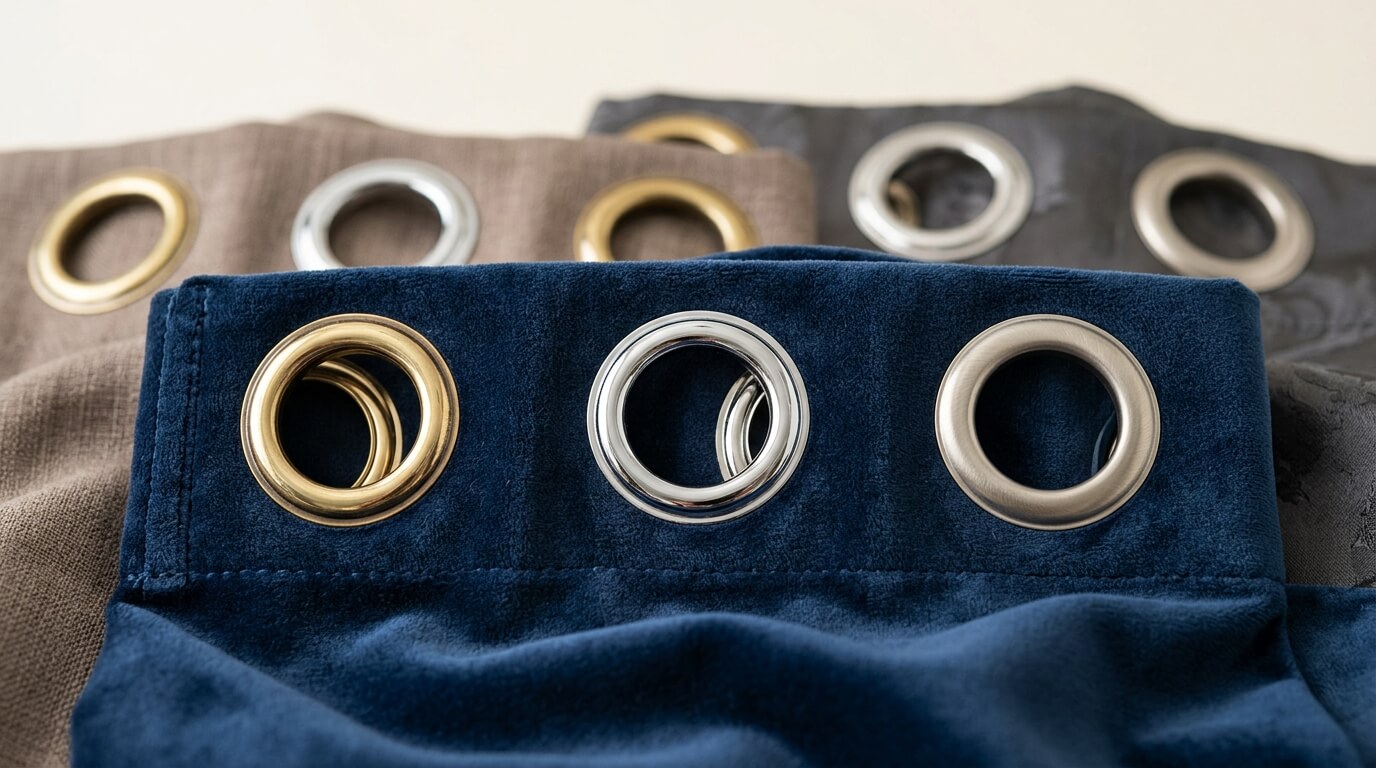
Eyelet curtains have metal rings built into the top of the fabric, so you slide them straight onto a curtain pole without hooks. To buy the right pair, measure your pole width and drop, choose a width about 1.5 to 2 times the pole length for good fullness, and make sure the pole is slim enough to pass through the eyelets.
Key takeaways
- Eyelet curtains hang from poles, not tracks, and give regular, modern folds.
- Aim for curtain width of about 1.5 to 2 times the pole width and measure the drop from the pole.
- Check that the pole diameter fits through the eyelets, and use strong brackets for heavy fabrics.
- Follow the care label, and re-hang slightly damp to let creases fall out.
In this guide
- What Are Eyelet Curtains?
- Pros and Cons of Eyelet Curtains
- Eyelet vs Other Curtain Headings
- How to Measure for Eyelet Curtains
- Choosing the Right Pole
- How to Hang Eyelet Curtains
- Choosing Fabrics and Linings
- Care and Cleaning
- Common Mistakes to Avoid
- Frequently Asked Questions
Last updated: October 2026
Eyelet curtains are one of the most popular styles because they look neat, slide easily, and are simple to hang. Metal rings are built into the top of the fabric, and you slide the curtain straight onto a pole. This guide explains how they work, how to measure and choose them, how to hang them, and how to look after them.
What Are Eyelet Curtains?
Eyelet curtains, also called ring-top or grommet curtains, have large metal or plastic rings set into a reinforced heading at the top. The curtain pole passes through these rings. When the curtains are drawn, they fall into smooth, regular waves, giving a modern, tailored look without the need for hooks, tape, or separate rings.
Pros and Cons of Eyelet Curtains
| Pros | Cons |
|---|---|
| Clean, contemporary look | Rings can show a gap of bare pole at the top |
| Easy to hang with no hooks | Not suitable for curtain tracks, so you need a pole |
| Uniform, even folds | Curtains can be harder to pull across than rings with glides |
| Wide range of fabrics, colours, and linings | Heavy fabrics put strain on the pole and brackets |
| Good coverage when closed | Rings may click on metal poles |
Eyelet vs Other Curtain Headings
| Heading | Look | Hangs from | Best for |
|---|---|---|---|
| Eyelet | Modern, regular waves | Pole | Living rooms and bedrooms |
| Pencil pleat | Traditional, gathered | Pole or track | Classic interiors |
| Pinch pleat | Formal, structured | Pole or track | Elegant rooms and heavier fabrics |
| Tab top | Casual, relaxed | Pole | Light fabrics and informal spaces |
How to Measure for Eyelet Curtains
Step 1: Decide Where the Pole Goes
Fit the pole wider than the window so curtains can sit beside the glass when open and let in more light. A common guide is 10 to 15 cm beyond each side of the window frame and about 10 to 15 cm above it. Mounting higher can make a room feel taller.
Step 2: Measure the Pole Width
Measure the length of the pole between the end finials, or the width of the track area you want to cover.
Step 3: Work Out the Curtain Width
Curtains should look full, not flat. For eyelet styles, a fullness of roughly 1.5 to 2 times the pole width is usual. For example, a 180 cm pole at about 1.75 times fullness needs around 315 cm of total curtain width, which is roughly 157 cm per curtain when you use a pair. Always check the product’s stated width, as sizes vary.
Step 4: Measure the Drop
Measure from the underside of the pole, or the top of the rings, to where you want the curtain to end. The most common finishes are:
- Sill length: ends just above the windowsill.
- Below the sill: ends about 15 cm below the sill, which is a good compromise.
- Floor length: ends about 1 to 2 cm above the floor so it does not drag.
Measure at several points, because floors and walls are rarely perfectly level.
Choosing the Right Pole
- Diameter: the pole must pass through the eyelet openings. Eyelet openings are often around 40 mm wide, and poles of about 28 mm to 35 mm are common, but check each product’s measurements.
- Strength: heavy, lined, or blackout curtains need a sturdy pole with a centre bracket for wider windows.
- Finish: choose a colour that suits your decor, such as black, brushed steel, brass, or wood.
- Finials: end caps that help hold the curtains in place.
How to Hang Eyelet Curtains
- Fix the brackets. Use a spirit level and secure them into solid wall or lintel, using suitable plugs.
- Remove one finial. Take off the end cap from the pole.
- Thread the curtain. Slide the pole through each eyelet in turn, making sure the curtain faces the right way and the lining side faces the window.
- Replace the finial. Refit the end cap securely.
- Mount the pole. Place it into the brackets and tighten the grub screws.
- Arrange the folds. Pull the curtains closed, set the folds evenly, and leave them for a day to help them settle.
Choosing Fabrics and Linings
- Unlined: light and airy, good for filtering sunlight.
- Lined: hangs better and gives more privacy and insulation.
- Thermal: helps reduce heat loss through windows. The Energy Saving Trust offers advice on keeping your home warm.
- Blackout: blocks most light, which many people like in bedrooms. Our bedding and sleep guide explains how the bedroom environment affects sleep.
Care and Cleaning
- Always follow the care label. Many eyelet curtains can be machine-washed on a gentle cycle, but some need dry cleaning.
- Remove curtains from the pole and shake off dust before washing.
- Allow for a small amount of shrinkage with some fabrics.
- Re-hang while slightly damp so the weight helps drop out creases.
- Iron on a low heat and avoid the metal eyelets.
- Vacuum the pole and rings occasionally, as dust builds up there.
Common Mistakes to Avoid
- Buying curtains too narrow. Narrow curtains look flat and do not cover the window.
- Mounting the pole too low. It can make the window and room seem smaller.
- Using the wrong pole size. The eyelets may not slide properly.
- Ignoring the weight. Heavy curtains need strong brackets and fixings.
- Not measuring twice. Check measurements before ordering, especially for made-to-measure curtains.
Frequently Asked Questions
They are curtains with metal or plastic rings built into the top heading so they slide directly onto a curtain pole.
Not usually. They are designed for poles. For a track, choose pencil pleat, pinch pleat, or tape-top curtains with hooks.
About 1.5 to 2 times the width of your pole for a full look, but check the width stated by the manufacturer.
It must be narrower than the eyelet openings. Poles of about 28 mm to 35 mm are common, but always check the product specifications.
Common choices are sill length, about 15 cm below the sill, or floor length ending 1 to 2 cm above the floor.
Many can be machine-washed on a gentle cycle, but always follow the care label and consider dry cleaning for delicate or lined curtains.
This guide is general advice. Always check product measurements and care labels before buying or cleaning.



