
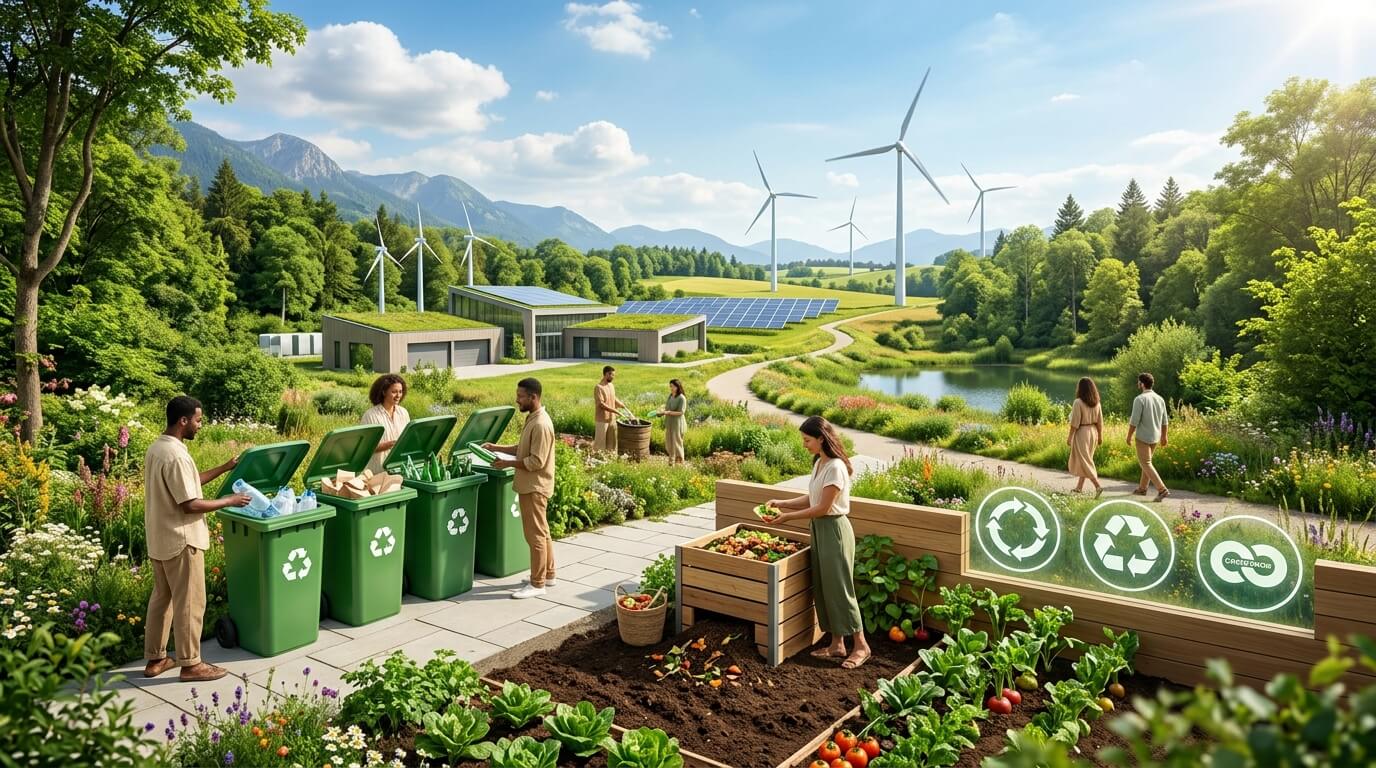
Eco-friendly waste solutions follow the waste hierarchy: prevent waste first, then reuse and repair, recycle, compost or digest organic waste, and recover energy only as a last resort before disposal. The most effective approaches combine better product design, circular economy practices, deposit return schemes, and clear sorting systems.
Key takeaways
- Prevention and reuse come before recycling in the waste hierarchy.
- Composting and anaerobic digestion turn food and organic waste into soil improver and energy.
- Deposit return schemes and extended producer responsibility raise collection and recycling rates.
- Businesses should audit waste, set targets, train staff, and check green claims carefully.
In this guide
- The Principle Behind Eco-Friendly Waste Solutions
- 12 Eco-Friendly Waste Solutions
- Comparing the Main Solutions
- Biodegradable, Compostable, and Recyclable: What Is the Difference?
- How Businesses Can Start
- How Communities and Individuals Can Help
- Common Mistakes to Avoid
- Frequently Asked Questions
Last updated: October 2026
Waste is not only a household problem. Cities, businesses, farms, and factories all produce it, and the way it is handled affects land, water, air, and climate. The most effective eco-friendly waste solutions work at several levels at once: preventing waste, keeping materials in use, and treating what remains in the least harmful way. This guide explains 12 practical solutions for communities, businesses, and individuals, and shows how they fit together.
The Principle Behind Eco-Friendly Waste Solutions
Environmental agencies describe a waste hierarchy that ranks options from best to worst: prevention first, then reuse, recycling, recovery, and finally disposal. The US Environmental Protection Agency explains this approach in its pages on sustainable materials management. For food, the EPA also publishes a food recovery hierarchy that puts reducing waste and feeding people ahead of composting and disposal. If you want the household view, see our guide on how to reduce household waste, and for the reasons behind recycling read why recycling is important.
12 Eco-Friendly Waste Solutions
1. Waste Prevention and Smarter Design
The cleanest waste is the waste never created. Businesses can redesign products to use less material, last longer, and be easier to repair. Individuals can choose durable items and avoid single-use products.
2. The Circular Economy
A circular economy keeps products and materials in use for as long as possible through reuse, repair, refurbishment, and recycling, instead of the usual take, make, and dispose model. The Ellen MacArthur Foundation is a leading source of information on the idea.
3. Reuse, Repair, and Sharing
- Repair cafes help people fix electronics, clothing, and furniture. You can find local groups through Repair Cafe.
- Libraries of things lend tools and equipment.
- Second-hand shops, swap events, and online marketplaces give items another life.
4. Better Recycling Systems
Clear labelling, easy-to-use collections, and high-quality sorting reduce contamination and raise recycling rates. Programmes such as separate collection for glass, paper, and food waste often give cleaner materials than single mixed bins.
5. Composting
Composting turns food scraps and garden waste into soil improver. Home composting works for many households, and larger-scale composting plants handle collected food waste. The EPA has a guide to composting at home.
6. Anaerobic Digestion
Anaerobic digestion breaks down food waste, manure, and sewage sludge without oxygen, producing biogas that can be used for heat, electricity, or vehicle fuel, and a nutrient-rich material called digestate that can be used on farmland.
7. Deposit Return Schemes
A small refundable deposit on bottles and cans encourages people to return them, which leads to high collection rates and cleaner recycled material. Many countries and regions operate or are introducing such schemes.
8. Extended Producer Responsibility (EPR)
EPR rules make producers responsible for the cost of collecting and recycling their packaging or products at the end of life. This gives companies a financial reason to design products that are easier to recycle. The UN Environment Programme publishes research on waste and circular approaches.
9. Reducing Food Waste
Food waste has big environmental and financial costs. Solutions include better planning and storage, donating surplus food, and using “ugly” produce. In the UK, WRAP provides guidance for households, retailers, and manufacturers.
10. Refill and Reusable Packaging
Refill stations, returnable containers, and bulk buying cut packaging waste. Businesses can offer deposits on reusable cups and containers, or use packaging that can be collected and reused.
11. Responsible Handling of Electronics and Hazardous Waste
Phones, batteries, paints, and chemicals contain materials that can harm the environment if thrown away carelessly. Use take-back schemes, collection events, and authorised recyclers.
12. Energy Recovery as a Last Resort
Waste-to-energy plants burn non-recyclable waste to generate electricity or heat, which can be better than landfill. However, it sits below prevention, reuse, and recycling in the hierarchy, and it must be done with strong pollution controls.
Comparing the Main Solutions
| Solution | Main benefit | Typical challenge |
|---|---|---|
| Prevention and redesign | Avoids waste and cost at source | Needs changes in design and habits |
| Reuse and repair | Keeps products in use | Repair skills, parts, and costs |
| Recycling | Recovers materials | Contamination and market demand |
| Composting | Returns nutrients to soil | Space, odour, and correct sorting |
| Anaerobic digestion | Produces energy and fertiliser | Needs facilities and a steady supply of waste |
| Deposit return | High return rates | Set-up and logistics |
| Waste-to-energy | Reduces landfill and generates energy | Emissions control and public concern |
Biodegradable, Compostable, and Recyclable: What Is the Difference?
- Recyclable: can be collected and turned into new products, if local systems accept it.
- Compostable: can break down under specific composting conditions, often in industrial facilities only. Check labels and local rules.
- Biodegradable: a broad claim that can be misleading, because it does not say how long or under what conditions the item breaks down.
Be careful with vague green claims, and prefer reusable items over disposable ones even if they are labelled eco-friendly.
How Businesses Can Start
- Do a waste audit. Measure what you throw away and where it comes from.
- Set targets. For example, cut packaging or food waste by a set percentage.
- Change purchasing. Choose suppliers with less packaging and recyclable materials.
- Train staff. Make sure everyone knows how to sort and reduce waste.
- Work with reliable waste partners who can show where materials go.
- Track and report. Share progress and keep improving. If you need professional help, see our guide to what a business consultant does.
How Communities and Individuals Can Help
- Support local repair, reuse, and refill initiatives.
- Follow local sorting rules carefully.
- Compost food scraps or use a food waste collection if available.
- Buy second-hand, repair items, and borrow rarely used tools.
- Ask local councils and businesses for better recycling and refill options.
Common Mistakes to Avoid
- Focusing only on recycling. Prevention and reuse come first.
- Trusting vague green labels. Ask for specific proof.
- Contaminating recycling. Dirty or wrong items can spoil a batch.
- Buying new “eco” products you do not need. Use what you already have first.
- Expecting a single solution. A combination of approaches works best. For more ideas on keeping costs and waste low, see our guide to financial planning.
Frequently Asked Questions
They are methods that prevent, reduce, reuse, recycle, or safely treat waste in ways that reduce harm to the environment.
It ranks waste options from best to worst: prevention, reuse, recycling, recovery, and then disposal.
It is an approach that keeps products and materials in use for as long as possible through reuse, repair, and recycling, instead of throwing them away.
It is a policy that makes producers responsible for the cost of collecting and recycling their products and packaging at end of life.
Not always. Many compostable items need industrial facilities, so check local rules, and choose reusable options where possible.
Start with a waste audit, set targets, change purchasing, train staff, and work with waste partners that can show where materials go.
This article is general information. Waste rules and facilities differ by country and local authority, so follow local guidance.



