
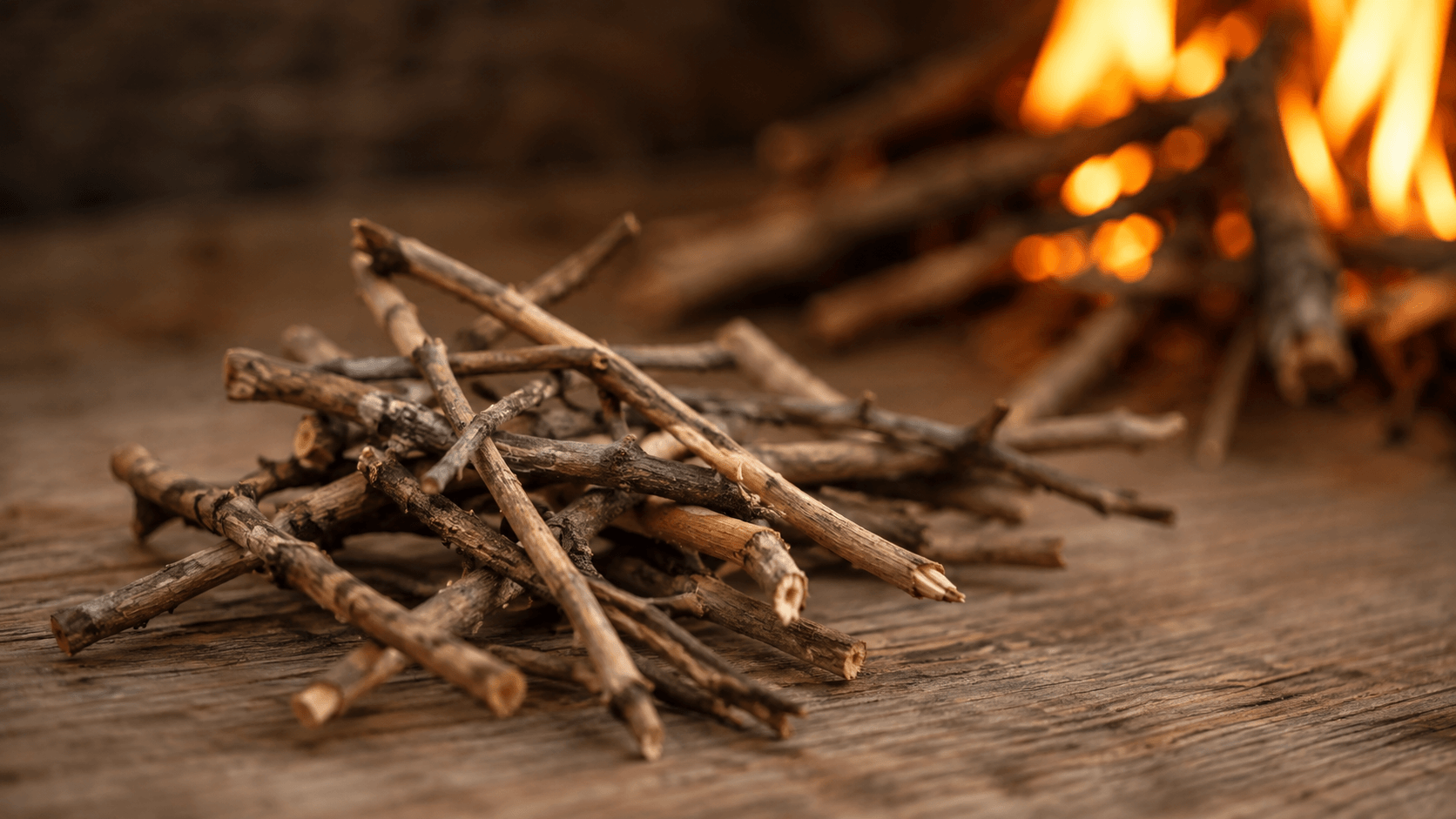
Kindling is small, dry pieces of wood, usually pencil to thumb thickness, used to catch fire from tinder and build enough heat to ignite larger logs. It sits between tinder, which catches a spark, and firewood, which keeps the fire burning. Dry softwood twigs and split sticks are the most common kindling.
Key takeaways
- Tinder catches the spark, kindling builds the flame, and firewood sustains the fire.
- Dry softwood such as pine or spruce makes excellent kindling, and fatwood lights even when slightly damp.
- Build with airflow in mind, adding larger pieces gradually.
- Check fire rules, never use accelerants, and make sure the fire is fully out.
In this guide
- What Is Kindling?
- The Fire Triangle
- Tinder vs Kindling vs Firewood
- The Best Wood for Kindling
- How to Make Kindling
- How to Build a Fire Step by Step
- Popular Fire Lay Methods
- Why Dry Wood Matters
- Common Problems and Fixes
- Fire Safety Rules
- Keeping Warm Safely at Home
- Frequently Asked Questions
Last updated: October 2026
Anyone who has struggled to light a campfire or a wood stove knows the problem: you hold a flame to a big log and nothing happens. The secret is not a bigger flame, but the right sequence of materials. Kindling is the middle step between a quick-lighting starter and the large logs that keep the fire going. This guide explains what kindling is, how it differs from tinder and firewood, how to prepare it, and how to build and manage a fire safely.
What Is Kindling?
Kindling is small, dry pieces of wood, such as thin sticks and split pieces, used to catch fire from a tiny flame and build enough heat to ignite larger logs. It usually ranges from about the thickness of a pencil up to a thumb. It burns quickly and fiercely, which is exactly why it works: it turns a small ember or flame into a strong, steady fire.
The Fire Triangle
Every fire needs three things: heat, fuel, and oxygen. Tinder and kindling help you get the heat and fuel in balance, while good airflow supplies the oxygen. If you remove any one of them, the fire goes out. This is why a tightly packed pile smothers a flame, and why a loose structure with air gaps burns well.
Tinder vs Kindling vs Firewood
| Material | Size | Job | Examples |
|---|---|---|---|
| Tinder | Very fine and fluffy | Catches a spark or small flame quickly | Dry grass, birch bark, cotton wool with petroleum jelly, paper, wood shavings |
| Kindling | Pencil to thumb thickness | Builds flame and heat | Dry twigs, split softwood, fatwood sticks |
| Fuel wood (firewood) | Wrist thickness and larger | Sustains the fire for a long time | Seasoned hardwood logs such as oak, ash, or beech |
The Best Wood for Kindling
- Softwoods such as pine, spruce, and cedar light easily and burn fast, so they make excellent kindling.
- Dry, dead twigs that snap cleanly are usually ready to burn.
- Fatwood is resin-rich pine that lights even when slightly damp.
- Hardwoods are better saved for the main fuel, because they burn longer and hotter.
Avoid treated, painted, or varnished wood, and never burn plastics or chemically treated materials, as they produce toxic smoke.
How to Make Kindling
- Start with dry wood. Wood that has been stored under cover is ideal.
- Split a small log into quarters using a hatchet or a splitting axe on a stable chopping block.
- Split the pieces again until you have sticks about as thick as a pencil to a thumb.
- Make feather sticks by shaving thin curls along a stick without cutting them off, which gives extra surface area for the flame.
- Use proper tools and protect yourself. Wear sturdy gloves and footwear, and keep onlookers well back.
How to Build a Fire Step by Step
- Prepare a safe spot. Clear the area of leaves and flammable materials, and use a fire ring or stove where possible.
- Place tinder in the centre.
- Add kindling around and above the tinder in a structure that allows airflow, starting with the thinnest pieces.
- Light the tinder from the upwind side.
- Add more kindling gradually as the flame grows, without smothering it.
- Add small logs once the kindling is burning strongly, then larger logs.
Popular Fire Lay Methods
| Method | How it works | Best for |
|---|---|---|
| Teepee | Kindling leaned in a cone shape around tinder | Quick, hot flame and cooking |
| Log cabin | Sticks stacked in a square, getting smaller towards the top | Steady, long-lasting fire |
| Lean-to | Kindling leaned against a larger log, with tinder underneath | Windy conditions |
| Top-down (upside-down) | Large logs on the bottom, kindling above, lit from the top | Fireplaces and stoves, with less tending |
Why Dry Wood Matters
Wet wood wastes energy boiling off water, burns poorly, and produces more smoke. Firewood is generally considered well seasoned when its moisture content is below about 20 percent. Stack wood off the ground in a covered, airy place for months. The US Environmental Protection Agency’s Burn Wise programme explains how dry wood reduces smoke, and the Chimney Safety Institute of America offers advice on safe use of fireplaces and stoves.
Common Problems and Fixes
- Fire will not catch: use drier kindling, more tinder, and make sure air can flow.
- Too much smoke: the wood may be damp, or the fire may be starved of air.
- Fire burns out quickly: add logs earlier, once the kindling has built a good bed of heat.
- Fire is smothered: avoid piling logs too tightly or too soon.
Fire Safety Rules
- Check local rules and fire bans before lighting any outdoor fire.
- Never use petrol, lighter fluid, or other accelerants to start a fire.
- Keep water, sand, or a shovel nearby, and never leave a fire unattended.
- Put the fire completely out: drown it, stir the ashes, and drown it again until it is cold to the touch. The Smokey Bear campaign offers wildfire prevention tips.
- Follow Leave No Trace principles by using existing fire rings and only dead and downed wood where collecting is allowed.
- Fit smoke and carbon monoxide alarms if you burn wood indoors.
Keeping Warm Safely at Home
If you rely on a wood stove or fireplace for heat in cold weather, make sure the chimney is swept, wood is dry, and ventilation is good. Our guide to winter weather advisories explains how to prepare for storms and cold snaps, and our article on choosing bedding shows how to stay warm at night without overheating.
Frequently Asked Questions
It is small, dry sticks or split wood used to build up a fire after the tinder lights, before you add bigger logs.
Tinder is very fine material that catches a spark or small flame. Kindling is larger, from pencil to thumb thickness, and builds the heat for the main logs.
Dry softwoods such as pine, spruce, and cedar are common choices because they light easily. Fatwood is also very effective.
It is much harder to light and creates more smoke. Use dry wood stored under cover, or split wet wood to expose the dry centre.
Usually from about the thickness of a pencil up to a thumb, with the thinnest pieces going on first.
Pour water on it, stir the ashes, and add more water until everything is cold to the touch. Never leave a fire unattended.
This article is general information. Always follow local fire rules and safety guidance.



