
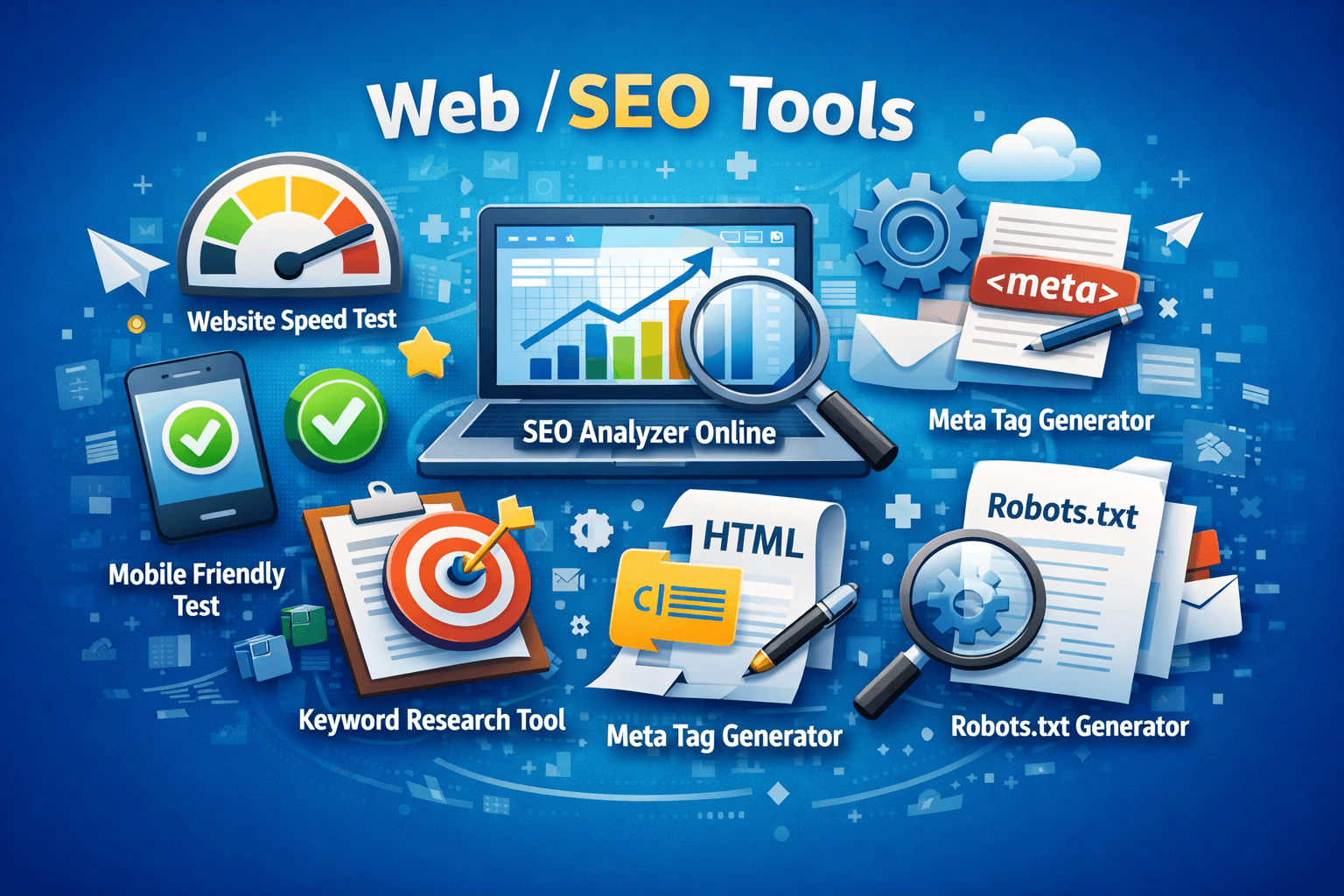
In today’s fast-paced digital world, simply owning a website is not enough. To succeed online, your website must be fast, mobile-friendly, search-engine optimized, and easy for users to navigate. Whether you are a blogger, developer, business owner, or digital marketer, using the right Web & SEO tools can significantly improve your website’s performance, visibility, and search engine rankings.
This comprehensive guide explains essential tools such as Website Speed Test, Mobile-Friendly Test, Online SEO Analyzer, Keyword Research Tool, Meta Tag Generator, Sitemap Generator, and Robots.txt Generator. These powerful tools help you optimize your website for better user experience, higher search engine rankings, and increased organic traffic.
By leveraging these Web and SEO tools effectively, you can identify performance issues, improve on-page SEO, target the right keywords, and ensure your website meets modern search engine standards—ultimately leading to greater online visibility and long-term success.
Search engines like Google use hundreds of ranking factors to determine which websites appear in search results. Key factors such as technical SEO, content optimization, mobile usability, and website speed play a major role in improving search engine rankings.
Identify technical issues that negatively impact search rankings
Improve website loading speed and overall performance
Optimize content to be search engine friendly
Enhance the mobile user experience
Automatically generate essential SEO files
Increase online visibility and organic traffic
Monitor and continuously improve website performance
By using reliable Web and SEO tools regularly, you can ensure your website remains optimized, competitive, and aligned with modern search engine algorithms—leading to sustainable growth and better online presence.
A website speed test measures how quickly your website loads and identifies performance issues that may be slowing it down. Since users prefer fast-loading websites, page speed is a critical ranking factor for search engines. Websites with slow loading times often experience higher bounce rates and lower conversion rates.
Website speed plays a vital role in search engine optimization because it:
Helps websites rank higher in search engine results
Enhances overall user experience
Reduces bounce rates
Increases conversions and user engagement
Improves performance on mobile devices
Optimizing your website’s loading speed not only improves SEO rankings but also ensures visitors stay longer and interact more effectively with your content—leading to better results and long-term growth.
Website speed test tools provide detailed insights into your site’s performance and help identify areas for improvement. Key features include:
Analysis of overall page load time
Measurement of Core Web Vitals (LCP, CLS, and INP)
Image optimization recommendations
Server response time analysis
Suggestions for optimizing CSS and JavaScript files
Detailed performance score reports
These features allow you to diagnose speed-related issues and take action to improve website performance effectively.
To enhance your website’s loading speed and overall performance, follow these proven techniques:
Reduce image file sizes without compromising quality
Enable browser caching
Minify and combine JavaScript and CSS files
Use a fast and reliable web hosting provider
Implement a Content Delivery Network (CDN)
Applying these speed optimization techniques improves user experience, boosts SEO rankings, and helps your website perform better across all devices.
A mobile-friendly test checks whether your website functions properly on smartphones and tablets. Since the majority of internet users browse on mobile devices, search engines prioritize websites that are optimized for mobile usability.
Optimizing your website for mobile devices is essential for SEO and user experience because it:
Supports Google’s mobile-first indexing
Improves usability on smaller screens
Increases user engagement and time spent on the site
Enhances visibility in mobile search results
A mobile-optimized website not only performs better in search engine rankings but also delivers a smoother, more enjoyable experience for users across all devices.
Mobile-friendly test tools analyze how well your website performs on mobile devices and identify usability issues. Key features include:
Analysis of mobile usability
Text readability checks on smaller screens
Responsive design testing across different devices
Evaluation of touch element spacing
Validation of proper viewport configuration
These features ensure your website delivers a smooth and accessible experience for mobile users.
To improve mobile performance and user experience, follow these best practices:
Use a responsive web design
Avoid large and intrusive pop-ups
Optimize images for mobile devices
Use clear, legible font sizes
Improve overall page loading speed
Implementing these mobile optimization techniques helps improve search engine rankings, enhances user engagement, and ensures better visibility in mobile search results.
An online SEO analyzer is a tool that evaluates the overall SEO health of your website by analyzing both on-page and technical SEO elements. It helps identify errors and weaknesses that may be preventing your website from achieving higher search engine rankings.
An SEO analyzer reviews multiple ranking factors, including:
Optimization of title tags and meta descriptions
Proper heading structure (H1, H2, H3, etc.)
Effective and strategic use of keywords
Internal linking structure and navigation
ALT attributes for images
Mobile usability and page loading speed
Detection of errors and broken links
By addressing the issues highlighted by an SEO analyzer, you can improve website performance, enhance user experience, and increase your chances of ranking higher in search engine results.
Using an SEO analyzer offers multiple benefits that help improve your website’s overall performance and search visibility, including:
Increases visibility in search engine results
Quickly identifies on-page and technical SEO errors
Provides actionable and easy-to-follow optimization recommendations
Helps beginners understand the fundamentals of SEO
Regular SEO analysis ensures that your website remains optimized according to the latest search engine guidelines. By continuously monitoring and improving SEO performance, you can maintain higher rankings, attract more organic traffic, and stay ahead of the competition.
Keyword research is the process of identifying the search terms and phrases that people use in search engines. A keyword research tool helps you discover the most relevant and high-value keywords, allowing your content to reach the right audience at the right time.
Effective keyword research plays a crucial role in SEO because it:
Drives highly targeted and relevant traffic
Improves search engine rankings
Helps understand user search intent
Makes content more relevant and valuable
Supports effective content planning and strategy
By choosing the right keywords, you can create content that aligns with user needs, performs better in search results, and delivers long-term organic growth.
Keyword research tools provide valuable insights to help optimize your content and improve search engine rankings. Important features include:
Search volume data to gauge keyword popularity
Keyword difficulty scores to evaluate ranking potential
Suggestions for related and alternative keywords
Discovery of long-tail keywords for targeted traffic
Competitor keyword analysis to identify gaps and opportunities
To maximize the effectiveness of your keyword research, follow these SEO-friendly best practices:
Focus on long-tail keywords to target specific queries
Prioritize low-competition keywords for easier ranking
Understand the search intent behind keywords
Integrate keywords naturally within your content
Avoid keyword stuffing, which can harm SEO performance
Following these practices ensures that your content reaches the right audience, ranks higher in search results, and provides a better user experience.
A meta tag generator is a tool that helps create SEO-friendly meta tags for websites. Meta tags play a crucial role in improving click-through rates and providing search engines with important information about your web pages.
Using the right meta tags ensures better visibility and search engine understanding. Key meta tags include:
Meta Title – defines the page title shown in search results
Meta Description – summarizes the page content for users and search engines
Meta Keywords – specifies relevant keywords (optional for modern SEO)
Meta Robots Tag – instructs search engines on how to index the page
Open Graph Tags – optimize how your content appears on social media platforms
Properly generated meta tags help improve SEO performance, attract more clicks, and enhance the overall online presence of your website.
Using a meta tag generator provides several benefits that help improve your website’s SEO and search performance:
Saves time by reducing manual coding efforts
Instantly generates optimized meta tags
Enhances how your pages appear in search results
Increases click-through rates (CTR) from search listings
To maximize the effectiveness of your meta tags, follow these SEO-friendly best practices:
Keep the meta title under 60 characters for optimal display
Write clear, engaging, and compelling meta descriptions
Naturally include primary keywords in meta tags
Avoid using duplicate or redundant meta tags across pages
Proper meta tag optimization ensures your website is search-engine friendly, attracts more clicks, and improves overall online visibility.
A sitemap is an XML file generated by a sitemap generator that lists all the pages of your website. Sitemaps help search engines crawl and index your site more efficiently, ensuring that all important pages are discovered and ranked appropriately.
Using a sitemap provides several SEO advantages:
Helps search engines discover pages quickly
Improves indexing of fresh and updated content
Essential for large websites with many pages
Enhances understanding of your site structure for both search engines and users
By maintaining an up-to-date sitemap, you ensure that search engines can efficiently navigate your website, boosting visibility and search performance.
A sitemap generator helps streamline the creation and management of your website’s sitemap, making it easier for search engines to index your pages. Key features include:
Automatic generation of XML sitemaps
Support for large websites with many pages
Ability to set priorities and update frequencies for pages
Easy submission to search engines for faster indexing
To ensure your sitemap is effective and SEO-friendly, follow these best practices:
Regularly update your sitemap to include new and updated pages
Submit your sitemap through Google Search Console for efficient indexing
Remove broken or deleted URLs to maintain accuracy
Keep your sitemap organized and easy to read
Maintaining a clean and up-to-date sitemap improves crawling efficiency, enhances search engine understanding of your website, and boosts overall SEO performance.
A Robots.txt generator creates a file that tells search engine crawlers which pages of your website they are allowed to access and which they should avoid. This file is essential for guiding crawlers efficiently and protecting sensitive areas of your site.
Using a Robots.txt file provides several key SEO benefits:
Controls crawler access to specific pages or directories
Prevents indexing of irrelevant or low-value pages
Saves crawl budget, ensuring important pages are indexed first
Protects private or sensitive directories from being publicly accessible
Properly configured Robots.txt helps search engines focus on your most important content, improving crawling efficiency and overall website performance.
A Robots.txt generator helps you efficiently manage crawler access and protect sensitive content on your website. Key features include:
Easy rule creation for allowing or disallowing pages
User-agent specific control to target different crawlers
Allow and disallow directives to manage page indexing
Sitemap integration for better crawling efficiency
To ensure your Robots.txt file is effective and SEO-friendly, follow these best practices:
Do not block important pages that should be indexed by search engines
Test your Robots.txt file before publishing to avoid accidental blocks
Keep the file simple, clear, and easy to manage
Update the file whenever there are changes in your website’s structure
A well-optimized Robots.txt file helps search engines crawl your website efficiently, protects private content, and improves overall SEO performance.
While each SEO and web tool serves a specific purpose, using them together creates a comprehensive website optimization system. Here’s how they complement each other:
Website Speed Test enhances performance by identifying and fixing loading issues
Mobile-Friendly Test improves usability across smartphones and tablets
SEO Analyzer detects technical problems and on-page SEO issues
Keyword Research Tool helps target the right content for your audience
Meta Tag Generator optimizes how your pages appear in search results
Sitemap Generator makes indexing easier for search engines
Robots.txt Generator controls crawler access to your site
By leveraging all of these tools in tandem, your website can achieve optimal technical performance, better search engine rankings, and improved user experience, ensuring long-term success online.
SEO and web tools are valuable for a wide range of professionals and website owners, including:
Content creators and bloggers looking to optimize their articles
Website owners aiming to improve performance and visibility
Digital marketers focused on driving traffic and conversions
SEO specialists managing technical and on-page SEO
Web developers who want to ensure fast and responsive sites
E-commerce businesses seeking higher rankings and sales
Small business owners managing online presence
No matter whether you run a large corporate website or a personal blog, using SEO and web tools is essential for online growth, higher search visibility, and improved user experience.
The Web & SEO tools and content provided on this website are intended solely for general informational and optimization purposes. While we strive to provide accurate analysis and useful recommendations, the results generated by these tools should be considered guidance rather than guaranteed solutions for improving your website’s search engine rankings or overall performance.
We do not guarantee specific SEO outcomes, traffic growth, or ranking positions, as search engine algorithms and ranking factors are constantly evolving. Users are responsible for implementing any changes and verifying results according to their own website’s requirements.
All tools are provided “as is”, without any implied or express warranties. We are not responsible for any loss, damage, or issues that may arise from using these tools or relying on their recommendations.
EveryToolfy provides fast, free online tools for everyday tasks, including documents, photos, videos, SEO, calculators, security checks, and AI utilities.