
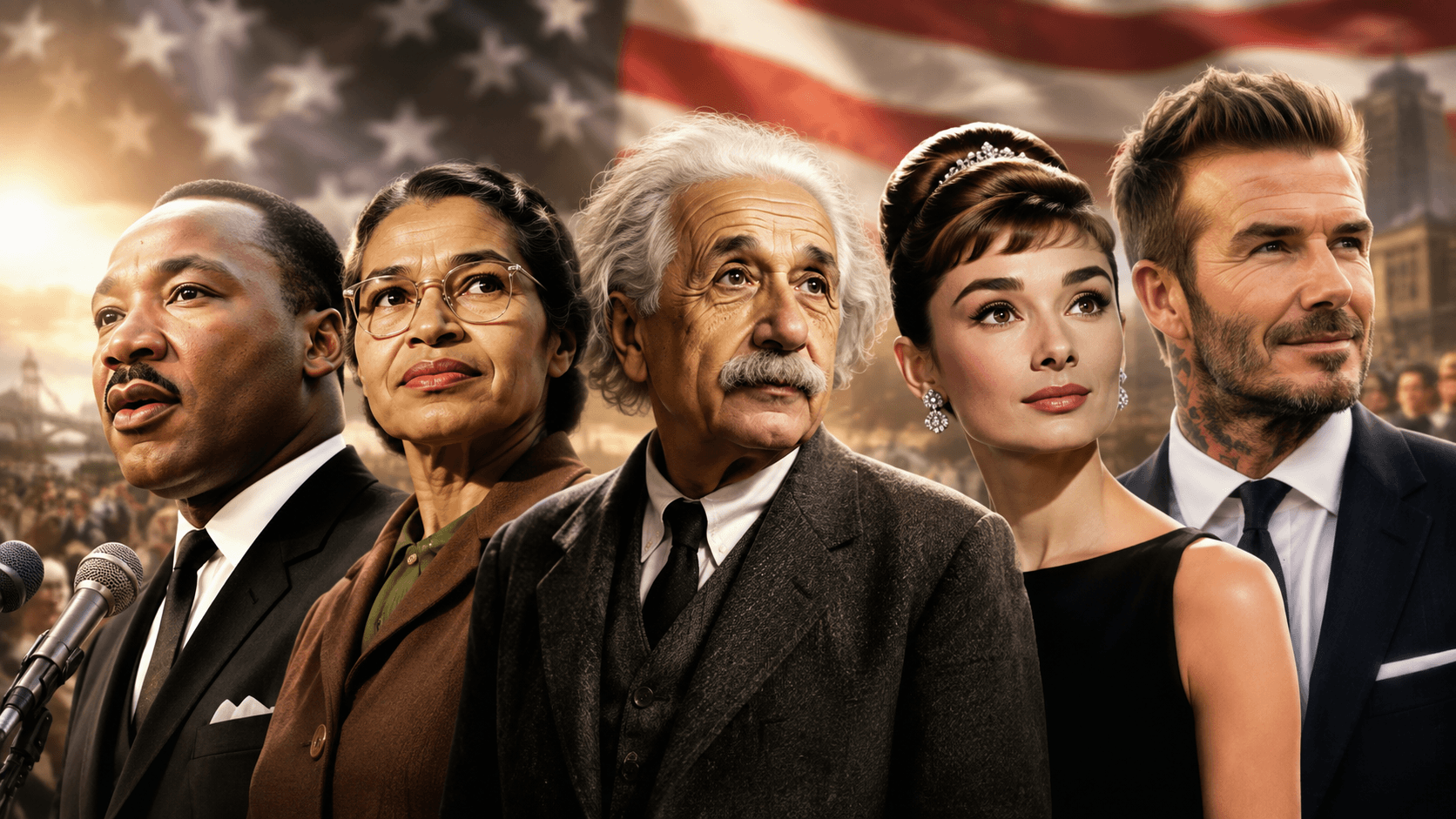
Famous people who changed the world include scientists such as Marie Curie, Albert Einstein, Isaac Newton, and Charles Darwin, inventors such as Johannes Gutenberg and Tim Berners-Lee, medical pioneers such as Alexander Fleming and Florence Nightingale, and leaders such as Mahatma Gandhi, Nelson Mandela, Martin Luther King Jr., Rosa Parks, and Malala Yousafzai.
Key takeaways
- Scientists such as Curie, Einstein, Newton, and Darwin reshaped how we understand nature.
- Gutenberg, Lovelace, and Berners-Lee changed how knowledge is shared and how computers are used.
- Fleming and Nightingale transformed medicine and healthcare.
- Gandhi, Mandela, King, Parks, and Malala showed the power of peaceful action for rights and education.
In this guide
- How These 15 People Were Chosen
- Quick Overview Table
- Scientists Who Changed How We See the World
- Inventors and Creators
- Pioneers in Medicine and Healthcare
- Leaders and Campaigners for Rights and Freedom
- What These Lives Have in Common
- Where to Learn More
- Frequently Asked Questions
Last updated: October 2026
Some people change the world through discoveries, some through courage, and some through ideas that give others the tools to do more. This guide looks at 15 historic figures whose work reshaped science, medicine, technology, society, and politics. For each, you will find what they did, why it mattered, and where to read more. It is a starting point rather than a complete ranking, because the world is shaped by countless people.
How These 15 People Were Chosen
- Lasting impact: their work still affects our lives today.
- Breadth: they come from science, medicine, technology, rights movements, and the arts.
- Documented achievements: each has a well-recorded legacy and trustworthy sources.
Quick Overview Table
| Person | Field | Best-known contribution |
|---|---|---|
| Marie Curie | Science | Pioneering research on radioactivity |
| Albert Einstein | Science | Theory of relativity |
| Isaac Newton | Science | Laws of motion and universal gravitation |
| Charles Darwin | Science | Theory of evolution by natural selection |
| Leonardo da Vinci | Art and invention | Art, anatomy studies, and engineering ideas |
| Johannes Gutenberg | Technology | Movable-type printing in Europe |
| Ada Lovelace | Computing | Early vision of computer programming |
| Tim Berners-Lee | Technology | The World Wide Web |
| Alexander Fleming | Medicine | Discovery of penicillin |
| Florence Nightingale | Healthcare | Modern nursing and hospital hygiene |
| Mahatma Gandhi | Leadership | Nonviolent resistance |
| Nelson Mandela | Leadership | Ending apartheid and building a democracy in South Africa |
| Martin Luther King Jr. | Civil rights | Leader of the US civil rights movement |
| Rosa Parks | Civil rights | Sparked the Montgomery bus boycott |
| Malala Yousafzai | Education | Campaigner for girls’ education |
Scientists Who Changed How We See the World
1. Marie Curie
Marie Curie carried out pioneering research on radioactivity and discovered the elements polonium and radium with her husband Pierre. She was the first woman to win a Nobel Prize and remains the only person to win Nobel Prizes in two different scientific fields, physics in 1903 and chemistry in 1911. Her work helped lay the foundation for modern cancer treatments using radiation.
2. Albert Einstein
Albert Einstein developed the theories of special and general relativity, which changed our understanding of space, time, and gravity. He received the Nobel Prize in Physics in 1921 for his explanation of the photoelectric effect, which was important for quantum theory.
3. Isaac Newton
Isaac Newton formulated the laws of motion and the law of universal gravitation, published in his 1687 work Principia. He also made major contributions to optics and mathematics, and his ideas formed the basis of classical physics.
4. Charles Darwin
Charles Darwin proposed the theory of evolution by natural selection in On the Origin of Species, published in 1859. It remains the central idea of modern biology.
Inventors and Creators
5. Leonardo da Vinci
Leonardo da Vinci was a painter, scientist, and engineer of the Italian Renaissance. His works, such as the Mona Lisa and The Last Supper, are among the most famous in the world, and his notebooks show detailed studies of anatomy, flight, and machines.
6. Johannes Gutenberg
Johannes Gutenberg introduced movable-type printing to Europe around 1440. Cheaper, faster printing helped spread knowledge, literacy, and new ideas.
7. Ada Lovelace
Ada Lovelace wrote notes in 1843 on Charles Babbage’s proposed Analytical Engine, including what is often described as the first published algorithm intended for a machine. She also saw that such machines could go beyond pure calculation.
8. Tim Berners-Lee
Tim Berners-Lee invented the World Wide Web while working at CERN in the late 1980s and early 1990s. The web made the internet accessible to ordinary people and changed communication, business, and education. If you want to publish on the web yourself, see our guide on how to choose a web developer.
Pioneers in Medicine and Healthcare
9. Alexander Fleming
Alexander Fleming discovered penicillin in 1928 after noticing that mould had stopped bacteria growing in a laboratory dish. It led to the era of antibiotics, which have saved countless lives.
10. Florence Nightingale
Florence Nightingale became famous for her nursing work during the Crimean War in the 1850s. She promoted hygiene, data-based healthcare, and professional nurse training, and she is regarded as the founder of modern nursing.
Leaders and Campaigners for Rights and Freedom
11. Mahatma Gandhi
Mahatma Gandhi led India’s nonviolent campaign for independence from British rule, which was achieved in 1947. His philosophy of peaceful resistance inspired movements around the world.
12. Nelson Mandela
Nelson Mandela spent 27 years in prison for opposing apartheid in South Africa. After his release, he helped negotiate the end of apartheid, shared the Nobel Peace Prize in 1993, and became the country’s first democratically elected president in 1994.
13. Martin Luther King Jr.
Martin Luther King Jr. was a leader of the American civil rights movement, using nonviolent protest to challenge racial segregation. He delivered the “I Have a Dream” speech in 1963 and received the Nobel Peace Prize in 1964.
14. Rosa Parks
Rosa Parks refused to give up her bus seat in Montgomery, Alabama, in 1955. Her arrest helped spark the Montgomery bus boycott, a major event in the civil rights movement.
15. Malala Yousafzai
Malala Yousafzai campaigned for girls’ education in Pakistan and survived an attack in 2012. In 2014, at the age of 17, she became the youngest person to receive the Nobel Peace Prize.
What These Lives Have in Common
- Curiosity and persistence. Most faced failures and criticism before success.
- Willingness to question the accepted view. They challenged old ideas.
- Service to others. Many acted to help communities, not just themselves.
- Collaboration and support. Few worked alone, and many relied on teachers, partners, and communities.
These stories also make good conversation starters with children. Our guide on raising resilient kids explains how talking about setbacks and perseverance helps young people cope.
Where to Learn More
- The official Nobel Prize website has biographies and lectures from laureates.
- Encyclopaedia Britannica offers detailed biographies.
- The Smithsonian Institution publishes articles and exhibitions on science and history.
- Local libraries and museums often have excellent biographies and exhibits.
Frequently Asked Questions
There is no single list, but figures such as Newton, Einstein, Curie, Darwin, Gandhi, and Mandela are widely recognised for their lasting impact.
Marie Curie, who won the Nobel Prize in Physics in 1903 and later the Nobel Prize in Chemistry in 1911.
He invented the World Wide Web while working at CERN, making the internet easy to use through linked pages and browsers.
Alexander Fleming discovered penicillin in 1928, which led to the development of antibiotics.
Malala Yousafzai, who received the prize in 2014 at the age of 17.
Use biographies, documentaries, and museum visits, and talk about the challenges these people overcame and the choices they made.
This article is a general overview. Dates and details are drawn from widely documented historical records, and further reading is recommended.



