
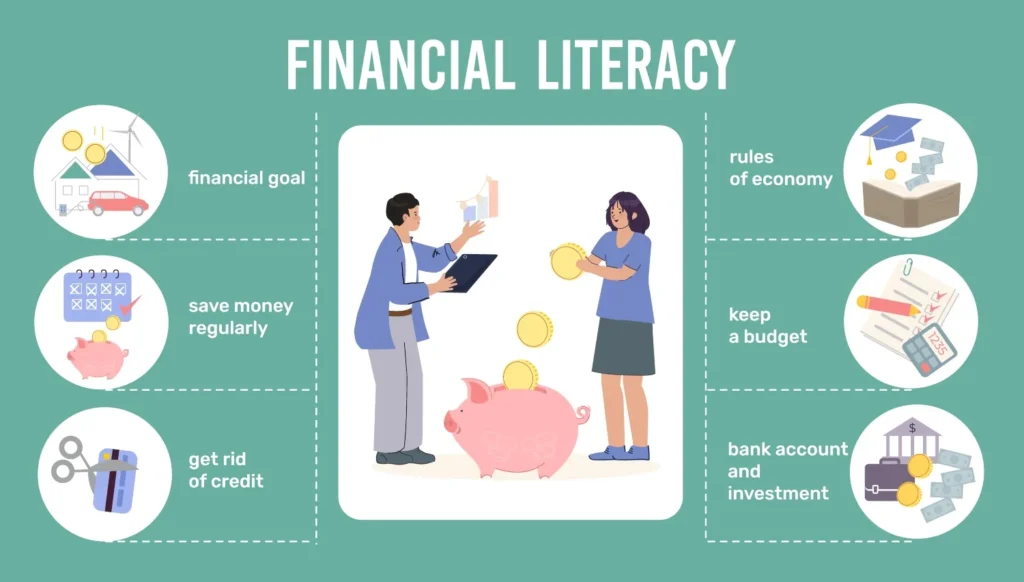
Financial literacy is the ability to understand and apply money skills, earning, spending, saving, borrowing, investing and protecting your assets, to make sound financial decisions. In 2026, the average U.S. adult correctly answered only 47% of basic financial literacy questions, the lowest score in a decade of tracking. The good news: financial literacy is a learnable skill, not a fixed trait, and this guide walks through exactly how to build it, for free, starting today.
Money touches almost every decision you make: where you live, what you buy, how you handle an emergency, and how comfortably you retire. Yet most schools never taught a single class on it. This guide breaks financial literacy into plain language, backs it with the latest 2026 research, and gives you a practical path to improve it regardless of your starting point.
What Is Financial Literacy?
Financial literacy is the combination of knowledge, skills and confidence needed to manage money effectively. It covers understanding how interest works, how to build a budget, how debt and credit scores function, how inflation erodes purchasing power, and how investing grows wealth over time.
Researchers Hastings, Madrian and Skimmyhorn define it as the ability to use knowledge and skills to manage financial resources for lifetime financial security, a definition widely cited in academic literature on the topic (see this peer-reviewed analysis of financial literacy and household market participation). The Global Financial Literacy Excellence Center (GFLEC) frames it similarly: the ability to understand and use financial knowledge to make informed decisions about earning, spending, saving, borrowing and investing.
In plain terms: financial literacy means you can look at a financial decision, loan terms, a credit card offer, a retirement account choice, and understand what it actually costs or earns you before you commit.
It is different from simply “being good with money.” Someone can be naturally frugal without understanding compound interest, or can earn a high income while carrying expensive debt because they never learned how credit works. Financial literacy is about knowledge and process, not income or personality.
Why Financial Literacy Matters
Financial literacy is not an abstract academic topic. It has a measurable, often painful, price tag when it is missing.
It prevents expensive mistakes. People with low financial literacy are more likely to pay excessive fees, carry high-interest debt, fall for predatory loans or miss out on employer retirement matching.
It builds resilience. Emergency savings, insurance decisions and debt management all depend on understanding trade-offs. A Federal Reserve survey on household economic well-being regularly shows a meaningful share of U.S. adults would struggle to cover a modest unexpected expense.
It compounds over a lifetime. Someone who starts investing at 25 instead of 35, because they understand compound growth, can end up with dramatically more at retirement from the same monthly contribution. The U.S. Securities and Exchange Commission’s Investor.gov compound interest calculator is a free way to see this for yourself.
It reduces financial stress. Financial literacy is linked to lower financial anxiety, because understanding your situation, even an imperfect one, is less stressful than uncertainty.
It affects the broader economy. Research summarized by the World Economic Forum has pointed to widespread financial knowledge gaps contributing to higher debt levels and weaker retirement preparedness across entire populations.
Financial Literacy Statistics for 2026
Here is where things stand today, based on the most recent available research.
- The 2026 TIAA Institute–GFLEC Personal Finance Index (P-Fin Index) found U.S. adults correctly answered only 47% of the index’s 28 questions on average, a statistically significant decline and the lowest score in the survey’s ten-year history, according to the TIAA Institute’s 2026 P-Fin Index report.
- Risk comprehension is the weakest area. Only 36% of risk-related questions were answered correctly in 2026, and this weakness holds across every generation.
- Education matters enormously. Adults with a bachelor’s degree or higher correctly answered 61% of P-Fin Index questions, compared with just 30% among those without a high school diploma. People who received formal financial education scored roughly 13 percentage points higher than those who did not.
- According to the National Foundation for Credit Counseling’s 2024 Financial Literacy Survey, cited by WalletHub’s financial literacy statistics report, 47% of U.S. adults grade their own personal finance knowledge a “C” or worse.
- The OECD PISA financial literacy assessment of teenagers ranked the United States 8th among 20 participating countries.
- The lack of financial literacy was estimated to have cost Americans roughly $388 billion in 2023 alone, according to figures compiled by Moneyzine’s financial literacy statistics breakdown.
- Financial literacy correlates with income: only about 28% of Americans earning less than $25,000 a year are considered financially literate under common measurement standards.
- A gender gap persists, with women consistently scoring lower than men on standardized financial literacy indexes, a pattern tracked for over a decade in the P-Fin Index.
- Among younger adults, roughly 36% of Gen Z are classified as financially literate, according to figures compiled by Zippia’s financial literacy statistics roundup.
The pattern across every source is consistent: a large share of U.S. adults, across age groups and income levels, lack confidence or accuracy on basic money questions, and the gap is widening rather than closing.
The 6 Core Components of Financial Literacy
Most frameworks, including those used by the Consumer Financial Protection Bureau and MyMoney.gov, break financial literacy into these building blocks.
1. Earning
Understanding gross vs. net pay, how taxes are withheld, how benefits like a 401(k) match add to real compensation, and how to evaluate a job offer beyond the headline salary.
2. Spending
Knowing the difference between needs and wants, understanding how a budget works, and recognizing how small recurring costs add up over a year.
3. Saving
Building an emergency fund, understanding the difference between short-term savings and long-term investing, and knowing how a high-yield savings account differs from a standard one.
4. Borrowing and Credit
Understanding how interest rates work, what a credit score measures, how credit card minimum payments can trap people in long-term debt, and the real cost of a loan over its full term. The Consumer Financial Protection Bureau’s credit and debt resources are a strong free starting point here.
5. Investing
Grasping the basics of compound growth, diversification, risk tolerance, and the difference between retirement accounts such as a 401(k) and an IRA. The IRS’s overview of retirement plans explains account types in plain terms.
6. Protecting
Understanding insurance, recognizing fraud and scams, knowing how to freeze your credit, and protecting your identity. The FTC’s consumer protection resources and IdentityTheft.gov cover this component well.
A financially literate person does not need to be an expert in all six areas. They need enough working knowledge in each to make informed decisions and know when to seek professional advice.
Signs You May Have a Financial Literacy Gap
Financial literacy gaps are common and nothing to be embarrassed about, most people were never formally taught this material. Common signs include:
- You carry credit card balances but are unsure of the actual interest rate you are paying.
- You do not know roughly how much you spend in a typical month.
- You have never calculated what compound interest does to savings or debt over 10+ years.
- You are unsure what is in your retirement account or how it is invested.
- You do not have a sense of your credit score or what affects it.
- Financial decisions, like choosing insurance or a loan, feel confusing rather than straightforward.
- You have no emergency fund and no clear plan to build one.
If several of these sound familiar, that is simply a starting point, not a verdict on your intelligence or capability. Financial literacy, like any skill, is built through deliberate, incremental practice.
How to Improve Your Financial Literacy: A Step-by-Step Plan
Step 1: Get a clear picture of where you stand
Before learning new skills, see your current numbers. Track your income, expenses, debts and savings for one month. Free tools make this fast, our budget calculator and personal finance app comparison guide are good starting points on Every Tools.
Step 2: Learn the vocabulary first
A lot of financial confusion is really vocabulary confusion. Spend an hour learning the meaning of terms like APR, compound interest, net worth, diversification and liquidity. Investopedia’s financial terms dictionary is a reliable, free reference.
Step 3: Build a simple budget
Start with something as basic as the 50/30/20 framework: roughly 50% of after-tax income on needs, 30% on wants, and 20% on savings and debt repayment. See this explained clearly in Investopedia’s guide to budgeting.
Step 4: Build a small emergency fund
Before anything else, aim for a starter emergency fund, even $500 to $1,000 reduces the chance of a surprise expense turning into high-interest debt. The CFPB’s guide to building emergency savings walks through this step.
Step 5: Understand your debt, in full
List every debt with its balance and interest rate. Learn the difference between good debt (often mortgages, some student loans) and expensive debt (high-interest credit cards). The National Foundation for Credit Counseling offers free and low-cost credit counseling if debt feels overwhelming.
Step 6: Check your credit report and score
You are entitled to a free credit report from each major bureau. Start at AnnualCreditReport.com, the only federally authorized source for free credit reports.
Step 7: Learn the basics of investing
You do not need to become a stock picker. Understanding index funds, employer retirement matching, and the power of starting early is enough to make a meaningful difference. The SEC’s Investor.gov is a free, unbiased federal resource built specifically for this.
Step 8: Automate good habits
Set up automatic transfers into savings and retirement accounts. Automation removes the need for willpower on every single paycheck.
Step 9: Revisit and adjust quarterly
Financial literacy is not a one-time project. Revisit your budget, goals and progress every three months, and adjust as life changes.
Step 10: Teach someone else
Explaining a concept, like how compound interest works, to a friend, partner or child is one of the fastest ways to cement your own understanding.
Free Financial Literacy Resources and Courses
You do not need to spend money to build real financial literacy. These are credible, free starting points.
Government resources
- MyMoney.gov – the U.S. government’s central financial education portal.
- Consumer Financial Protection Bureau – tools, guides and complaint resources.
- Investor.gov – SEC-run investing education and calculators.
- IRS.gov – official tax and retirement account information.
- USA.gov’s money and credit section – general consumer financial guidance.
Courses and structured learning
- Khan Academy’s personal finance course – a completely free, self-paced curriculum.
- edX personal finance courses – university-backed courses, many free to audit.
- Coursera personal finance and financial markets courses – includes Yale’s well-known “Financial Markets” course, free to audit.
Nonprofit and nonbiased organizations
- National Endowment for Financial Education (NEFE) – free curricula and consumer tools.
- Jump$tart Coalition for Personal Financial Literacy – focused on youth financial education standards.
- National Financial Educators Council – financial literacy test and resources.
Books, research and data
- TIAA Institute–GFLEC Personal Finance Index – the leading annual financial literacy benchmark.
- FINRA Investor Education Foundation – research on financial capability in America.
- Federal Reserve Economic Well-Being of U.S. Households report – annual household finance survey.
Local and community options
- Your local public library, many offer free financial literacy workshops.
- Credit unions, which often run free financial education seminars for members, more info via America’s Credit Unions.
- Employer-sponsored financial wellness programs, increasingly common as a workplace benefit.
Financial Literacy for Different Life Stages
Teens and young adults
The focus here is foundational: how a bank account works, what a credit score is, how student loans accrue interest, and basic budgeting. The CFPB’s youth financial education tools are built specifically for this age group, and Jump$tart’s financial literacy standards outline what students should know by grade level.
Early career (20s–30s)
Priorities shift to building credit responsibly, starting retirement contributions early to maximize compound growth, managing student loan repayment, and avoiding lifestyle inflation as income rises.
Mid-career (30s–50s)
This stage often involves balancing competing goals: a mortgage, children’s education costs, maximizing retirement contributions, and building a diversified investment portfolio. The IRS contribution limit pages are worth checking yearly, since limits change.
Pre-retirement and retirement (50s+)
Focus moves toward catch-up contributions, understanding Social Security timing, healthcare costs, and converting savings into sustainable retirement income. The Social Security Administration’s retirement benefits portal is the authoritative source here.
Financial Literacy and Mental Health
Financial stress and mental health are closely linked, and financial literacy plays a measurable role in that relationship. Research summarized in the P-Fin Index and by the TIAA Institute consistently shows that higher financial literacy correlates with greater reported financial well-being and lower financial anxiety.
This connection runs both ways: financial stress can make it harder to focus on learning new money skills, and improving financial literacy, even in small steps, tends to reduce that stress over time. If financial anxiety feels overwhelming, free and low-cost credit counseling through the National Foundation for Credit Counseling can help create a concrete plan, which is often the fastest way to reduce the uncertainty driving the stress.
How Financial Literacy Is Taught in Schools
Financial education in K-12 schools varies dramatically by state. Some states require a standalone personal finance course for high school graduation, while others fold minimal content into broader economics or social studies classes.
The Council for Economic Education’s Survey of the States tracks which states mandate personal finance education, and the data shows steady but uneven progress nationally. Where strong financial education policy exists, research has generally linked it to improved financial behaviors in early adulthood, including higher savings rates and lower delinquency on debt.
If your state does not mandate financial education, the free resources listed earlier in this guide can fill that gap at any age.
Books That Build Financial Literacy
While this guide focuses on free online resources, a few widely recommended books remain useful references for deeper, structured learning:
- The Psychology of Money by Morgan Housel, on behavior and mindset around money.
- I Will Teach You to Be Rich by Ramit Sethi, a practical, step-by-step system for young adults.
- Your Money or Your Life by Vicki Robin, on aligning spending with values.
- The Total Money Makeover by Dave Ramsey, a structured debt payoff and savings framework.
Most public libraries carry these titles for free through programs like Libby or Hoopla, which connect to library cards for free digital borrowing.
Financial Literacy vs. Financial Capability
These terms are often used interchangeably, but researchers draw a distinction worth knowing.
Financial literacy is knowledge and understanding, can you correctly answer a question about compound interest or credit scores?
Financial capability goes a step further: it combines that knowledge with access to financial products and the actual behavior of applying it. Someone can be financially literate in theory but lack capability if they do not have access to a bank account, affordable credit, or the practical means to act on what they know.
The FINRA Investor Education Foundation’s National Financial Capability Study is the leading research project tracking this broader picture in the United States, and it consistently finds that literacy alone does not guarantee good financial outcomes, access and behavior matter just as much.
Tools That Pair Well With Financial Literacy
Knowledge works best paired with the right tools. A few free resources on Every Tools that complement what you learn in this guide:
- Our personal finance app comparison guide walks through the best budgeting and net worth tools for 2026.
- Our hourly to salary calculator helps you see your real annual income before you budget.
- Browse more free calculators and tools on the Every Tools homepage.
- Learn more about the team behind these guides on our About page.
Outside of Every Tools, the SEC’s compound interest calculator and the CFPB’s budgeting worksheet tools are excellent free companions.
Common Myths About Financial Literacy
Myth: “Financial literacy is about having a lot of money.” Reality: Financial literacy is about understanding money, regardless of how much you have. Some high earners carry expensive debt; some modest earners build significant wealth through consistent, informed habits.
Myth: “I’m too old to improve my financial literacy.” Reality: Research consistently shows financial literacy can improve at any age with deliberate learning, and even small improvements measurably reduce costly financial mistakes.
Myth: “You need a finance degree to understand this stuff.” Reality: The core concepts, budgeting, compound interest, credit, diversification, are explainable in plain language and are covered thoroughly by free government and nonprofit resources.
Myth: “Financial literacy guarantees financial success.” Reality: Literacy helps you make informed decisions, but outcomes also depend on income, access to financial products, unexpected life events and broader economic conditions. It tilts the odds in your favor; it does not eliminate risk entirely.
Frequently Asked Questions
What is financial literacy in simple words?
Financial literacy is the ability to understand and use money skills, such as budgeting, saving, borrowing, investing and protecting yourself from fraud, to make informed financial decisions.
Why is financial literacy important?
It helps people avoid debt traps, build emergency savings, invest for retirement, and sidestep costly financial mistakes. Research consistently links higher financial literacy to greater financial well-being and lower financial stress.
What are the 5 (or 6) components of financial literacy?
The most common components are earning, spending, saving, borrowing and investing. Many frameworks, including those used by federal agencies, add protecting money and assets as a sixth component.
How can I improve my financial literacy for free?
Use free resources such as MyMoney.gov, the CFPB’s financial education tools, Khan Academy’s personal finance course, your local library, and free budgeting apps.
What percentage of Americans are financially literate?
According to the 2026 TIAA Institute–GFLEC Personal Finance Index, U.S. adults correctly answered only 47% of financial literacy questions on average, the lowest result in the survey’s ten-year history.
At what age should financial literacy be taught?
Most experts, including the Jump$tart Coalition, recommend introducing basic concepts like saving and needs vs. wants in elementary school, with more advanced topics like credit and investing introduced by high school.
Is financial literacy the same as being good at math?
No. Financial literacy relies more on understanding concepts and habits, like compound interest, budgeting and risk, than on advanced math skills. Most financial literacy questions require only basic arithmetic.
Does financial literacy guarantee I won’t go into debt?
No, but it significantly reduces the odds of debt stemming from misunderstanding terms, interest rates or loan structures. Debt can still result from job loss, medical emergencies or other circumstances outside anyone’s control.
What is the difference between financial literacy and financial capability?
Financial literacy is knowledge and understanding. Financial capability combines that knowledge with actual access to financial products and the behavior of applying what you know.
Financial literacy is not a trait you either have or lack. It is a practical, learnable skill, and the data shows most people, across every income level and generation, have real room to grow. The 2026 numbers make that clear: even with more financial information available than ever before, average scores on basic financial literacy questions hit their lowest point in a decade.
The fix is not complicated, even if it takes consistency. Learn the vocabulary, build a simple budget, start an emergency fund, understand your debt, learn the basics of investing, and revisit your plan regularly. Every one of the resources linked in this guide is free, and most can be started in under an hour.
Start small. Pick one step from this guide, your budget, your credit report, or one free course, and complete it this week. Financial literacy compounds the same way money does: the earlier you start, the more it is worth.



