
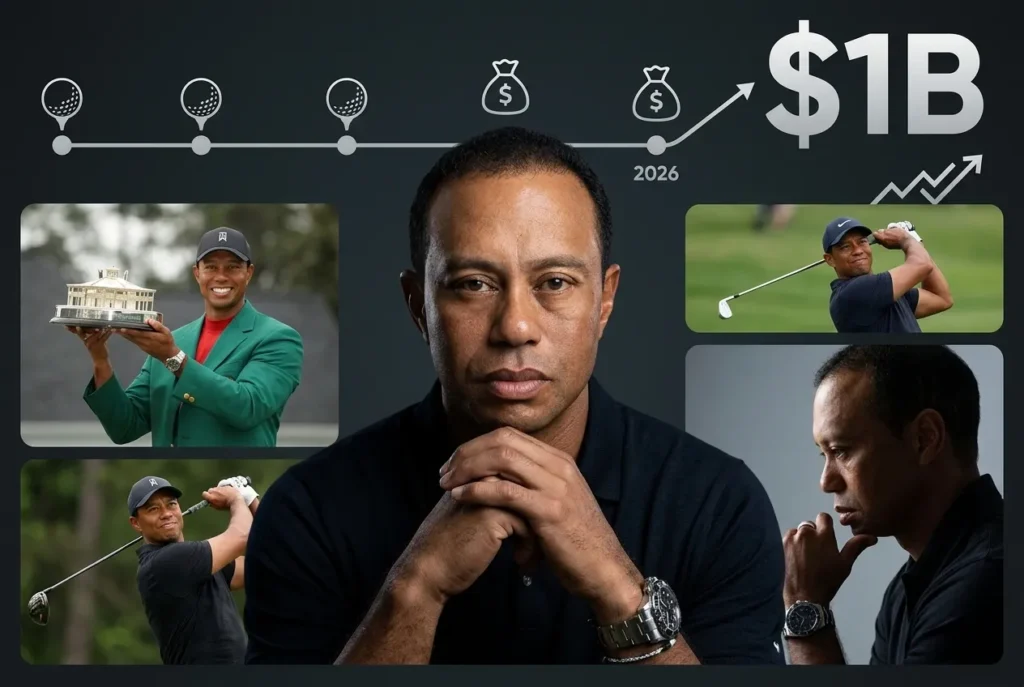
Tiger Woods has an estimated net worth of about $1.5 billion in 2026, according to Forbes, making him only the second active-era athlete, after LeBron James, to reach billionaire status.
Tiger Woods is one of the greatest golfers of all time, but his fortune reaches far beyond the golf course. Prize money built his name, but endorsements, business ventures and smart investments built his wealth. This guide breaks down exactly where Tiger Woods’ money comes from, how his net worth has grown over the decades, and how he compares to other elite athletes.
All figures below are public estimates compiled from Forbes and other reputable outlets, since exact personal wealth is never fully disclosed. Numbers can shift as new deals, investments and valuations are reported.
Key Facts at a Glance
| Fact | Detail |
|---|---|
| Estimated net worth (2026) | About $1.5 billion (Forbes) |
| Career PGA Tour prize money | About $121 million (PGA Tour record) |
| Lifetime pre-tax earnings | Close to $2 billion across his career |
| Billionaire status achieved | Certified by Forbes in 2022 |
| Main income source | Endorsements (reported to be roughly 90% of earnings) |
| Biggest sponsor | Nike (decades-long partnership) |
| Business ventures | TGL/TMRW Sports, PopStroke, Full Swing Golf, golf course design |
| Age | 50 (born December 30, 1975) |
| Comparable athlete | LeBron James (also a billionaire) |
What Is Tiger Woods’ Net Worth in 2026?
Forbes puts Tiger Woods’ net worth at approximately $1.5 billion as of 2026. He was first certified as a billionaire by Forbes in 2022, becoming only the second active athlete in history to reach that status, behind basketball star LeBron James.
What makes this remarkable is that Woods has not been a dominant on-course competitor in recent years due to a long run of injuries. His fortune has kept growing anyway, because the vast majority of it comes from business activity off the course rather than tournament checks.
Some outlets report figures slightly below or above $1.5 billion, since private companies and investments are hard to value precisely. The $1.5 billion figure from Forbes is the most frequently cited and most recently updated estimate.
How Tiger Woods Makes His Money
Tiger Woods’ income breaks down into four broad categories.
1. Tournament winnings. The smallest share today, but still historic. Woods holds the PGA Tour’s all-time record for prize money won.
2. Endorsements and sponsorships. By far the largest share. Forbes has reported that roughly 90% of Woods’ income has historically come from sponsors rather than golf earnings.
3. Business ventures. Woods has founded or co-founded several companies, including a tech-driven golf league and a golf entertainment chain.
4. Investments and real estate. Stakes in golf-technology companies and a portfolio of high-value real estate, including his Jupiter Island estate in Florida.
This mix is why athletes like Woods can keep getting richer even during years with little or no tournament play.
Golf Career Earnings
Tiger Woods turned professional in 1996 and made his PGA Tour debut in 1997 at age 20. Since then, he has won the PGA Tour’s money list more times than any other golfer and currently holds the tour’s all-time career earnings record at roughly $121 million in official prize money.
He has also earned significant appearance fees at events outside the US, which are common in professional golf but not always publicly disclosed. Combined with prize money, endorsements and business income, Woods’ total pre-tax career earnings are estimated at close to $2 billion.
For comparison with other sports, the PGA Tour’s official career money list tracks on-course earnings for every player in tour history, and Woods sits at the very top.
Endorsement Deals
Endorsements are the backbone of Tiger Woods’ fortune.
Nike
Woods signed with Nike as a rookie professional in 1996, and the partnership became one of the most famous endorsement relationships in sports history. While Nike exited the golf equipment business, Woods has continued to be closely associated with the brand’s apparel and footwear lines for most of his career.
Other major sponsors
Over the years, Woods has also had major deals with brands across categories including automotive, financial services, watches and consumer goods. Exact dollar figures for most of these deals are not publicly disclosed, which is standard in professional endorsement contracts.
TaylorMade
Woods has also had a long equipment partnership, using clubs that helped define his swing and game throughout his most dominant years on tour.
Business Ventures and Investments
This is where a large share of Woods’ recent wealth growth has come from.
TGL and TMRW Sports
Woods co-founded TMRW Sports alongside fellow golfer Rory McIlroy and sports executive Mike McCarley. The company created TGL, a tech-driven, simulator-based golf league designed for television and digital audiences. The venture has attracted significant outside investment and media rights interest.
PopStroke
Woods is also behind PopStroke, a chain of tech-enabled mini-golf and entertainment venues built around interactive putting courses, food and family entertainment. The company has expanded to multiple US locations.
Full Swing Golf
Woods is an investor and brand ambassador for Full Swing Golf, a golf simulator and launch-monitor technology company. Reports have placed the value of deals connected to this investment in the hundreds of millions of dollars.
Golf course design
Through his design company, Woods has worked on golf course architecture projects around the world, a business line that golf legends such as Jack Nicklaus and Arnold Palmer also used to build long-term wealth after their playing careers slowed down.
Real Estate
Woods owns an extensive estate on Jupiter Island, Florida, reportedly built across multiple combined lots and described by local real estate agents as resembling a private sports compound. Reports have placed its value in the tens of millions of dollars, and it is widely regarded as one of the most notable private golf estates owned by an athlete.
Net Worth Over the Years
Tiger Woods’ net worth has grown steadily, with a few notable inflection points.
- Late 1990s: Entered pro golf and signed his first major Nike deal, instantly becoming one of the highest-paid athletes in the world.
- 2000s: Dominated the PGA Tour, winning multiple majors and cementing himself as the sport’s biggest commercial draw.
- 2009–2010: Faced a high-profile personal scandal that led some sponsors to end their relationships, temporarily slowing his earnings growth.
- 2017–2019: Recovered from serious back surgeries and completed one of the most celebrated comebacks in sports history, culminating in a major championship win.
- 2021: Survived a serious car accident that threatened his leg and his playing career.
- 2022: Certified by Forbes as a billionaire, becoming only the second active athlete to reach that milestone.
- 2023–2026: Played a reduced tournament schedule due to ongoing injuries, while business ventures like TGL and PopStroke expanded his non-golf income.
How Tiger Woods Compares to Other Athletes
Tiger Woods is regularly named alongside a small group of athletes who have reached or approached billionaire status through a mix of career earnings, endorsements and business ventures.
| Athlete | Sport | Estimated Net Worth Range (public estimates) |
|---|---|---|
| Tiger Woods | Golf | ~$1.5 billion |
| LeBron James | Basketball | ~$1+ billion |
| Cristiano Ronaldo | Soccer | ~$1+ billion |
| Michael Jordan | Basketball (retired) | ~$3 billion+ |
| Floyd Mayweather | Boxing (retired) | ~$1 billion (varies by source) |
Figures for all athletes above are rough public estimates and vary by source and year. You can find updated athlete wealth rankings on Forbes’ Athletes list and Sportico’s athlete valuations.
Career Highlights and Records
Tiger Woods’ commercial value is built on a genuinely historic playing career. Highlights include:
- 15 major championship titles, including the Masters, PGA Championship, U.S. Open and The Open Championship.
- A record-tying number of PGA Tour wins across his career.
- The 1997 Masters win, where he became the tournament’s youngest-ever champion at the time.
- The “Tiger Slam,” holding all four major championship titles at once across 2000–2001.
- A dramatic 2019 Masters win after years of injury struggles, widely regarded as one of the greatest comebacks in sports history.
You can see his full tournament history on the PGA Tour’s official Tiger Woods player profile and detailed records on the Official World Golf Ranking site.
Philanthropy
Woods has directed significant resources toward charitable work through the TGR Foundation (formerly the Tiger Woods Foundation), which focuses on education access for young people. The foundation has funded scholarship programs, a learning lab, and other education initiatives over more than two decades. You can read more about its mission on the TGR Foundation’s official website.
Inside the Nike Partnership
Tiger Woods’ deal with Nike is widely considered one of the most important endorsement relationships in modern sports, not just for its size but for how it changed athlete marketing. When Woods signed as a rookie in 1996, it was one of the largest endorsement contracts ever given to an athlete who had not yet won a single professional event. Nike bet on Woods’ long-term star power rather than his results up to that point, and the bet paid off almost immediately as Woods went on to dominate the sport for more than a decade.
The relationship has evolved over time. Nike eventually stepped back from manufacturing golf clubs and balls, a category it had entered partly because of Woods, and shifted its golf business toward apparel and footwear. Even so, Woods has remained closely associated with the brand for most of his career, and the Nike “swoosh” became as recognizable on him as his red Sunday shirt. Analysts who track athlete endorsements, including those at Sportico, have repeatedly cited the Woods-Nike relationship as a case study in how a single long-term partnership can outlast short-term performance dips.
Why Tiger Woods’ Fortune Kept Growing Through Injuries
A striking part of Woods’ financial story is that his net worth did not shrink during the years when injuries kept him off the course. Between major back surgeries, a serious car accident in 2021, and a reduced tournament schedule in the years since, Woods played far less competitive golf than at his peak. Yet his overall wealth continued to climb.
This is largely because his income model shifted from “pay per performance” to “pay for brand value.” Sponsors continued to value Woods’ name recognition, media reach and cultural relevance even when he wasn’t winning tournaments every month. At the same time, his business ventures, including TGL and PopStroke, were structured to generate revenue independent of his personal playing schedule. This is a pattern seen with other long-retired sports stars, such as Michael Jordan, whose business and endorsement income has continued to grow decades after his final game.
What Analysts Watch Going Forward
Several factors will likely shape how Tiger Woods’ net worth changes over the next few years.
TGL’s media rights and franchise value. As the league he co-founded with Rory McIlroy builds a television and streaming audience, the value of his ownership stake could grow significantly, similar to how team ownership has boosted the wealth of other retired athletes.
PopStroke’s expansion. Each new location adds recurring revenue, and expansion into new markets is a key growth lever for the business.
Endorsement renewals. As Woods ages and plays less competitive golf, some sponsors may renegotiate deals, which could either increase or decrease his endorsement income depending on how brands value his continued cultural relevance.
Health and playing schedule. While most of his income no longer depends on tournament play, continued public appearances at majors like the Masters still support his brand visibility, which indirectly supports sponsor interest.
Common Questions People Search For
Based on frequent search patterns around this topic, people most often want to know:
- The exact current dollar figure (addressed in the Quick Facts table above).
- How much of his money comes from golf versus endorsements (covered in the “How Tiger Woods Makes His Money” section).
- Whether he is richer than other top athletes (see the comparison table above).
- How his business ventures like TGL and PopStroke work (see the Business Ventures section).
Financial Lessons From Tiger Woods’ Career
Regardless of golf talent, Woods’ financial path offers a few lessons that apply to anyone managing money.
Diversify beyond your main income. Golf earnings built Woods’ name, but endorsements and businesses built the bulk of his wealth. Relying on one income stream is risky even at the highest level of a career.
Long-term brand relationships compound. A decades-long partnership, like the one with Nike, created far more value over time than any single contract could.
Reinvest into new ventures. Instead of simply holding cash, Woods moved into businesses connected to his expertise, such as golf technology and entertainment, which let him keep growing wealth even while playing fewer tournaments.
Plan for setbacks. Both personal setbacks and injuries affected Woods’ income at different points, and his ability to rebuild shows the value of not being overleveraged during a downturn. If you want to apply a similar diversification mindset to your own money, a personal finance app is a practical place to start tracking income from multiple sources.
Related Tools and Calculators
If you are curious how high earnings translate into monthly or hourly terms, try these free tools on Every Tools:
- Hourly to salary calculator
- £12.71 an hour: how much is that a year after tax
- Compare budgeting and personal finance apps
- Browse all free tools on Every Tools
Frequently Asked Questions
What is Tiger Woods’ net worth in 2026?
Tiger Woods has an estimated net worth of about $1.5 billion in 2026, according to Forbes.
How did Tiger Woods become a billionaire?
Mainly through decades of endorsement income, led by his Nike partnership, along with business ventures like TGL and PopStroke, investments such as Full Swing Golf, golf course design fees, and roughly $121 million in PGA Tour prize money.
How much prize money has Tiger Woods won?
Around $121 million in official PGA Tour earnings, the most of any golfer in tour history.
Is Tiger Woods a billionaire?
Yes. Forbes first certified him as a billionaire in 2022.
Is Tiger Woods richer than LeBron James?
The two are often compared as the only active-era athletes to reach billionaire status, with estimates placing them in a broadly similar range depending on the year and source.
How much does Tiger Woods make from Nike?
Exact figures are not publicly disclosed, but the multi-decade Nike partnership has been described by Forbes and other outlets as one of the largest endorsement relationships in sports history.
What business does Tiger Woods own?
Woods co-founded TMRW Sports (creator of the TGL golf league) with Rory McIlroy, owns the PopStroke entertainment chain, and is an investor in Full Swing Golf, alongside a golf course design business.
How many majors has Tiger Woods won?
15 major championships, second all-time behind Jack Nicklaus’ 18.
Where does Tiger Woods live?
He owns a large estate on Jupiter Island, Florida, among other properties.
Does Tiger Woods still play golf?
Yes, though his schedule has been limited in recent years due to a series of injuries and back surgeries.
How old is Tiger Woods?
He was born December 30, 1975, making him 50 years old as of 2026.
Who manages Tiger Woods’ business interests?
Woods’ ventures are run through his companies, including TGR Ventures, with support from business partners across his various projects; exact management structures for private deals are not always public.
Tiger Woods’ golf record alone would make him a legend. His $1.5 billion net worth shows how he turned that legend into one of the largest personal fortunes in sports history, mostly by building a business empire around his name rather than relying on tournament winnings alone. As ventures like TGL and PopStroke continue to grow, his net worth is likely to keep climbing even as his playing schedule slows down.



