
The Ultimate Guide to Plagiarism Detection
In today’s digital world, content has become the driving force of the internet economy. From academic research papers and university assignments to corporate blogs and SEO-driven articles, the demand for high-quality, original content is higher than ever before. However, with this rapid growth in content creation comes a major challenge: maintaining true originality.
Plagiarism—whether intentional or accidental—poses a serious risk to academic integrity and online publishing credibility. This is where a reliable online Plagiarism Checker becomes essential. At EveryToolfy, we recognize the importance of authentic expression and genuinely unique content.
This comprehensive guide will help you understand what plagiarism is, how modern detection systems work, the serious consequences of using duplicate content, and how you can protect your work and reputation using advanced digital tools with ease.
Understanding Plagiarism: More Than Just Copying and Pasting
Most people think plagiarism only means copying someone else’s work word for word and presenting it as their own. However, it goes far beyond that. Plagiarism includes a wide range of unethical practices that are important to understand, especially for academic and professional writing.
1. Direct Plagiarism
This occurs when a writer copies a section of text directly from another source without using quotation marks or providing proper attribution. It is the most easily detected form of plagiarism but also carries the most severe penalties.
2. Accidental Plagiarism
Accidental plagiarism often occurs in academic research when a writer fails to properly cite sources, misquotes references, or unintentionally uses similar wording from an existing document due to unstructured or incomplete note-taking.
3. Paraphrasing Plagiarism (Mosaic or Patchwriting)
This is a more subtle form of plagiarism in which a writer copies a paragraph and only replaces a few words with synonyms or minor changes, while keeping the original sentence structure and main ideas intact without proper attribution. Modern AI-powered detection systems are highly advanced and can quickly identify and flag this type of content.
4. Self-Plagiarism
Many students and writers are surprised to learn that it is possible to plagiarize themselves. Self-plagiarism occurs when you submit a paper or blog post that you have already published or submitted elsewhere without proper citation or permission.
Why Is Content Originality Crucial?
Maintaining 100% unique content is not just about avoiding penalties—it also enhances your credibility, improves search visibility, and strengthens your professional authority.
For Students and Academics
Academic institutions use advanced, enterprise-grade plagiarism detection software to ensure academic integrity. Submitting a plagiarized thesis, essay, or dissertation can result in serious consequences such as failing grades, academic suspension, or even permanent expulsion. True academic success depends on your ability to understand information, synthesize ideas, and present them in your own original voice.
For Bloggers, Copywriters, and SEO Professionals
For digital publishers, originality is the foundation of effective Search Engine Optimization (SEO). Search engines like Google aim to deliver the most relevant and high-quality answers to user queries. If a website publishes scraped, duplicated, or thin content, search engines may de-index or penalize the domain, leading to a significant drop in organic traffic. In contrast, original content strengthens brand authority, improves user engagement, and helps websites rank higher on Search Engine Results Pages (SERPs).
How Does an Online Plagiarism Checker Work?
EveryToolfy’s Plagiarism Checker uses cutting-edge technology to scan your text within seconds. But what actually happens behind the interface? The process involves several advanced stages:
- Text Preprocessing: When you paste text or upload a document, the system removes unnecessary formatting and breaks the content into smaller parts such as sentences, phrases, and clauses. This process is known as tokenization.
- Database Comparison: The tool then compares these text segments against a massive database containing billions of live web pages, archived websites, academic journals, books, and previously uploaded documents.
- Semantic Analysis: Instead of relying only on exact word matches, the system evaluates sentence structure, vocabulary patterns, and overall meaning to detect paraphrased content and synonym-based rewrites.
- Report Generation: Finally, the tool creates a detailed, user-friendly report highlighting matching sentences, providing originality scores in percentages, and linking directly to the original source URLs.
Step-by-Step Guide: How to Use EveryToolfy’s Plagiarism Checker
Using our platform is simple, fast, and highly secure. Just follow these easy steps to verify your document:
Step 1: Prepare Your Document
Open your draft and ensure it is fully ready for scanning. You can also copy and paste the raw text directly.
Step 2: Enter Your Text
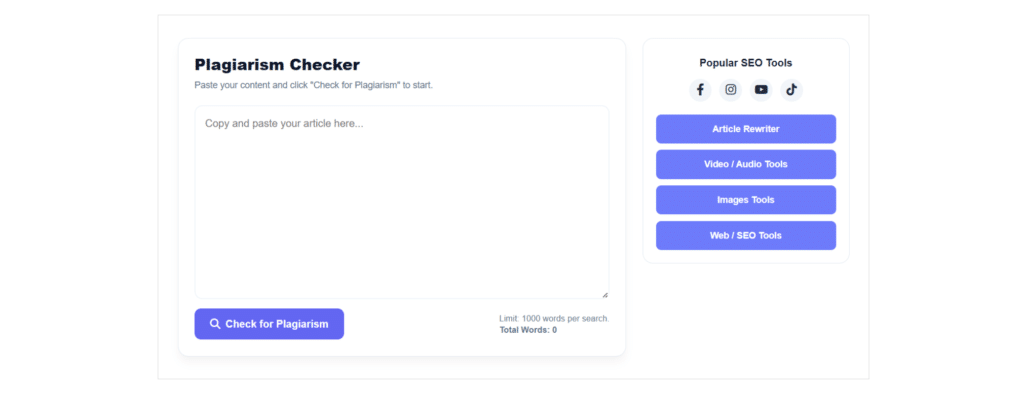
Visit the EveryToolfy Plagiarism Checker page and paste your content into the input box. You may also use the file upload option to directly upload .docx, .pdf, or .txt files from your computer or mobile device.
Step 3: Start the Scan
Click on the “Check Plagiarism” button. Our advanced system will quickly compare your text against billions of online sources.
Step 4: Review the Results
Within seconds, your detailed report will be generated. A higher uniqueness score (ideally 95%–100%) indicates original content. Any highlighted sections in red or pink show matching sources that may need revision.
Best Practices to Keep Your Writing 100% Unique
Using a scanner tool is your final line of defense, but practicing healthy writing habits helps prevent issues before they occur.
Master the Art of Paraphrasing
When referencing an external study, close the source tab, fully understand the core idea, and then explain it as if you are teaching a friend. Write down that spoken explanation in your own words. This helps ensure the sentence flow and rhythm are completely original and naturally written by you.
Implement Proper Citations
Whenever you use a specific statistic, direct quotation, or specialized theory from another source, always provide proper attribution immediately using recognized citation styles such as APA, MLA, Chicago, or standard hyperlinks for web articles.
Use Quotes for Direct Speech
If an author presents an idea in a way that is so precise and impactful that any alteration would change its meaning or effect, the exact words should be enclosed in quotation marks (“…”) along with proper attribution to the author’s name immediately following the quote.
Why Choose EveryToolfy for Your Document Needs?
At EveryToolfy, we believe that high-quality web utilities should be simple, accessible, and available to everyone. Our platform delivers a range of powerful advantages designed to improve your productivity:
- 100% Free and Easily Accessible: No hidden charges, no credit card requirements, and no forced subscriptions. You can scan and analyze your text anytime, completely free of cost.
- Privacy and Security First: Your content remains fully yours. We do not store your uploaded documents or save your text in any permanent database, ensuring complete confidentiality and data protection.
- Cross-Platform Compatibility: Whether you are working on a desktop in a university library or editing content on your smartphone, our web app works smoothly across all major operating systems and modern browsers—no installation required.
- All-in-One Productivity Toolkit: In addition to plagiarism checking, EveryToolfy offers a complete suite of writing and document tools, including grammar checking, word counting, and PDF conversion—making it your ultimate daily productivity solution.
For web publishing and blogging, a 100% unique score is always the ideal target. However, for academic work that includes standard definitions, legal citations, or referenced material, an originality score of 85% to 90% is generally acceptable at most institutions, as long as all matched content is properly cited.
No. EveryToolfy does not store or index your submitted text. When your professor or client checks your document using other plagiarism detection tools later, it will not be flagged as duplicate content because of your use of our platform.
A plagiarism checker is designed to identify similarities against existing sources and databases. AI-generated text usually requires specialized linguistic and pattern analysis. For best results, we recommend using our dedicated AI Detection tool alongside the plagiarism checker for a more complete evaluation.
Our tool uses a sophisticated algorithm based on the DIME method to deliver accurate, reliable, and precise financial calculations. Also explore our PDF to Word and Online Notepad for more useful online tools.