
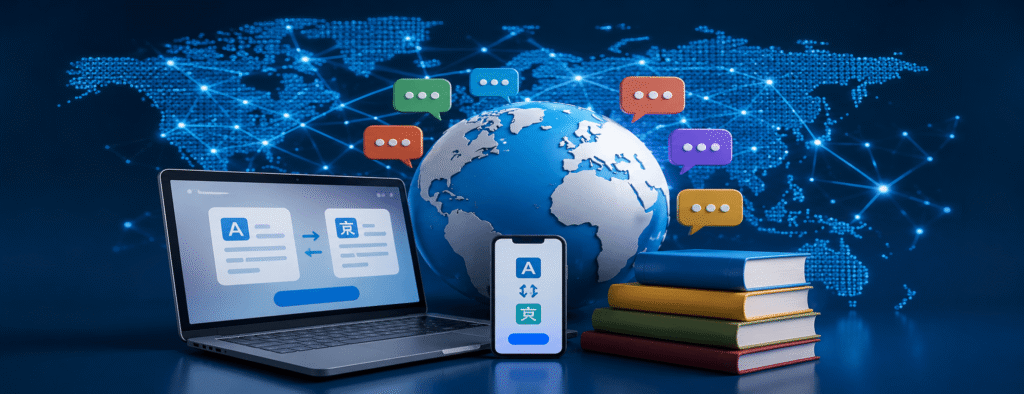
The Comprehensive Guide to Language Translation Technology
In the era of globalization, the ability to transcend language barriers is not just a technical luxury but a social and economic necessity. Language is central to human identity, yet it can also act as a barrier. Digital translation tools, such as the one hosted on EveryToolfy, help break down these barriers and connect people across the world. However, behind every simple “Translate” button lies one of the most complex areas of computer science: Natural Language Processing (NLP) and Neural Machine Translation (NMT).
The Evolution of Translation: From Books to Bots
To understand why this tool is so valuable, it helps to see how translation technology has evolved over time. In the past, translation was a manual and highly complex process carried out by skilled scholars.
- Human Translation: This traditional method requires deep cultural understanding and linguistic expertise. While it is highly accurate, it is also slow and costly.
- Rule-Based Machine Translation (RBMT): Developed in the 1950s, this early computer-based approach relied on fixed grammar rules and dictionaries. However, it often produced unnatural and inaccurate translations.
- Statistical Machine Translation (SMT): Introduced in the early 2000s, this method improved accuracy by analyzing large volumes of bilingual text to identify statistical patterns and likely translations.
- Neural Machine Translation (NMT): The most advanced technology used today by modern tools like EveryToolfy. It uses deep learning to translate entire sentences at once, preserving meaning, context, and natural flow for much more accurate results.
How Neural Machine Translation Works (The Technical Side)
The Google Translate 2 interface on this page does more than simply replace words—it performs complex mathematical processing behind the scenes.
The Vector Space Model
Every word you type is converted into a series of numbers known as a “vector.” In this system, words with similar meanings are positioned close together within a multi-dimensional vector space. For example, “king” and “queen” are mathematically related in what can be described as the system’s conceptual understanding.
The Encoder-Decoder Architecture
Encoder: This component of a neural network processes the input sentence and compresses its meaning into a compact “context vector.”
Attention Mechanism: This feature enables the AI to focus on relevant words in a sentence. For example, in “The big blue house,” it helps the model understand that “blue” describes the “house,” not something else.
Decoder: This part uses the context vector to generate the output sentence in the target language, producing each word step by step while maintaining proper grammar and structure.
Professional Best Practices for Accurate Translation
Using a translation tool effectively is both an art and a skill. To ensure your business emails or academic papers are accurate and professional, follow these EveryToolfy pro tips:
- Avoid Idioms: Phrases like “break a leg” can be difficult for AI to interpret. Instead, use clear expressions like “good luck” for more accurate translation results.
- Control Ambiguity: Words such as “light” can have multiple meanings (e.g., not heavy or illumination). Always provide sufficient context so the AI understands the correct meaning.
- Use Proper Punctuation: Missing commas or periods can confuse the translation engine and lead to unclear or incorrect sentence structure. Proper punctuation ensures smoother and more accurate output.
- Check for Gender Accuracy: Some languages, such as Spanish or French, use gendered nouns. Always review the translation to ensure the correct gender is applied based on your context.
The Impact of Translation on Global Business
For a website like EveryToolfy, these tools play a vital role in helping small businesses expand globally:
- Localization: Adapting your product to feel native and relevant to international customers.
- Customer Support: Using translation tools to provide real-time support in customers’ native languages.
- SEO Expansion: Translating blog content to reach and engage audiences across different countries, improving global visibility.
For speed and cost efficiency, yes. However, for creative writing, legal documents, or highly sensitive content, a human review is always recommended to ensure accuracy and context.
We prioritize user privacy and data security. Please review our Privacy Policy page for full details on how your data is handled and protected.
The EveryToolfy Mission
At EveryToolfy, our goal is to empower users with the best utility tools on the web. By providing in-depth articles alongside our tools, we aim to address the “low-value content” problem for both our platform and our community. We believe that information and utility should always go hand in hand.
Our tool uses a sophisticated algorithm based on the DIME method to deliver accurate, reliable, and precise financial calculations. Also explore our Word Counter and Lorem Ipsum for more useful online tools.