
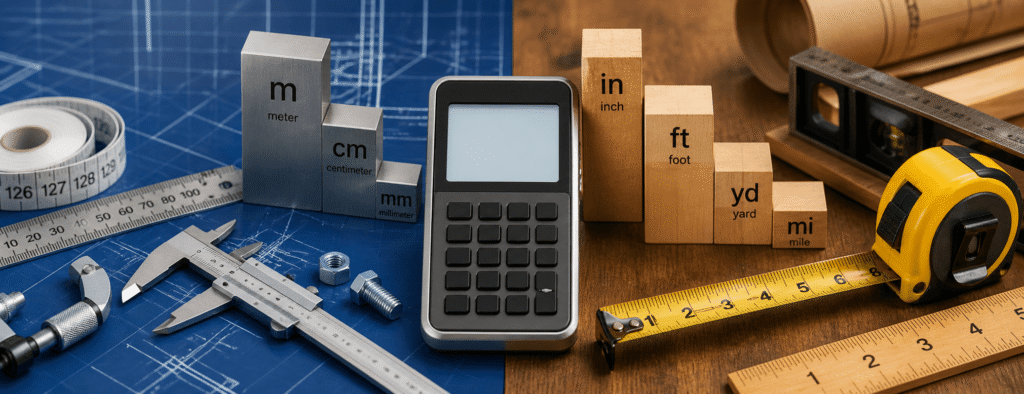
Mastering the Art of Measurement The Ultimate Guide to Unit Conversion
Measurement is the silent foundation of modern civilization. From the blueprints of ancient pyramids to the microchips in our pockets, everything depends on our ability to accurately quantify length, width, and height. However, as the world has become increasingly interconnected, a key challenge has emerged: we do not all speak the same “measurement language.”
The need to convert between different systems—primarily the Metric and Imperial systems—is more than just a mathematical exercise; it is an essential skill for engineers, travelers, students, and DIY enthusiasts. In this guide, we will explore the history, science, and practical applications of unit conversion to help you confidently master every inch (and centimeter) of your projects.
The Great Divide: Metric vs Imperial
To understand why a unit converter is essential, we must first understand the two major systems of measurement.
1. The Metric System (The International System of Units - SI)
Adopted by almost every country on Earth, the metric system is widely valued for its simplicity and logical structure. It is a decimal-based system, which means all units are based on powers of ten, making conversions easy and consistent.
The Meter (m): The base unit of length in the metric system.
Kilometer (km): Equal to 1,000 meters, commonly used to measure long distances such as the distance between cities.
Centimeter (cm): Equal to 1/100th of a meter, ideal for measuring everyday objects like notebooks, phones, or small items.
Millimeter (mm): Equal to 1/1,000th of a meter, used for precise measurements such as jewelry, engineering parts, and mechanical work.
The true advantage of the metric system lies in its simplicity—converting between units only requires shifting the decimal point. For example, 1.5 meters is equal to 150 centimeters.
2. The Imperial System (US Customary Units)
Primarily used in the United States, Liberia, and Myanmar, the Imperial system is based on historical tradition rather than decimal logic.
- The Inch (in): Historically based on the width of a human thumb.
- Foot (ft): Equal to 12 inches, approximately the length of a human foot.
- Yard (yd): Equal to 3 feet, commonly used in sports and fabric measurements.
- Mile (mi): Equal to 5,280 feet, used for long-distance travel in the United States.
Because these units are not based on a decimal (base-10) system—for example, 12 inches in a foot and 3 feet in a yard—manual conversions can be complex, time-consuming, and prone to errors.
Why Precision Matters: The Cost of a Wrong Calculation
Why can’t we simply rely on estimation? In many industries, even a small unit conversion error can lead to serious consequences or even disasters.
The $125 Million Mistake
In 1999, NASA lost the Mars Climate Orbiter due to a unit conversion error. One engineering team used metric units, while another used imperial units. As a result, the spacecraft entered the Martian atmosphere at the wrong trajectory and was destroyed.
This incident remains a powerful reminder that accuracy is essential. Whether you are a scientist or a home renovator, even small measurement errors can lead to major consequences.
Everyday Stakes
- Home Improvement: When ordering flooring in meters for a room measured in feet, improper unit conversion can result in excess material waste or an incomplete floor installation.
- E-commerce: Purchasing clothing from international brands often requires converting centimeters to inches to ensure an accurate size and proper fit.
- Science & Medicine: Medical dosages are frequently calculated based on body weight or measurements, and even a small unit conversion error can have serious or life-threatening consequences.
How to Use Our Unit Converter Effectively
At EveryToolfy, our tool is designed to remove the hassle of manual calculations and make conversions simple and accurate. Here’s how to get the most out of it:
- Select Your Source Unit: Choose the unit you currently have (for example, inches).
- Enter the Value: Type in the number you want to convert. The tool supports both decimals and large numbers with ease.
- Choose Your Target Unit: Select the unit you want to convert into (for example, centimeters).
- Get Instant Results: The conversion happens in real time, delivering fast and highly accurate results.
The Future of Measurement: Will the World Ever Unify?
There has been a global push toward metrication for decades. While the metric system is the international standard for science and global trade, the imperial system remains deeply rooted in American culture and infrastructure. Replacing every road sign, measurement standard, and toolset in the United States would cost billions of dollars.
As long as both systems continue to exist, the demand for reliable, fast, and free unit conversion tools will continue to grow. We are gradually moving toward a hybrid world, where being “bilingual” in measurement systems is becoming a valuable advantage.